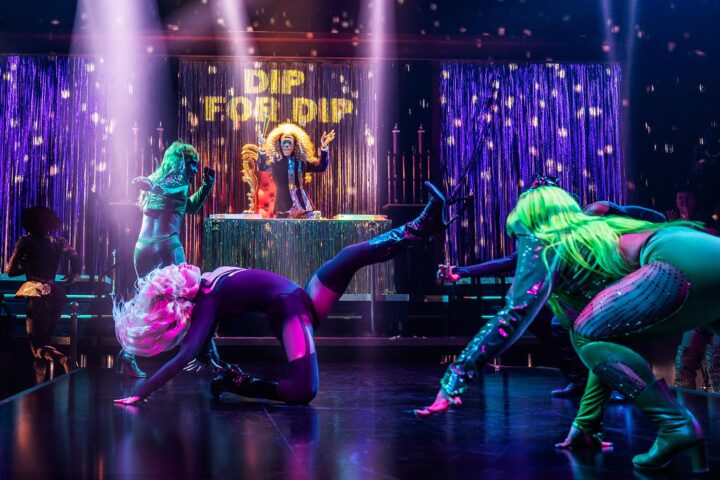
In Paris Is Burning, Jennie Livingston’s celebrated snapshot of the late-’80s New York drag ball scene, such terms as “beauty” and “reality” become loose mercury, blurred like the identities of the black and Latino gay men hitting the drag houses every night. The documentary is right away upfront about the racial, social, and sexual politics of tucking in cocks and putting on dresses: “You’re black, you’re male, and you’re gay,” one queen says early on, recounting the three-strikes-you’re-out fringe status pressed on him since birth.
The world of flaming, cross-dressing theater, then, can stand for an enclosed universe not just of communal acceptance, but also of mockery of the gender-rigidity of “normal” society. Indeed, “Schoolgirl,” “Butch Queen,” “Luscious Body,” and “Town and Country” are just a few of the categories in the drag ball’s burlesque of the beauty pageant.
Where, however, does parody end and yearning begin? To white, middle-aged queen Dorian Corey, the film’s weary drag historian, looking like a less manic Divine while daintily putting on makeup, the events’ obsession with “realness”—that is, with convincingly “passing” as straight men or actual women, instead of gay men—amounts to strutting back into the closet. Yet, to Pepper LaBeija or Angie Xtravaganza, the performativity inherent in drag balls works as pipeline from inner psyche out into the world, transformative rather than delusional.
The beauty of Paris Is Burning is the way Livingston’s nonjudgmental camera is able to accommodate both views, among others, while depicting a familial world apart from white America, with its own sets of rules, rituals, even idioms—notably voguing, the art of pantomime dissing, taken by Willi Ninja into the mainstream via Madonna. (On another level, the creative energy of the balls is explicitly evoked as an alternative to street violence, with the face-offs between queens often acquiring the intensity of gang duels.)
Seemingly amorphous, the film is actually structured as a series of contrasts between dreams and reality, pretending and being, the hopeful youth of Venus Xtravaganza lying on a mattress and the disillusioned middle-age of Corey in front of a pitiless mirror. The quota, with the sudden deaths of various participants, leaves a sad aftertaste, though even while leaving the dry final word to Corey, Livingston’s preference for feeling over exoticism secures an ultimately hopeful study of the search for personal wholeness.
Image/Sound
Boasting a 2K transfer from a 16mm interpositive that I’m sure Junior LaBeija would crack ought to be 24K, Jennie Livingston’s Paris Is Burning has never burned brighter on home video than it does on the Criterion Collection’s crucial new Blu-ray release. The images crack with vibrant activity, and the film’s careening vérité cinematography is raw and immediate. Paris Is Burning wears its fly-by-night look on its sleeve, and if it’s not the typical type of presentation that gives home theater buffs a rise, it’s unerringly faithful to the source material. The single-channel sound is as well, in ways that play up the documentary’s aspirational concerns. For example, the polished sheen of Cheryl Lynn’s “Got to Be Real” stands in stark contrast to the sad, spacious echo of the doomed Venus Xtravaganza’s boom box as it blasts Barbara Mason’s menace-drenched “Another Man” in the summer twilight of the piers.
Extras
Category is “Film School in a Box,” and the House of Criterion earns 10s across the board. It’s truly hard to imagine a release more likely to please the film’s legion of fans than this, short of tracking down every last person featured in the film for a Michael Apted style flash-forward update. I’d personally love to see all-grown-up versions of the two 12- or 13-year-old kids caught by Livingston living their best lives off Times Square, drinking their Sunkist sodas at the height of 2 a.m., but at least the disc’s commentary track reveals that one of them was eventually adopted and went to college. The commentary, recorded in 2005 just prior to the death of participant Willi Ninja, also features Livingston, Freddie Pendavis, and editor Jonathan Oppenheim. There’s a lot of material to unpack against Paris Is Burning’s tight 76-minute running time, but it retains a nice balance between examining the film’s historical, political, and technical elements and giving over to the convivial energy shared by Pendavis, Ninja, and Livingston, and in the track’s best moments, it’s the former that brings out the latter, as when Livingston challenges the other two on her qualifications as a feminist.
Livingston gets the full floor in a new, 10-minute introduction to the film’s legacy, and shares the floor in a half-hour conversation with Freddie and Sol Pendavis and filmmaker Thomas Allen Harris. It’s a kick to see how much further ex-soldier Sol, in particular, has come in the last three decades, and the four of them all get in solid observations. (Yes, Paris Is Burning should be one of the 12 films anyone sees before they turn 13.) From the other side of the “how far we’ve come” coin, the disc also features a 1991 episode of The Joan Rivers Show that, thankfully, sees Rivers only occasionally asking cringey questions to panelists Dorian Corey, Pepper LaBeija, Freddie Pendavis, and Willi Ninja, at least up to the point when Rivers corrals them into simulating a ball with dowdy audience members. Criterion rarely includes booklets with their releases any longer this day, but for this release the library is open, featuring a 1991 review of the film by poet Essex Hemphill and a new essay from filmmaker Michelle Parkerson.
But the true coup here is a reel of never-before-seen outtakes advertised as “over an hour” but actually closer to two. The outtakes, some of which has deteriorated quite photogenically (call it Decasia Is Burning), may not be consistently as engaging as the film from which they were cut but offer fans an opportunity to see more stolen moments with beloved souls. Dorian Corey, in particular, gets even more room to spin her slow-rolling ruminations (and, at one point, she calls 911 when bullets ring just outside her window as the film crew scrambles). The outtake reel also features a compilation of competitors from varying categories not featured in the film: “Best Butch,” “Face,” “Dance,” “Realness,” “House Portraits,” “Sleepers” (balls were held during tough hours), and the now undeniably problematic “International Runway Models Effect Coming from a Foreign Place (Russia, Scotland, China, Arabia and Japan),” during which yellowface abounds. And there’s an intriguing interlude in which the house of Xtravaganza takes a road trip to D.C., expounding upon dick size on the long bus ride there.
Overall
Criterion’s edition of this culturally influential doc is so good that it’ll have you working the runway with your own copy, echoing Willi Ninja’s “I bought it, mind you. I have the receipts.”
Since 2001, we've brought you uncompromising, candid takes on the world of film, music, television, video games, theater, and more. Independently owned and operated publications like Slant have been hit hard in recent years, but we’re committed to keeping our content free and accessible—meaning no paywalls or fees.
If you like what we do, please consider subscribing to our Patreon or making a donation.