
 A sprawling saga of crime and punishment set against the backdrop of postwar Japan, A Fugitive from the Past is widely considered Uchida Tomu’s masterpiece. At one point, it was named the third best Japanese film of all time by Kinema Junpo magazine, which makes it especially lamentable that (aside from a few festival screenings) the film has been virtually unavailable in the West.
So it’s gratifying to report that A Fugitive from the Past, now available on Arrow Video, lives up to its reputation. From a director whose earliest work dates back to the silent era, this is a daringly modernist film that combines profound psychological insight with a truly epic sweep, especially if by epic we understand Ezra Pound’s definition of the term as “a poetic work including history.”
Spanning the years 1947 to 1957, A Fugitive from the Past divides roughly into three parts. In the first, we’re introduced to Inukai (Mikuni Rentarō) as he flees the scene of a robbery-homicide with his two partners, who subsequently either drown in a tempest or are tossed into the sea by Inukai. He soon takes up with courtesan Yae (Hidari Sachiko), deciding to bequeath her a substantial portion of his take out of gratitude for her kindness.
The film’s middle portion follows Yae as she seeks a new life on the outskirts of Tokyo, only to be drawn back into prostitution. The third act details the disastrous reunion of Yae and Inukai, now living under an assumed name as a successful businessman, and its dire ramifications. Popping up throughout A Fugitive from the Past is Yumisaka (Bun Junzaburō), a dogged detective who loses his job over his obsessive pursuit of Inukai. He’s sort of like Inspector Javert to Inukai’s Jean Valjean, except Inukai is far from innocent.
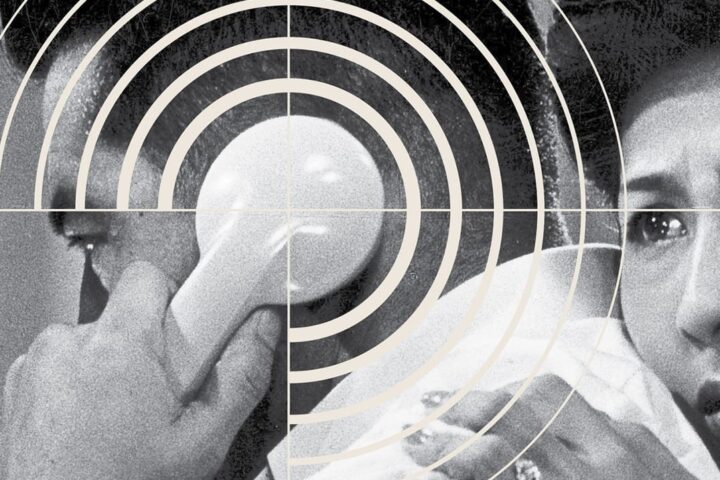
Uchida and cinematographer Nazakawa Hanjirō toy with the film’s formal elements to achieve a number of striking effects. For one, A Fugitive from the Past was shot on 16mm, then blown up to 35mm for exhibition, lending the image the grainy, washed-out look of a period newsreel. This aesthetic is aided by the frequent use of shaky handheld camerawork. At times, Uchida abruptly switches to a negative image, lending a surreal, almost unearthly feel to moments of psychological acuity, like Inukai’s frightful encounter with a blank-eyed female shaman.
A Fugitive from the Past also displays a perverse sense of eroticism, and of the distinctly Sadean variety. After Yae mocks Inukai’s fear of death and what might come afterward, their lovemaking takes on violent overtones. Inukai places his hand over Yae’s mouth and comes close to throttling her, in an eerie precursor of her eventual fate. Later, Yae violently rakes her throat with a thumbnail clipping she has kept as a fetishized souvenir from her time with Inukai, marking her body as a way of bringing back mixed emotions of pleasure and pain. Even Yumisaka has his own fetish object: a mound of ash—all that’s left from a boat Inukai set ablaze during his escape, though for Yamisaka the feelings it arouses are less erotic than fanatical.
Tomu’s film is bookended with images of the sea, opening with a typhoon sinking a passenger-laden ferry. This infamous event would have situated A Fugitive from the Past within relatively recent and recognizable history for audiences back in 1965. Uchida cleverly peppers the film with images of protest, declamatory signage, and dialogue that explicitly evokes Japan’s sociopolitical turmoil during the period of its economic recovery. A Fugitive from the Past ends on a shot of a wake falling endless back behind a moving ship, the perfect objective correlative for the idea of recalling a past that must always remain fugitive.
Image/Sound
Considering the film’s origins on 16mm, Arrow’s 1080p HD transfer of A Fugitive from the Past looks great overall, with crisp black-and-white cinematography that’s entirely free from discernible damage. The Japanese LPCM mono track sounds quite good, cleanly capturing the radical sound design and modernist score from composer Tomita Isao.
Extras
Bonus features include a lengthy introduction from Japanese film expert Jasper Sharp that exhaustively covers the life and career of director Uchida Tomu from his start in the silent era, his “missing years” in Manchuria during and after World War II, and his subsequent career through the 1970s. There are also six audio commentaries from a handful of film historians that run the gamut from actually scene specific to more generalized visual essay-type pieces. Probably the most compelling track comes from Erik Homenick on composer Tomita Isao’s contributions to the film, which does a compelling job of tying specific musical cues to larger thematic and visual strategies. Some of the other pieces hew toward the abstruse and academic, but at the very least there’s always something worthwhile on offer. Lastly, there are an illustrated Uchida filmography, an image gallery, and a trailer.
Overall
A Fugitive from the Past is a sweeping, psychologically astute study in guilt and expiation.
Since 2001, we've brought you uncompromising, candid takes on the world of film, music, television, video games, theater, and more. Independently owned and operated publications like Slant have been hit hard in recent years, but we’re committed to keeping our content free and accessible—meaning no paywalls or fees.
If you like what we do, please consider subscribing to our Patreon or making a donation.




A Fugitive from the Past is a sweeping, psychologically astute study in guilt and expiation that is sure to please fans of Japanese cinema.