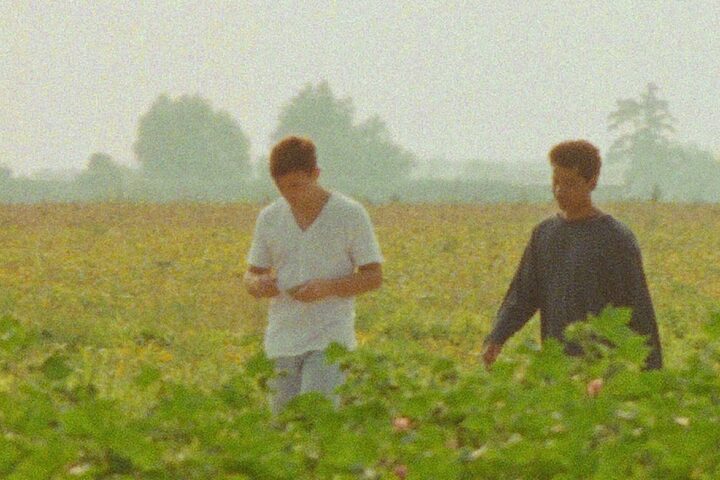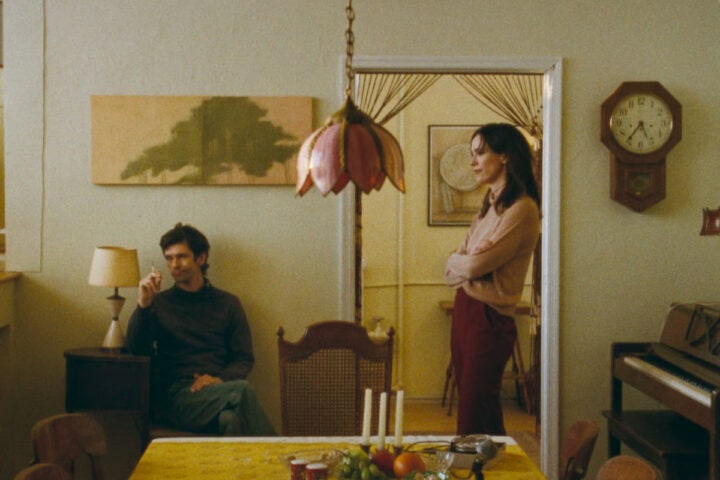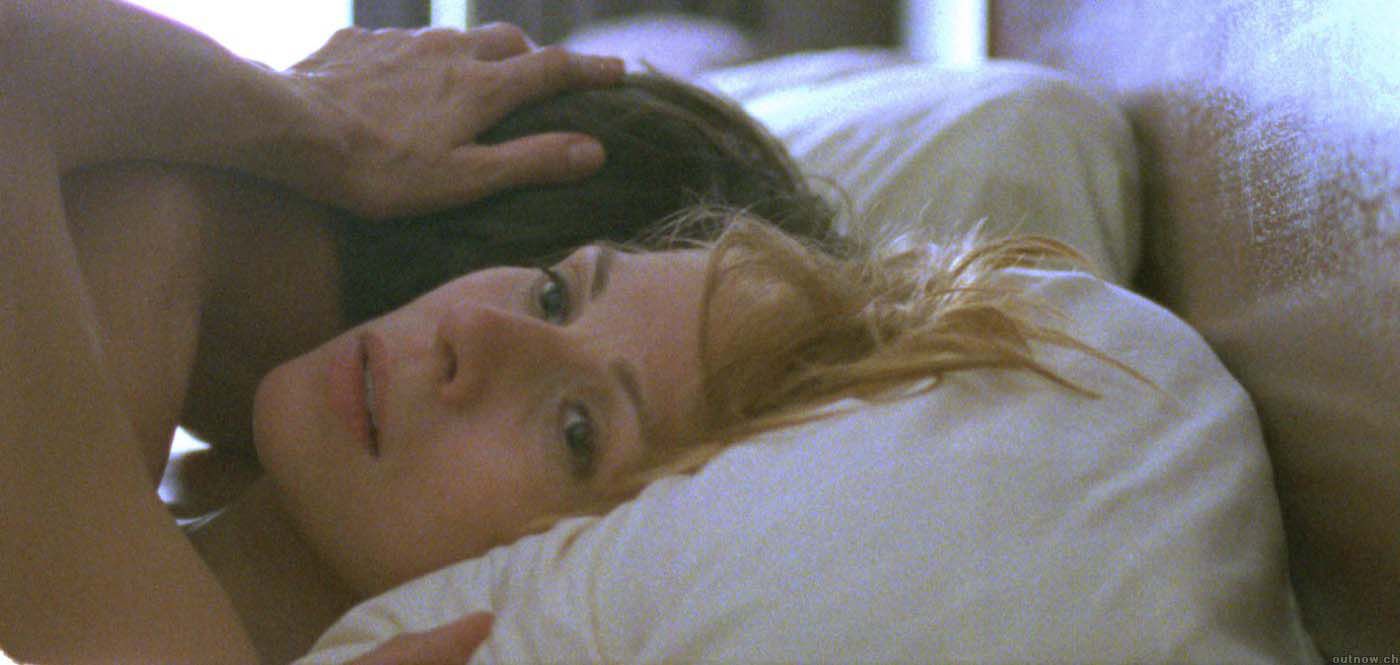
As testament to the generosity of Ira Sachs’s cinema, witness an early scene from the writer-director’s recent, masterful feature Forty Shades of Blue, in which Memphis-based singer J. Blackfoot takes the stage at a musical tribute, spreads his arms wide and welcoming, and good-naturedly commands the audience to “Show your love!” It’s an order for empathy that lacks any trace of condescension and it parallels the demands Sachs’s films (which include various shorts and only one other feature, The Delta) make on his viewers. I think there’s an implicitly cynical vibe that runs through today’s movie audiences, be they critics or casual patrons, a feeling that everything has been seen and that only a sledgehammer surprise can shock us out of our senses-dulled complacency. Yet surprise is one of the arts’ more overrated aspects—we need less momentary jolts akin to intravenous caffeine infusions (films that finally flatter our own passive disengagement from them) than we do whole new ways of seeing (films that require of us a commitment to and participation in their each and every waking moment). Forty Shades easily falls into the latter category, detailing the disintegration of a relationship and the birth of a self-aware individual with a vividness, clarity and emotional precision entirely unique to its creator. In this critic’s opinion it’s a film for the ages and in anticipation of its first-run release I met with Ira at his office in downtown Manhattan.
I had the chance to watch some of your short films, which was helpful as I was only familiar with your two features The Delta and Forty Shades. I especially enjoyed the video portrait of your father Get It While You Can: My Father in Moscow in which there’s a line of dialogue that I think is key to approaching your filmography. It’s when your father turns to you and says, “It’s all vicious, but true.”
[laughs] That’s really nice, I like that.
I think that gets at what I really love about your movies.
I’ve never done anything with Get It While You Can and I really like it because it’s a portrait film and I’ve always been really interested in portraiture. I’m interested in how to present a heroine or hero, much like Henry James in that it’s an almost psychoanalytic reading of the characters.
Without the psychobabble.
Well, I don’t connect psychoanalytic with psychobabble. I deeply respect psychoanalysis and I don’t think of it as babble. It’s just how good or bad you are, how good your analysis is. I think when you’re making certain kinds of films—perhaps any kind of film—you put yourself on the line to be judged for how you view people. Your sensibility, and the texture of your sensibility, is how the film is defined. It’s only as good as its own texture and that texture is very personal when it comes to a film like Forty Shades.
Get It While You Can helped inform my view of Rip Torn’s character Alan in Forty Shades. In my review I called him “Svengali” and a lot of people seem to view him as a bastard, a total jerk. I think they’re missing something because he’s a character who has a very tender side as well.
I think Alan is a character, and in this way he’s somewhat similar to my father, who has an inability to speak and to listen to the people closest to him. Over the course of the film he actually becomes much more human because of the vulnerability that this situation creates in him. He’s finally open to other people’s expressions and emotions and I think the tragedy of the film is that he probably could connect with Laura (Dina Korzun) and Michael (Darren Burrows) toward the end, but it’s too late. John Cassavetes’s Husbands is a film that was inspiring to me because it looks at masculine male behavior, but with affection. I think Alan’s character is very male and very domineering and dominating, but there’s also a genius to him that is lovely.
You mention Cassavetes. I think a good comparison for the tone of Forty Shades is The Killing of a Chinese Bookie.
I actually tried to write my senior thesis on that film. I ended up writing on Playtime by Jacques Tati because at that point the only print of Bookie I could locate was in Gena Rowlands’s bathroom in her house. I almost got them to send it to me when I was in college, but it didn’t work out.
When I saw Forty Shades a second time I realized I was wrong about a lot of things that I said in my review. For example, I said (as many critics who have reviewed the film have said) that Laura and Alan are married when they’re not. And it’s key that they’re not married.
Well I find that when you watch a movie there’s an experiential relationship for the viewer where they sort of create their own story. It’s your impressions: You take it in as you feel it and if you get involved enough then the details don’t really matter.
Your first short, Vaudeville, takes place in the world of amateur theater. Does that setting reflect your origins?
Yeah. I worked a little in amateur theater straight out of college. I started working in theater as a kid. I was involved with the Memphis Children’s Theater, which was this kind of urban performance theater in the middle of Memphis. The thing that inspires me most about theater is the idea of community, what kinds of communities and subcultures are created, these different little corners that have their own rules and their own heroes. I think that the setting for Forty Shades is a musical subculture that parallels growing up with my father in the ’70s. His was a sort of bachelor subculture, of guys going out to bars, and that later related to my own explorations of gay culture. When I was working on The Delta, at one point we thought there was going to be a larger sort of fireworks feel to the film and I actually went to a fireworks convention in upstate New York. That was fascinating to me, to arrive in a world that had its own complete hierarchy of highs and lows and heroes and victims and stars. I think that’s kind of what Forty Shades is about. It’s a culture in which there’s someone who’s king and the king is Rip Torn—his world is very small, but within that world he’s master of his domain.
Most filmmakers are inspired by movies but you seem to be one of the few who are able to translate that into something personal.
I’ve never gone to film school, but I do approach filmmaking through other movies. Watching movies is the way that I try to find a language that works for myself. I think that as you get better you find your own voice more clearly. Eventually you have to be interested in something that’s very honest and direct about the characters in a given story. That has to be primary when you’re directing a movie. I said earlier that psychoanalysis was something that was important to me. I take it really seriously because I think it’s an integral part of my directing. Good psychoanalysis is a process of trying to understand and analyze other people well, an ability to sort of dig deeper and deeper into a number of details within one moment. Proust is psychoanalysis to me. Proust is like an endless and endlessly fascinating sort of foray into the specificity of experience. I think that’s what directing is about on some level.
It’s interesting how you talk about psychoanalysis because to me it feels like a negative connotation to place on your movies, but I guess that just shows our different experiences with it.
[laughs] You know, I find that when I talk about making movies that I come across much more pretentious and academic and intellectual. When I’m actually making them I feel more instinctual. I spent seven years preparing Forty Shades, very much a process of study, and throughout that time I was looking at films, studying films, trying to understand the language of other films in order to get a deeper sense of how I wanted to write with images. Ken Loach was sort of the significant guidepost for my cinematographer and me. His was a type of visual language that we really wanted to use.
And then I come along and start making comparisons to Marlene Dietrich and Douglas Sirk. It’s interesting how we read different influences into the movies we see, whether we make them or just watch them.
Right. I think that’s what’s exciting, that you make something and it goes away from you and then other people can bring in their own barometers.
Let’s talk about the genesis of Forty Shades. You mentioned that it was a seven-year process and I heard that, along the line, Sydney Pollack and Julianne Moore were involved?
I started writing Forty Shades in 1998 with my co-writer Michael Rohatyn, we finished the script and very soon afterward an executive named Geoff Stier took the film to Sydney Pollack and he became the executive producer. We went after Julianne Moore and she wanted to star. We thought we’d be making a movie by the end of 1998. But it’s hard making a film like this, which is what they in the business call “execution driven,” meaning it’s only as good as how good it is. The story itself is not a genre story, it’s not a romantic comedy or something people can easily sell. So it ended up taking six more years to get the film made. Julianne went on to do other things. At some point Maggie Cheung was attached to star. I’m actually trying to work with Maggie on my new film Marriage. Finally, I cast Dina Korzun and to me Dina is the actress who makes the most sense and seems the most organic to the story. She’s a very artful, naturalistic actor, but she’s also an actress who works with craft. She has a very calculated sense of her performance, what she will give and not give to every moment on screen, a certain kind of calculated withholding that I think gives the film an artfulness and transforms it from just straight naturalism. I can’t imagine the movie with anyone else as Laura.
Based on what I’ve read and observed, I think how people react to the film kind of lives and dies on how interested they are in Laura.
And anyone who isn’t I think is a fool. [laughs] I don’t get ‘em. I don’t like ‘em!
[laughs] I agree. And I personally find Dina’s performance very interesting because when I first saw it I was under the mistaken impression that she was a model à la Bresson. And when I found out she was a trained actress it added an extra layer that made her work and the character of Laura even more fascinating. She stands out so much with her physicality and her movements and, as you say, her calculations, yet they’re completely appropriate choices.
Yeah, and she also gives you a sense that Laura is a character who could be considered a victim, but there’s such control in her performance that you always sense that she’s on top. So even when she’s going through painful experiences you feel that there’s real power in her choices, very similar to Dietrich.
Dina’s performance reminded me of how Dietrich looks and moves in a scene, very calculated and metronomic. It feels like an art that’s been lost and it’s wonderful that you were able to recapture it though your own aesthetic, which I think is best described as—and perhaps you can speak to this—a melding of fiction and documentary technique.
I think of it as an expressive naturalism. The sense of using observation, authenticity, location as a sort of stepping-stone toward the texture of the film. However, I feel that as I get older I want to carry that naturalism to more and more heightened places, so now I’m watching Pandora and the Flying Dutchman and other movies shot by Jack Cardiff. Movies in which every frame is about emotion on some level.
Your short film Lady I think taps into that emotional vein.
Lady I’m actually really happy with, the reason being that it documents a certain time in New York. It feels like that time and it feels of a piece with that late-’80s/early-’90s culture that I was a part of.
How would describe that culture?
I think you’re always a part of a certain moment, a certain history, a certain period. I started coming to New York in the summer of 1984, moved here full-time in 1988, and it was very much a time of terrible crisis in the gay community in terms of AIDS. There was a reaction to that which was the rise of organizations like ACT-UP. It was both a political thing where people could voice their feelings and also a totally social world in which people could enter a city and find a community to be a part of. There’s something very nostalgic about Lady to me, something about lost lives and lost glamour and lost people. I also always liked the idea of a drag queen offstage, the feeling of someone who’s very performative as seen in a less performative environment.
I think Laura in Forty Shades is a character who is always performing in some way and I think she comes to a moment of self-realization at the end and sheds the masks for a moment. However, I did have a nagging suspicion while watching the final tracking shot that she could have gotten back in the car with Alan.
Dina was asked at a screening in Berlin what she thought was going to happen. She said when we were shooting the scene that she thought she was going to get back in the car and then when she saw the movie she thought she wasn’t. It was interesting to me because I always thought she wasn’t. It was actually Julianne Moore who pushed us to the current ending. There’s a movie called Charulata by Satyajit Ray, which Forty Shades is sort of a loose remake of. It’s a film in which there’s a triangle between a woman, a husband and a cousin who comes to visit. It ends in media res with the relationship sort of doomed, but still accepted. As written, Forty Shades used to end in the car with Laura crying. Julianne said she didn’t feel like the character had moved on, so we rewrote it for her and it felt better so we kept it that way. To me what was important in that scene was the sense of movement as opposed to resolution, a sense from the character that there was no turning back from a recognition of what was going on inside her. I feel like once you come to a point where you have some understanding of your own interior and your own needs—and this is sort of like psychoanalysis again—that it’s too painful to return to a place where your interior is hidden. You know in speaking about this, I recognize that I feel a relatively natural affinity with outsiders. I suppose it could also be considered an exploitation of outsiders in the sense that I’m an upper-middle-class person who has some fascination with people who have less economic possibilities than I do. I sometimes think there can be a fetishism around that.
Something like liberal guilt?
I guess it’s somewhat liberal guilt. Being a rough Marxist on some level, I’m interested in how economics affect characters in a given situation. Still, I grew up in Memphis as a Jew, and gay, closeted for a certain number of years, and I think there was a certain sense of being outside mainstream culture. If I wasn’t gay, I might have been a lawyer, you know. There might even have been a possibility that I would want to embrace the mainstream. So thank god I’m gay. [laughs]
I think the outsider mentality you’re speaking about is quite explicitly addressed in Forty Shades, specifically by a character like Alan’s black maid, who’s very much peripheral to the narrative but who still feels very fleshed out and real. I’ve watched a lot of old films recently that feature Hattie McDaniel in similar servile roles and it made me wonder how one could have such a character in a movie nowadays and not have it come across as offensive or as an obvious postmodern point of some kind.
Part of it is in my just being true to what would be true there, true to the roles of the Memphis milieu. And then it’s about trying to give that character just enough insight into the main drama, which gives her a sort of Greek Chorus position in the narrative, a sense that she’s the observer in this family and in this drama.
A colleague of mine pointed out that while a lot of films address race, they forget to examine how class affects that concept.
To me class is just so present in everyone’s entire existence. The reason that I’m a filmmaker has so much to do with the history of my class and its sense of privilege. I understand privilege and I understand how it creates personalities. And you know, one thing I can say that I find kind of complicated—I could use the word sad, but I think I’m too much of a realist to really view it that way—is that in trying to make films over the course of your life I find that you have to very consciously deal with both the world that you live in and the industry that you work in. I think of my film The Delta and I realize that now, at 40 years old, I couldn’t make that film again. I couldn’t actually write a film about a half-black/half-Vietnamese gay character. And in coming to terms with that I start to recognize the choices I made regarding what stories I’ve told and what stories I might potentially tell. That’s where I feel like the death of independent film might be true, that you just can’t make truly personal films anymore that are specific, really specific, about characters and identity. I say this only because I wonder myself how I’ll be able to incorporate issues of race and class, among other interests, into my future films because I have a feeling they are going to be much broader in terms of their subject matter.
Broader in a bad sense?
Broader in the sense that you’ve got to learn how to get the same kind of depth and density into mainstream material what you had in earlier, less mainstream work.
To subvert the system in a way?
To subvert or to at least always pick really complicated subjects, to find a way to keep density. And that’s why I’m now making a genre film because genre is a good way to try to work the system but still deal with issues of interest to you. The movie is called Marriage and it’s a suspense film, but it’s also a domestic melodrama. It’s set in an unnamed Pacific Coast city in 1949 and it’s about a very gentle, middle-aged man who’s married and who falls in love with another woman. And he’s such a gentle figure that he decides that to divorce his wife would cause her too much pain, so he decides to kill her instead. To him, killing is the better, kinder act. It’s a sort of round robin about the nature of intimacy and what you know or don’t know about the people you marry.
Coming back to your view of the industry, where do you think we are now? I feel like there’s a sense of mystery that’s been lost.
I think mystery is a real key to moviemaking of all sorts. Mystery is sort of the key element to keeping people’s interest and to making a film evocative. To keep a certain number of elements elusive is really central to storytelling, I think. Where we are now is that I think there are still people who are able to make brave films, but just fewer and fewer than in the past. I’m not the first to say this, but I think the nature of the blockbuster has clearly influenced the independent film. When I first started making movies, a gross of a million or two million dollars was considered a success. Now a movie needs to make 20 to 30 million dollars to be considered a success and I think that alone changes what’s going to be made. I also feel like people look to television for identification and they look to movies for escape. People used to go see Antonioni and Godard and Visconti in the ’60s and ’70s. Now many of my friends go to see Mr. and Mrs. Smith and War of the Worlds because they don’t really look to movies for depth. They don’t look for narrative identification because television does that. Anytime you want to see someone who’s in a domestic situation it’s on television. So I think that there’s just different needs people have for movies now and that makes working in the industry harder.
Does that sadden you, or do you see it as a necessary change?
I think to be saddened by any sort of cultural evolution is a waste of time because you can’t beat it. You just have to figure it out.
So what made the Sundance jury so damn smart this year?
You’ll have to tell me. [laughs] There were a lot of actors on the jury and I think they responded to the performances.
I just feel like Sundance seems to have been overtaken by a tendency toward quirk.
It’s always had a little bit of that.
To me it took them a long time, I’d say since What Happened Was… in 1994, to award a film that I think is an experience. Pretty much all the other Grand Jury Prize winners seem so self-conscious and underwhelming.
Well, I don’t think it’s a great time for American film. It’s just not. And I don’t think anyone can say that it is. At the same time, I don’t want to be someone who romanticizes the ’70s or something, because I don’t think all those films are as good as they say. Some of them are good. There was an openness, obviously, to what was being made. I think the ’40s were a great time. The ’30s were a great time. The ’50s were a great time. I think the studio system was really productive. It gave people a chance to do a lot of work and I think now the stakes are so high that you don’t get the carelessness, you don’t get the adventure, you don’t get the mistakes that you had in the studio system or with an individual like Fassbinder. I mean Fassbinder would say to make a mistake in one film and fix it in the next, which I think is a great idea. You can tell there was a direct relationship between the artist and the material. Because of that directness there was a more expressive cinema. But I don’t want to look back. It doesn’t interest me.
Talk about the Sundance experience and winning the Grand Jury Prize.
It felt a little like student council elections. I ran for student council in school and I wanted it. [laughs] I arrived at the awards ceremony and it was just all these people in a room and it seemed like a really small little world. There was something really sweet about that on some level. I found that the high of winning the prize was something that lasted for a very short time. A high can only be maintained for so long. Then you’re kind of like, “Now what do I do?” I and two of my producers went out for pizza afterwards because we didn’t really know what to do with ourselves. In a way you get right back into reality really quickly. Still, there’s a depth of acceptance that’s sort of given you. It’s like another floor has been built in your sense of identity and that floor is solid, at least for now. I feel that’s sort of the gift of the prize. It’s a recognition on a public and a personal level for the seriousness of your intent to make a good movie. I find that it’s boosted my sense of confidence. I was always pretty confident, I think in that sense my parents did a good job. They raised an ambitious kid who thought that he could do things in the world. Maybe for better or worse. But I think there were times during those years between The Delta and Forty Shades when I questioned if filmmaking was the right choice for my life. I think winning Sundance, but even more than that, making a film that I like, makes me feel like this is what I should be doing.
Since 2001, we've brought you uncompromising, candid takes on the world of film, music, television, video games, theater, and more. Independently owned and operated publications like Slant have been hit hard in recent years, but we’re committed to keeping our content free and accessible—meaning no paywalls or fees.
If you like what we do, please consider subscribing to our Patreon or making a donation.