Argentine writer Manuel Puig’s book Kiss of the Spider Woman has a theme that endures throughout all its various adaptations: that of human dignity and compassion surviving within a society that denies it. The archetypal characters of Molina, a gay window-dresser who escapes into the pop fantasies of the women’s pictures he so enjoys, and Valentin, a bearded revolutionary whose life has been devoted to “the struggle,” are an odd couple in their prison cell who tolerate each other’s differences. Through their shared experiences, Valentin opens up to a softer, gentler worldview while Molina realizes that meaning in his lonely, falsely romanticized life can only be achieved through developing a philosophy of his own, in this case considering the possibility of being a part of Valentin’s revolution.
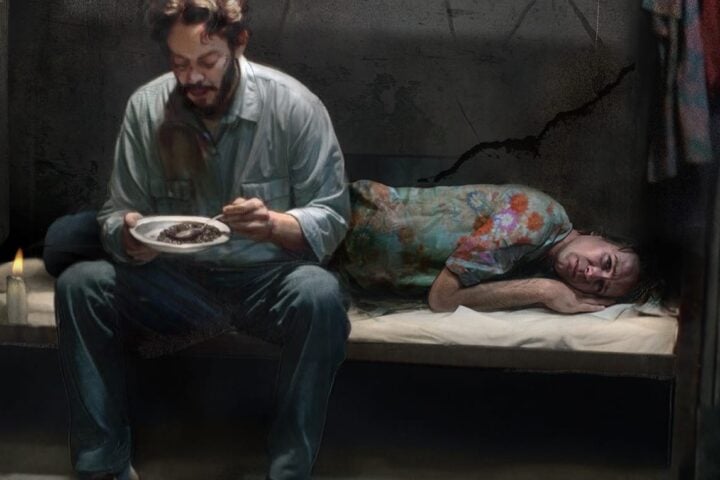
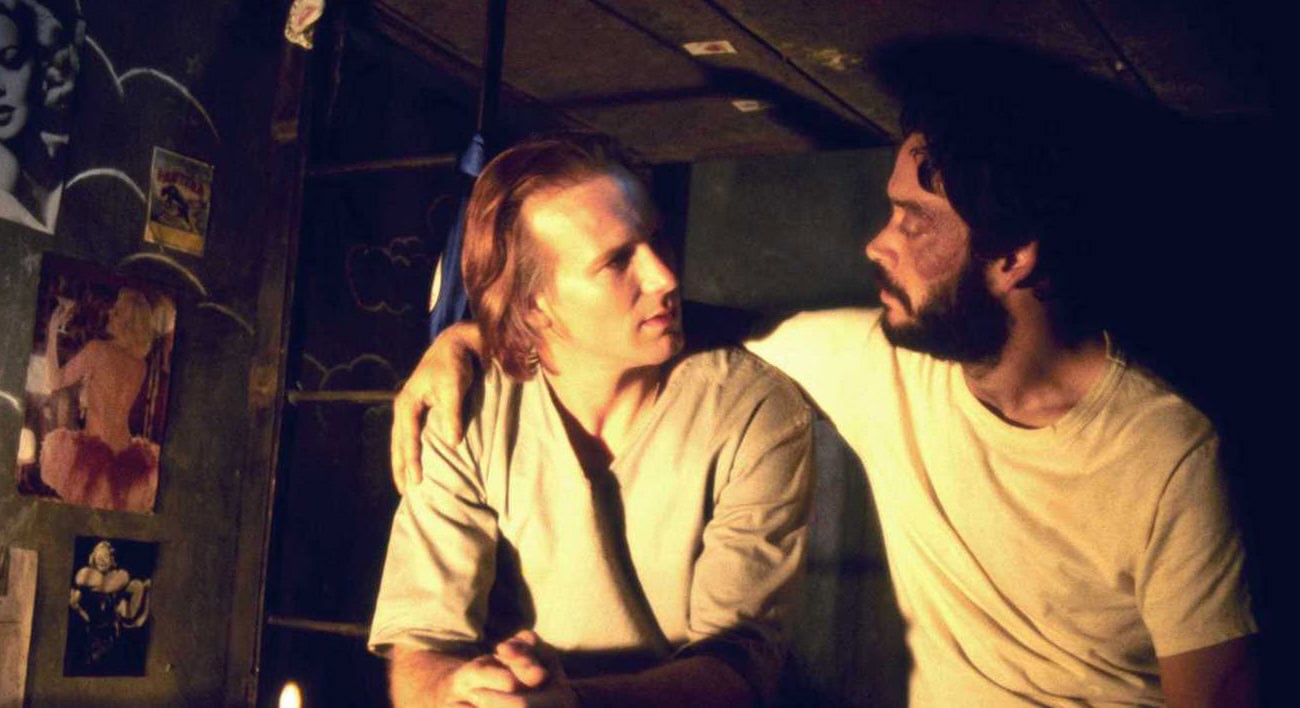
Héctor Babenco’s 1985 film contains all of those ingredients from the novel, which worked so well in the first place, and does something bizarre with them. The prison cell as depicted on screen—as opposed to the abstract place in the novel, which feels like a vacuum when we only have the dialogue of Valentin and Molina to go on—becomes a microcosm of their worlds. Valentin’s side of the room is austere and devoid of bourgeois comforts, while Molina’s is the best he can do with a few colorful things and some old black-and-white movie postcards.
The movies that Molina describes to Valentin become actual films-within-a-film, and the female protagonist of each of those stories is played by Sōnia Braga, who also plays Valentin’s upper-class girlfriend in a flashback. Molina’s movies are over-the-top, their expressionistic noir lighting standing in stark contrast to the naturalistic grimness of the prison cell.
Hurt gives a strange performance, seemingly playing Molina as if he were a benevolent space alien with maternal instincts. The very film seems to be coming from Valetin’s perspective, and it’s fair to say that it seems to be promoting heteronormative behaviors. When Molina tells the stories of his beloved movies, Valentin imagines the woman he loves, and the film’s climax involves the revolutionary having dreamlike contact with this beguiling woman of his fantasies—with even Molina acting butch, getting involved in the cause, and considering making a spy-movie phone call to the rebels, as if Babenco were saying, “This is how to be a man!”
As to its depiction of gay love on screen, you could be excused for thinking the film was made under the Hays Code. Valentin strips off his shirt, then leans over and blows out a candle, and we cut to the morning after. Far more intimate and touching is the sequence where the captors poison Valentin and the food troubles his stomach so much that he shits his pants, after which Molina gently cleans up after him. “It doesn’t disgust you?” Valentin keeps repeating, puzzled at Molina’s benevolence. The on-screen kiss between them is touching not because of whatever amorousness between the men it may hint at, but because it’s an act of kindness. “Don’t allow anyone to humiliate you,” Valentin says. “No one has the right to do that to anyone.”
The message transcends what might be seen as limitations in this film, and yet those limitations create new fissions that are pretty compelling. In much the same way audiences are fascinated by E.T., Valentin and Babenco are drawn in by Molina’s open kindness. Yet Hurt’s performance still transforms Valentin into an Other. If it feels grounded in reality, it’s due to Hurt’s committed method acting, a sense that he knows the character, knows the clothes, probably knows where every item of silverware and every hidden treasure is in the cell.
For his level of dedication, Hurt won an Academy Award, and perhaps deservedly so. Julia’s work went unrecognized because he doesn’t get to be as colorful, yet he projects a wary intelligence and a sense of genuineness as Valentin that’s more interesting to behold. Watching his Valentin, you feel that you’re watching that rare thing, a decent human being, in all its idiosyncrasies. He’s where Puig’s attractive notion of an ideal man to love meets Babenco’s notion of the hero straight men could identify with. That Babenco and Puig were able to find a common ground in this man is, in a way, as powerful as Molina and Valentin’s union.
Since 2001, we've brought you uncompromising, candid takes on the world of film, music, television, video games, theater, and more. Independently owned and operated publications like Slant have been hit hard in recent years, but we’re committed to keeping our content free and accessible—meaning no paywalls or fees.
If you like what we do, please consider subscribing to our Patreon or making a donation.