 King Hu’s Come Drink with Me was such a quantum leap for the director that it not only catapulted him to stardom but almost single-handedly prompted the Shaw Brothers Studio to shift away from making huangmei musical dramas and toward the wuxia action films that would make them so internationally beloved.
Compared to the somewhat convoluted plots of Hu’s earlier work, Come Drink with Me is nothing if not direct. A gang of bandits captures the son of a local governor to force a prisoner exchange for one of their own leaders, prompting the magistrate to dispatch his daughter, the mercenary Golden Swallow (Cheng Pei-pei), to rescue her brother.
The casting of Cheng alone was key to the advancement of the wuxia genre. Martial arts films had long been influenced by Chinese opera, but Cheng’s background in Peking opera gave her a thorough command of acrobatics and expressive body language that set a standard for the genre’s future stars. (Sammo Hung reportedly worked on Come Drink with Me as an assistant action director, and it’s rumored that Jackie Chan appears as a child singer in an early scene.)
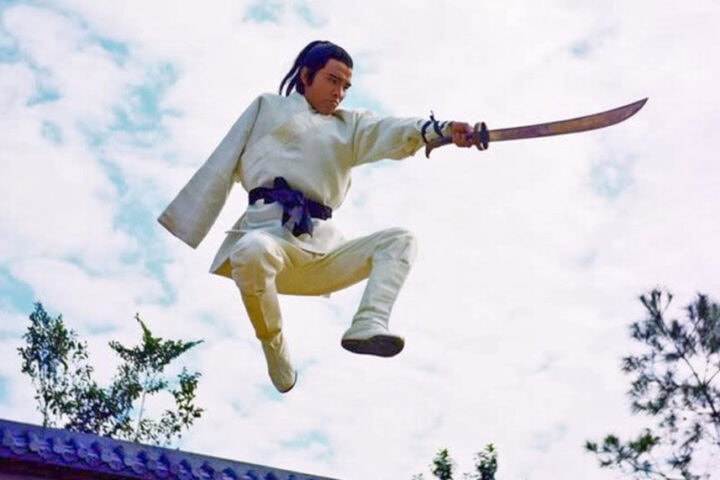
When she first heads to an inn to negotiate with the bandits, Golden Swallow pointedly sits straight as an arrow and avoids eye contact, not out of deference but to project superiority, and the slightest turn of her head is charged with the threat of violence. When talks inevitably break down, the fighter moves with a dancer’s grace, not a brute striking with pure force but a lithe figure flowing from target to target so fluidly that no one has time to properly react.
Further proof of Come Drink with Me’s allegiance to Peking opera, which stresses a continuity of actor motion, music, and staging, is the way that its camera movements and percussive score are in sync with Golden Swallow’s elegant dagger slashes. Hu’s previous film, Sons of Good Earth, climaxed with a Peckinpah-esque mass shootout that required extensive group choreography, and here he immediately tops that achievement with the multiplanar blocking of his actors during swordfights, always contrasting Golden Swallow’s smooth movements with the clumsier and more desperate motions of the fighters all around her.

And yet, in a harbinger of Hu’s future martial arts epics, the film regularly undercuts what might have been a simple affirmation of vengeance. For all the ferocity that Cheng projects in her diamond-hard stares and vertiginously sloping eyebrows, Golden Swallow exhibits no joy in violence. Despite her skill, Golden Swallow finds herself unwittingly reliant on the help of a deceptively bumbling wino, Drunken Cat (Yueh Hua), who proves especially useful when the head bandit, Jade-Faced Tiger (Chan Hung-lit), cowardly poisons her with a dart. As the film progresses, the heroes constantly face the choice of doling out punishment or showing mercy, and the moral conundrums these choices present become the true heart of the story.
This subtext finds Hu pivoting away from the political roots of his earlier work, with their depictions of social corruption in China, toward a focus on Confucian and Buddhist spirituality. This is especially pronounced upon the belated reveal of Come Drink with Me’s true villain, a venal and murderous monk (Yeung Chi-hing) whose lust for power perverts all the tenets of discipline that undergird his martial arts studies.
The monk’s warped ideology, combined with his past connection to Drunken Cat’s own training, leads to a finale that plays out as much as a moral battle as a physical one. And the distinction between Golden Sparrow’s noble mercy and the grisly bloodshed that caps Come Drink with Me establishes an ambivalent relationship between corporeal and spiritual victory that would become the bedrock for Hu’s later wuxia masterpieces.
Image/Sound
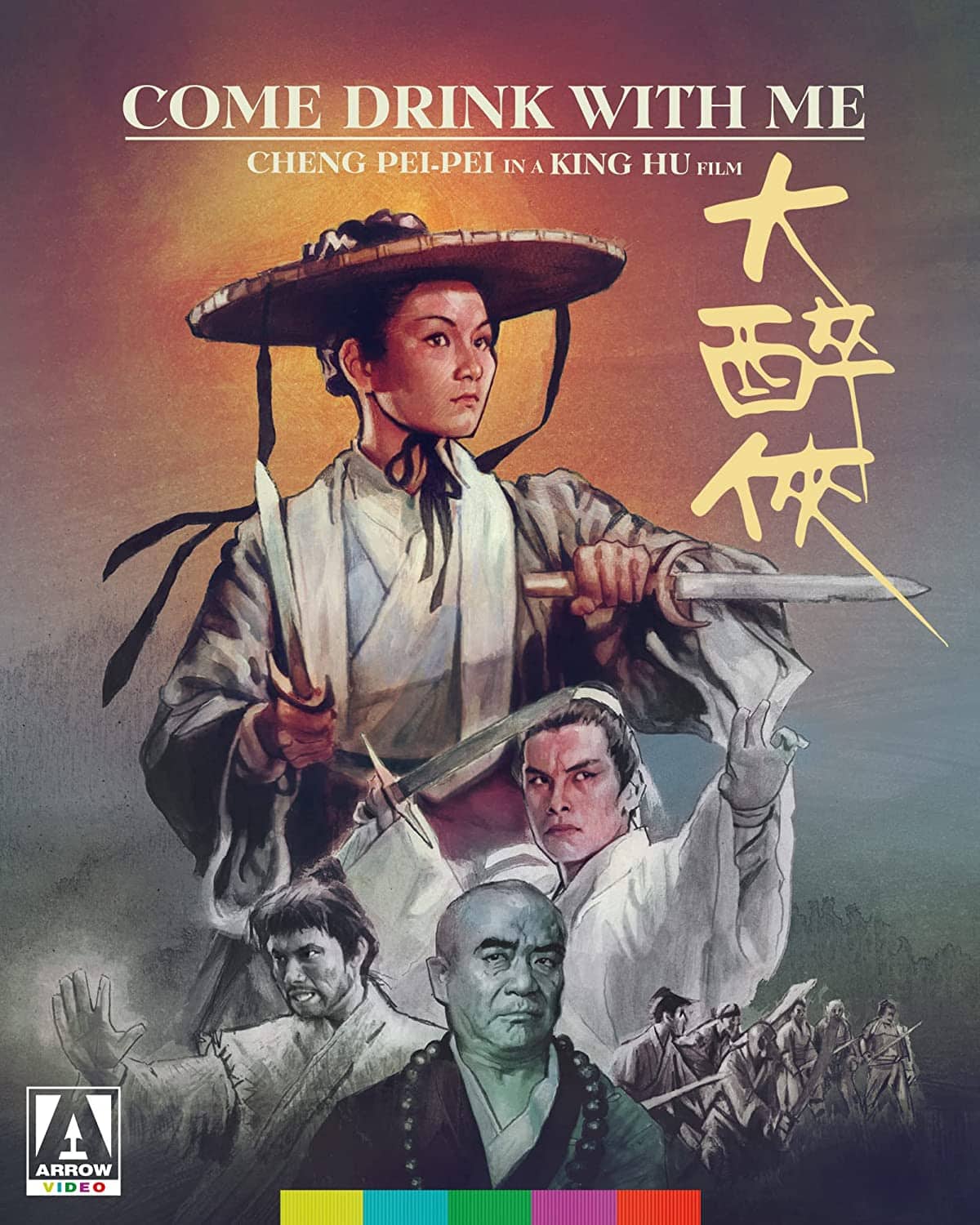
Arrow Video continues its hot streak of indispensable Hong Kong legacy releases with this disc, which presents Come Drink with Me’s florid colors in all their beauty. From the ghostly white pancake makeup on Chan Hung-lit’s face to the verdant foliage of the fake trees on the production’s soundstage sets, everything here looks luminous. Darkly lit scenes have filmic grain without losing detail to crush, and balance is consistent between realistic flesh tones and plain clothes with the more expressive color schemes. The disc comes with lossless mono tracks in both the original Mandarin and English dubs, both of which are free of any issues of tinniness or hiss common to lower-quality presentations of Hong Kong movies. All dialogue is crystal clear, as are the exaggerated sound effects and the rousing score.
Extras
In a predictably informative commentary track, critic Tony Rayns draws on his knowledge of Asian genre cinema to contextualize the importance of Come Drink with Me while also breaking down its aesthetic virtues. A 2003 documentary features a number of Shaw Brothers Studio stars and directors discussing the company’s legacy, while various archival interviews with the cast of Come Drink with Me reflect on the film’s making and success. Rounding things out are an original trailer, a press gallery, and a booklet containing essays by critic Anne Bilson and film professor George Chun Han Wang, the former analyzing the film’s action and subtext, and the latter offering a historical perspective on Hu’s time at Shaw Brothers.
Overall
King Hu’s breakthrough wuxia masterpiece gets an excellent release from Arrow Video that maximizes the film’s opulent beauty.
Since 2001, we've brought you uncompromising, candid takes on the world of film, music, television, video games, theater, and more. Independently owned and operated publications like Slant have been hit hard in recent years, but we’re committed to keeping our content free and accessible—meaning no paywalls or fees.
If you like what we do, please consider subscribing to our Patreon or making a donation.