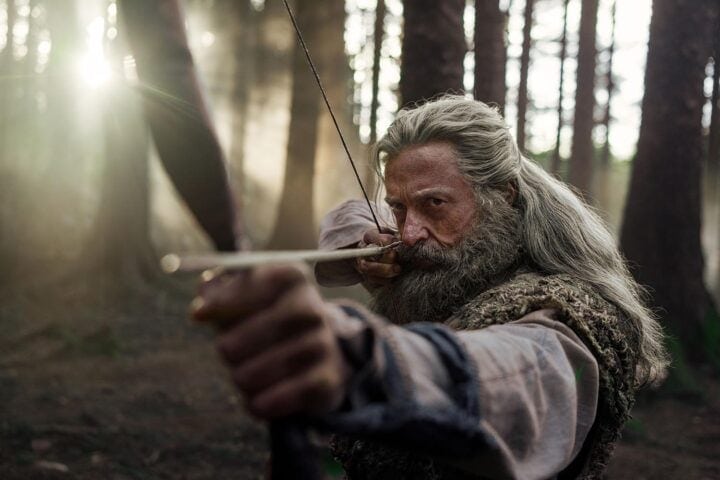
At the beginning of Baz Luhrmann’s Faraway Downs, 12-year-old Aboriginal boy Nullah (Brandon Walters) recounts the abiding lesson his grandfather taught him growing up in the wilderness of the Northern Territory of Australia: “Tell ‘em story.” Over the course of the six-part series, a reimagining of Luhrmann’s 2008 film Australia, story will emerge as one of the four cornerstones of Aboriginal identity, the others being country, song, and dreaming.
Luhrmann uses footage from the film, scenes that were lost to the cutting-room floor, and a modern soundtrack by Indigenous artists to expand the story and give it new depth. The narrative arc of the series, though, remains largely identical to that of Australia: When an English aristocrat, Lady Sarah Ashley (Nicole Kidman), travels to Australia to convince her husband to sell the titular ranch, she comes into the orbit of a cattle drover named Drover (Hugh Jackman), and after embarking on a journey together, their lives are forever changed.
One aspect of Australia that confounded audiences was its cross-genre nature, as it begins as a western (with Lady Ashley, Drover, and Nullah fighting to restore Faraway Downs to its former glory) only to then turn into a war epic (with the Japanese attack on Mission Island and Darwin). But the expanded form of Faraway Downs gives Luhrmann space to transition between the two more fluidly. It also allows him to flesh out plot points that had previously been glossed over, like the death of King Carney (Bryan Brown), the patriarch of a rival cattle dynasty.
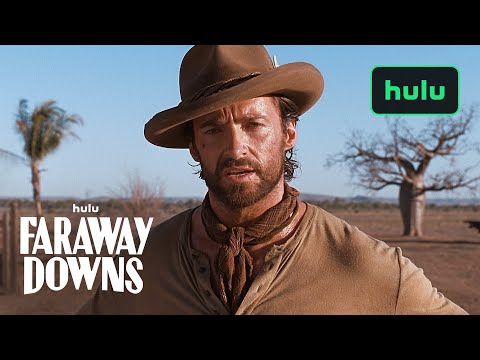
The basic premise—a privileged white woman falls in love with a rugged hunk and discovers her own identity in the process—is certainly well-trod. But like the feature film, the series is, for the most part, wryly aware of its broad brushstrokes. Drover, for one, is a pastiche of classic masculine movie heroes, as evinced by an early scene in which he assumes a Herculean pose while dousing himself in water as an open-mouthed Lady Ashley looks on.
At times, though, Faraway Downs utilizes its stock characters in the stalest of ways. Fletcher (David Wenham), Nullah’s father and heir to the Carney dynasty, is an exaggerated villain whose deeper motives are barely investigated, while Nullah’s grandfather, who’s known only by, per critic Germaine Greer, the “contemptuous whitefella appellation” of King George (David Gulpilil), is an exoticized approximation of Aboriginal culture.
Walters’s performance is Faraway Downs’s principal triumph, just as it was in the film. The young actor has a casual unaffectedness in front of the camera, at once evoking innocence, physical assuredness, and worldliness. Nullah is accustomed to a life of evading not only the natural threats of the bush, but also his tyrannical father and the police force, which in that period sought to remove “half-caste” children from their families and place them on church missions against their will. As the series unfolds, Walters brings a moving authenticity to Nullah as the boy becomes torn between life with his white guardians at Faraway Downs and a desire to reclaim his own cultural heritage by going “walkabout” in the wilderness with King George.
Aboriginals, though, were treated even worse than Faraway Downs can bear to acknowledge. In the series, Aboriginals are subjugated and insulted, but in reality, they were also made to endure the cruellest of working conditions without pay, housed in barely habitable shacks, and at times murdered en masse. The series is also somewhat naïve in its optimism for the future, envisioning an Australia in which all races of people can break bread, as symbolized by local publican Ivan (Jacek Koman) reluctantly serving Magarri (David Ngoombujarra), Drover’s Aboriginal right-hand man, in his white-only pub in the final episode.
Luhrmann seems less interested in accurately depicting Australia’s ugly past than in creating a national myth—a modern fairy tale to inspire story, country, song, and dreaming. In both the film and series, this approach risks romanticizing the experience of Aboriginals while keeping the central love story teetering on the edge of schmaltz. Faraway Downs’s ending goes partway toward remedying the latter, but fails to adequately address the former.
Since 2001, we've brought you uncompromising, candid takes on the world of film, music, television, video games, theater, and more. Independently owned and operated publications like Slant have been hit hard in recent years, but we’re committed to keeping our content free and accessible—meaning no paywalls or fees.
If you like what we do, please consider subscribing to our Patreon or making a donation.