If nothing else, Peacock’s Dr. Death has been smartly calibrated for its intended audience. Based on the 2018 Wondery podcast of the same name, the eight-episode series tells the story of Texas spine surgeon Christopher Duntsch (Joshua Jackson), who left a trail of permanently crippled (and two dead) patients in his wake, for which he was arrested and convicted. Unsurprisingly for a series rooted in the industry of true-crime podcasting, Dr. Death relishes in the lurid details and messy personal lives of its characters, employing nonlinear chronology for maximum drama and ironic juxtaposition. But despite the show’s few thrills, its structure only reveals an unsteady grasp of the story at its center.
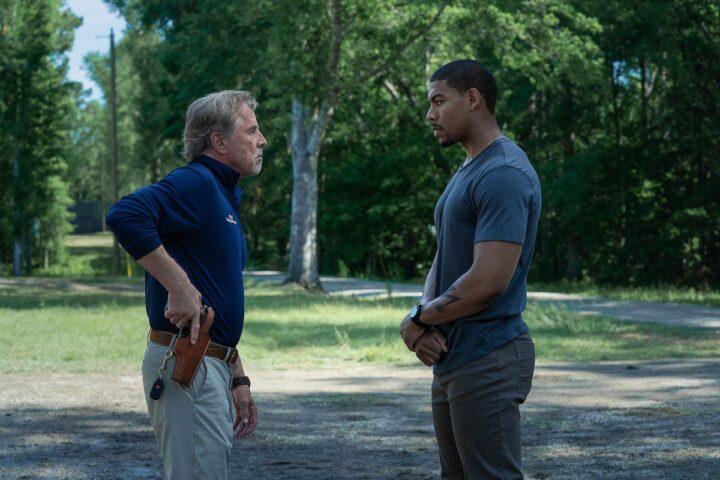
Dr. Death’s initial episodes revolve around two doctors who attempt to expose Duntsch’s misdeeds. Both witness his work up close: Randall Kirby (Christian Slater) performs an operation alongside him, while Robert Henderson (Alec Baldwin) is called in to correct the damage done to another one of Duntsch’s patients. These episodes seem designed to let the doctors confront various individuals who pass the buck of responsibility for Duntsch’s actions, carving out space for Baldwin and Slater to chew the scenery. The diplomatic Henderson, whom Baldwin imbues with his customary gravitas, wouldn’t go after another doctor if not for extraordinary circumstances, while the outspoken, abrasive Kirby is in his element, often donning sunglasses and a leather jacket while spouting phrases like “citadel of bullshit.”
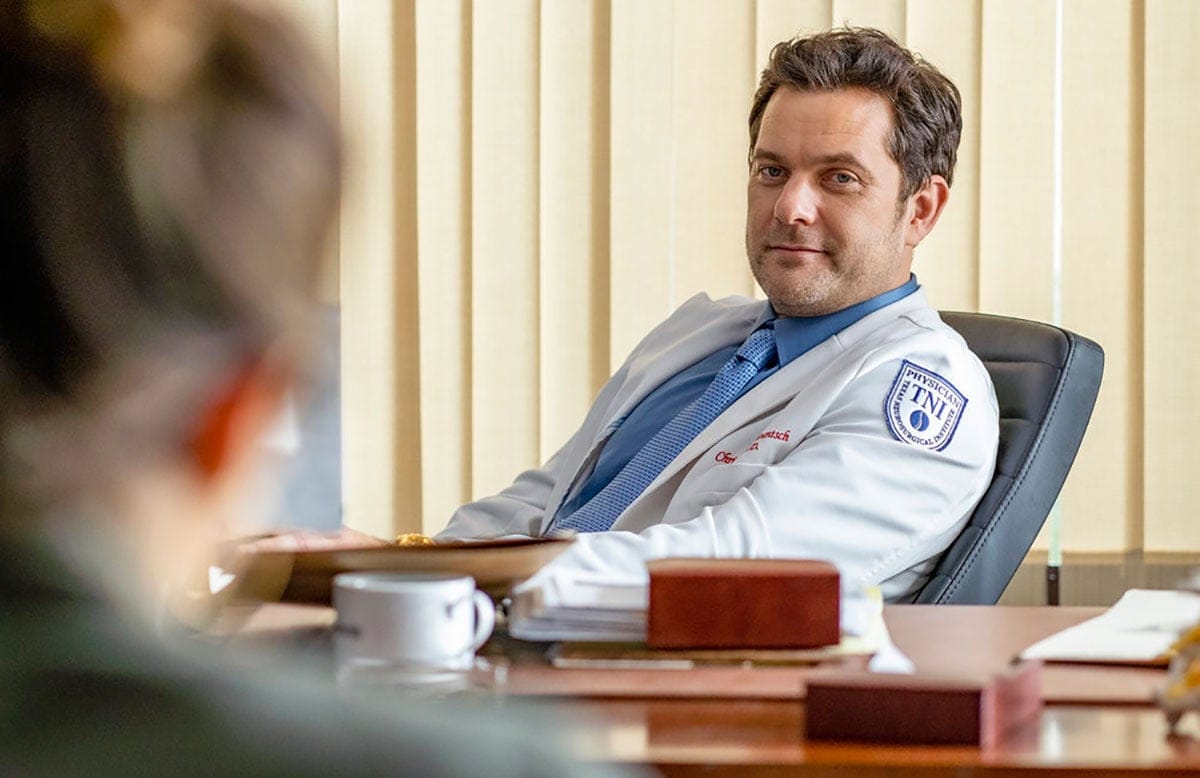
Their investigation is intercut with scenes of Duntsch, who’s boisterous and self-aggrandizing even by the standards of the profession (at one point, Kirby cracks that surgeons typically require “a decade to refine their god complexes”). Duntsch is a huckster who doesn’t seem to realize that he is one, and Jackson captures the charisma that initially puts the man’s patients at ease but, to the viewer, always seems a little bit off.
Neither playing Duntsch as transparently bad nor totally innocuous, Jackson pitches the character at a level of discomfort that hinges on his ability to perform his job well. It’s easy to imagine a context where Duntsch is excused for his social quirks like so many eccentric fictional TV doctors, if only he got results. That he very much does not get results demonstrates the razor-thin line between blistering confidence and perilous delusion.

Dr. Death covers a wide swath of time, with Jackson playing Duntsch all the way from college age to the eventual trial, which eventually requires stiff, distracting prosthetics to portray the doctor’s weight gain. But for how much we see of Duntsch, and for how sickening it is to hear the squelching and crunching noises of his surgeries when we know the outcome, our understanding of the character never really expands beyond his basic egotistical bullishness.
As portrayed, Duntsch is simply an inept surgeon, and his hubris leads him to deny that his work is anything but perfect. He blames the bad outcomes on everyone else: the nurse, the X-ray tech, the anesthesiologist, even the patients. Certainly there are people who behave this way, but Duntsch’s delusion is so complete, while being so transparently baseless, that the series never finds a way into his psyche, only ever prodding the surface from different angles.
Eventually, at Henderson and Kirby’s urging, a young assistant district attorney, Michelle Shughart (AnnaSophia Robb), takes the matter to criminal court. The trial might initially seem like a purposeful framing device, but it proves redundant because the series has spent so much time up to this point portraying the investigation, as well as Duntsch’s own perspective of his actions. The legal proceedings provide only slightly more information in somewhat clearer summaries, as though the writers are intent on withholding the most shocking details until the most climactic moment, even though they’ve already told us too much.
As a result, even our basic empathy for Duntsch’s patients suffers, with many of the living ones initially glossed over or treated as interchangeable until the series nears its climax. But perhaps the biggest casualty of Dr. Death are the ill-served systemic problems that it’s targeting throughout. Duntsch was enabled by the U.S.’s byzantine for-profit medical system, and while we do get to watch Henderson and Kirby sternly talk to a couple of the responsible parties, the bigger picture of loopholes taken advantage of by administrators more concerned with dodging lawsuits than providing good medical care quickly fades in favor of scenes where the show’s villain snorts coke and leers at strippers. Consistent with its true-crime origins, Dr. Death gets lost salivating over the salacious details of individual wrongdoing.
Since 2001, we've brought you uncompromising, candid takes on the world of film, music, television, video games, theater, and more. Independently owned and operated publications like Slant have been hit hard in recent years, but we’re committed to keeping our content free and accessible—meaning no paywalls or fees.
If you like what we do, please consider subscribing to our Patreon or making a donation.