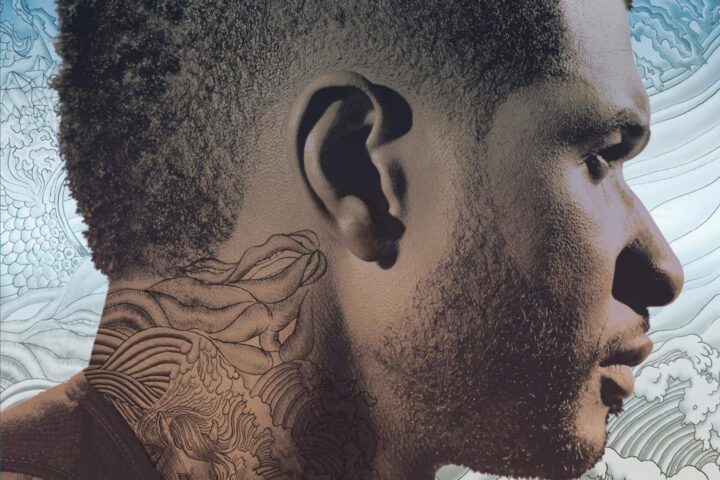
Usher’s first studio album in six years largely operates as a high-wire homecoming of sorts for the R&B singer. Released two days before his halftime performance at Super Bowl LVIII and following a highly successful Las Vegas residency, Coming Home feels less driven by creative ingenuity or an aesthetic vision than by sheer showmanship. This is further emphasized by the inclusion of the sleepy “Risk It All,” a duet with H.E.R. from the Color Purple soundtrack, and a remix of BTS member Jungkook’s “Standing Next to You,” both of which, thematically and sonically, have little in common with anything else on the album.
Which is to say that the 20-track Coming Home, like many of Usher’s post-Confessions output, is a bit of a bloated mess. For every few colorless duds defined by their embrace of contemporary R&B, such as the overly smooth “Kissing Strangers” or the brassy “Big,” there’s a creative cut or two, like the suave “Margiela,” that’s clearly attempting to do a little more than the bare minimum. For better or worse, you end up with a serviceable enough throwback like “I Am the Party” or an oddity in the vein of “A-Town Girl,” which flips Billy Joel’s “Uptown Girl” into a pop-rap fusion that’s equal parts absurd and amusing.
The sultry, trap-flavored “Cold Blooded” is a remarkably elegant and experimental team-up with The-Dream and Pharrell Williams, featuring Usher’s most acrobatic vocal performance since “Climax.” The track’s dense 808 kicks and operatic backing vocals exude an air of both danger and epicness—an electrifying combination compared to some of the album’s more sterile-sounding selections. Throughout, Usher continually belts out the phrase “Maybe I shouldn’t have loved you like I did” as if it’s the last words he’s ever going to sing.
Unfortunately, the remainder of the album is nowhere near as memorably melodramatic in how it approaches either romance or heartbreak—and it rarely even attempts to reach the dizzying levels of eroticism of “Cold Blooded.” Instead, as if recalling the days when he declared that he “didn’t mind” that his girlfriend was a stripper, Usher decides to embrace his inner nice guy. He amicably dumps his significant other right from the start of “Good Good”—going the extra mile in terms of geniality when he describes the situation as a case of “right one, right place, wrong time”—while on “Luckiest Man” he anoints himself the world’s luckiest man due to his romantic partner. Even when he’s reprimanding a former flame on “Ruin,” a mellowed-out Afrobeat collaboration with Nigerian singer Pheelz, it’s a mild-mannered tongue-lashing at worst.
It’s the first line on the disco-tinged “Keep on Dancin’,” however, where Usher delivers one of Coming Home’s most sobering reflections on love: “I admit breaking up is easier than commitment.” The remaining three minutes don’t really follow through on the promise of that self-probing statement, as he immediately proceeds with eye-rolling platitudes about how his devotion “is strong enough to never have an ending.” Like much of the material on Coming Home, it could have used some extra polish to reach its fullest potential.
Since 2001, we've brought you uncompromising, candid takes on the world of film, music, television, video games, theater, and more. Independently owned and operated publications like Slant have been hit hard in recent years, but we’re committed to keeping our content free and accessible—meaning no paywalls or fees.
If you like what we do, please consider subscribing to our Patreon or making a donation.