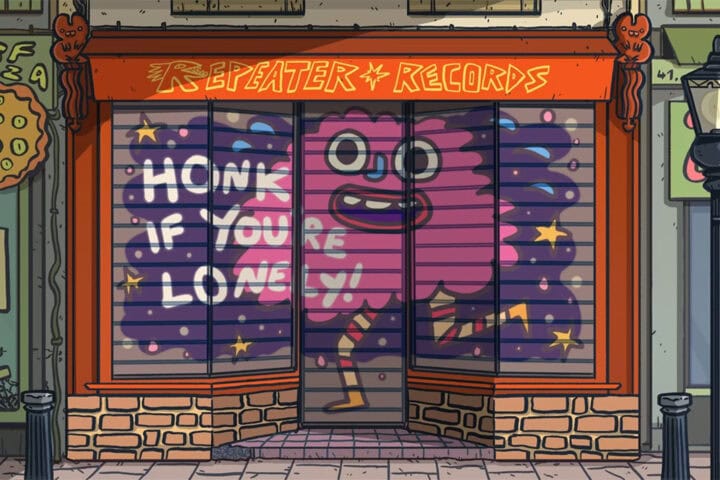
AP Thomson’s Titanium Court begins with a stroll in the woods that quickly goes south. Our unnamed protagonist wanders into an ethereal castle, whose faerie court immediately coronates her. It must be a prank, right? What else could explain Her Majesty’s nonsensical ascent, the mischievous absurdity of her new subjects, and the fact that she can’t seem to open the keep’s front gate and go home? “There is no single conspiratorial joke,” says the queen’s steward. “There are just scattered chuckles, like wind rustling the leaves.”
An impish sense of humor blows through Titanium Court, less a breeze than a gale. The game is structured like a roguelite, with runs representing forays in a war between fae—a silly endeavor, considering the immortality of these beings. Each encounter starts out as a match-three puzzle, where you align tiles to generate resources and reconfigure the grid, then pivots to a tower defense phase, as your workers toil and your troops march.
It’s all set to Thomson’s beguiling spell of a soundtrack, a surfy, dreamy marvel that suggests a performance by the Ventures at the Roadhouse in Twin Peaks. Thomson, who created all of Titanium Court’s writing, art, music, and code, uses the closing credits to thank the numerous souls who helped shape his work, gently reframing the increasingly fetishized solo-dev mythos.
The queen can equip an eclectic array of jobs to change how the court makes money on the battlefield. “Youth,” a standout, fills the coffers by burning down the landscape—and, like any half-decent rebellious adolescence, teaches you responsibility, as you must balance the queen’s pyromania with the need to preserve timber for harvest (in order to fuel future fires).
Charming framed images flash on the screen to punctuate dramatic moments, like postcards from the frontlines. In Youth’s case, the crackling of flames might conjure a shot of a faerie lighting a cigarette. Demolish an enemy outpost and you may be treated to a basketball swishing into a net, or a batter slamming a baseball, in celebration.
Sports and other human activities are a fixation of Titanium Court’s faeries, who, unbound by mortality, are dying to learn about mortal life. Both during runs and at the fortress, where you can click around to explore Her Majesty’s royal digs, they bombard the queen with outlandish questions. Why do people let the bestial “bus” devour them? Is the yearbook she found in the library, filled with notes from soon-to-be-distant companions, a “tomb for friendship”? What’s the difference between “offense” and “defense”?
These inquiries poke fun at our social rituals, of love, labor, and leisure. But in time, the game jolts its madcap tone with a shift to somberness, as a debilitating condition spreads among the faeries. The cause, it appears, is you, the player. “You are a reader and player, voracious and destructive,” a magic mirror, one of a handful of end bosses, says. “You are steadily consuming the Court and its denizens. If You do not stop, there will be nothing left.”
As the faeries drop one by one, leaving the queen’s halls ever lonelier, Titanium Court prompts reflection on what it means to live, to die, and to play in the interim. Built with the trappings of the roguelite genre, that treadmill designed to keep you running forever, Thomson’s game proves to be an anti-roguelite. It begs you to leave the castle, to return to the realm of the living and dying, to let things be finished. And you will depart, ruefully but willingly, without turning back for one last look at the mess you’ve made.
This game was reviewed with a code provided by Two Frogs in a Trenchcoat.
Since 2001, we've brought you uncompromising, candid takes on the world of film, music, television, video games, theater, and more. Independently owned and operated publications like Slant have been hit hard in recent years, but we’re committed to keeping our content free and accessible—meaning no paywalls or fees.
If you like what we do, please consider subscribing to our Patreon or making a donation.