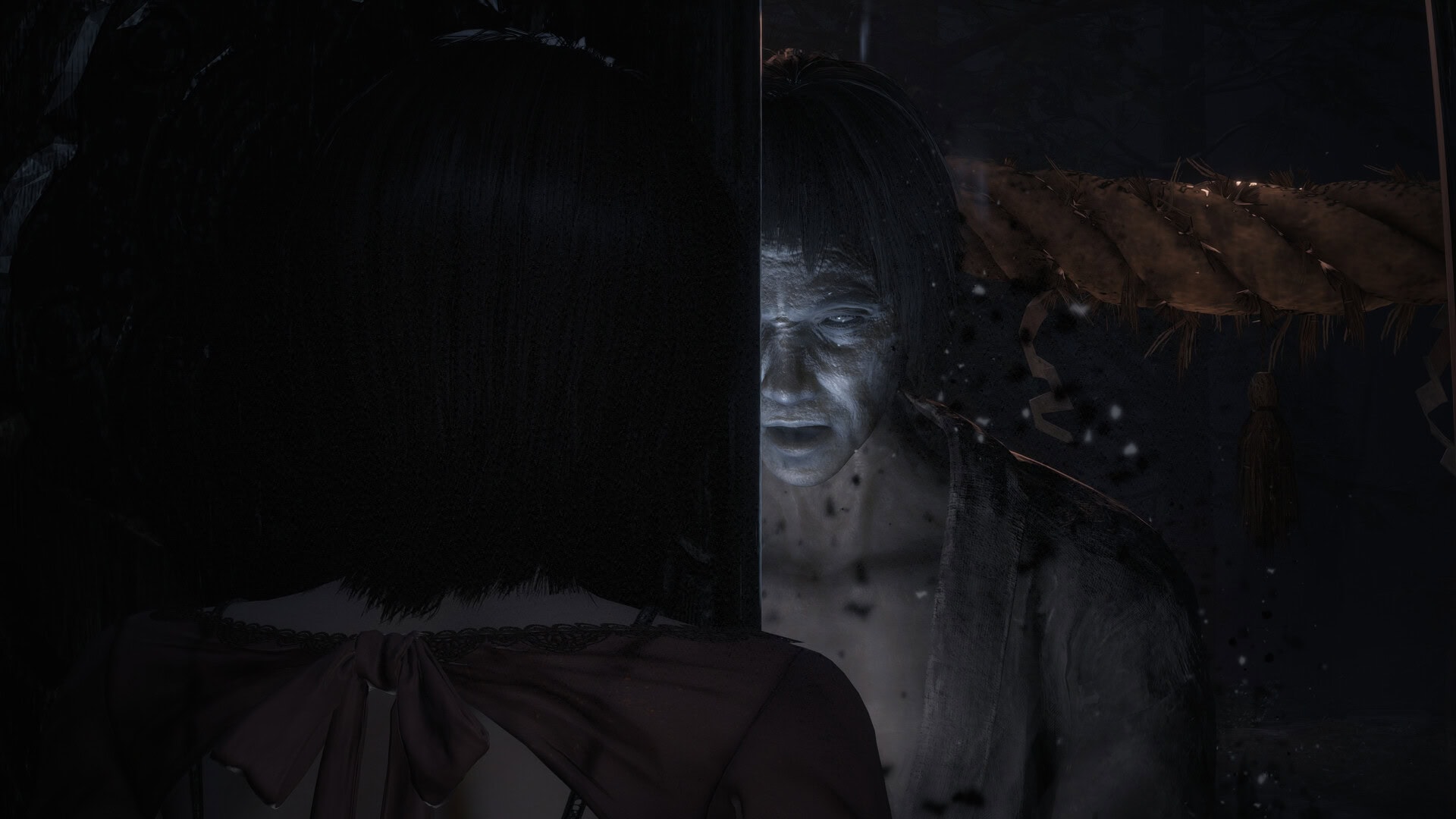
Where Resident Evil and Silent Hill put their own spin on distinct subgenres of American horror media, the Fatal Frame series has always fit snugly into the J-horror wave, led by films like The Ring and The Grudge, which combined the spectral motifs of Japanese folk horror with the technological advancement of modern Japan. This leads to the distinctly Japanese series’s most distinguishing feature: the Camera Obscura, its young heroines’ weapon of choice against the supernatural, which by facing the malevolent spirits of the past head on and recording them on film successfully exorcises what guns and lead pipes cannot.
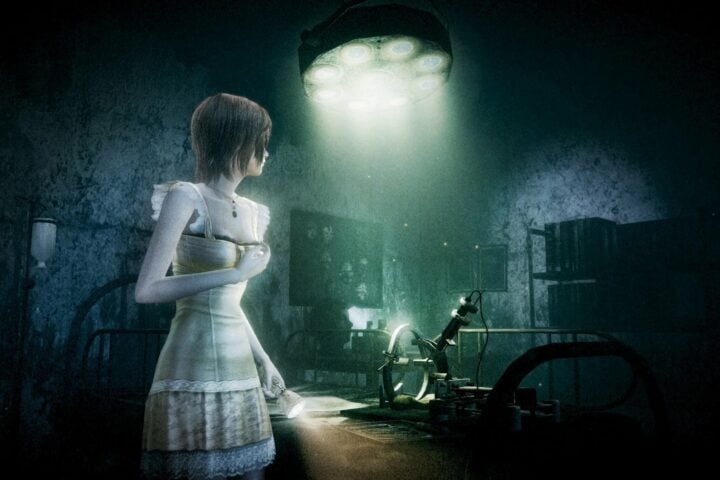
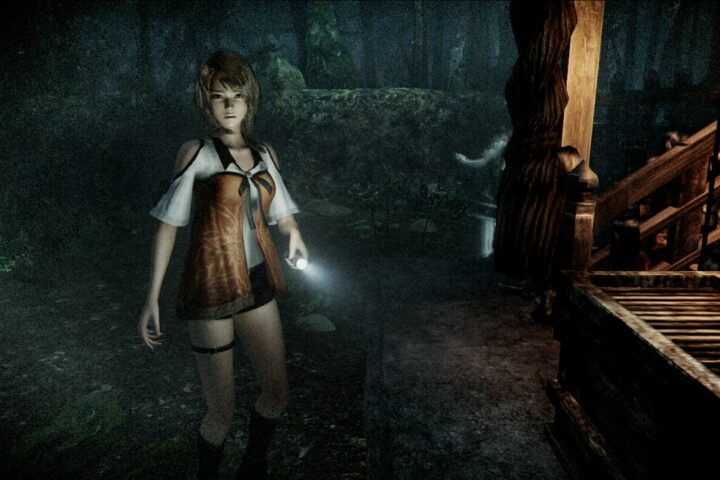
It’s fitting, then, that the Fatal Frame II: Crimson Butterfly remake follows its survival-horror predecessors into a conversation about whether and when the modernization of Y2K-era horror game classics serves those games’ interests. Actually a remake of the 2012 remake of 2004’s Fatal Frame II, the new game is a faithful recreation of the source material. Players control doll-like teenager Amakura Mio as she follows her troubled sister Mayu through the haunted Minakami Village, collecting clues to its mysteries and her own past while using the Camera Obscura to reveal hidden pathways and snap an assortment of ghosts both passive and wrathful.
Minakami Village is a vividly realized ghost town, an architecturally realistic Japanese hamlet of decaying wooden longhouses and Shinto shrines that modernity seems to have bypassed entirely. Indeed, Crimson Butterfly preserves attractive qualities of midsized games of its era that are all too rare today. Minakami Village is neither a linear corridor nor an open world, but a detailed, contained, and cohesive single setting crisscrossed by players as they remove barriers and venture down pathways that eventually connect.
Mio is also neither a voiceless avatar nor an exhaustively fleshed out protagonist, but an emotional vector defined through brief cutscenes and symbolic suggestion enough to draw the player in, without so much definition that her agency overshadows theirs. The photography mechanics overlaid on classic survival-horror level design (resource-gathering, path-plotting, key-finding, combat/evasion, and so on) are genuinely novel in a way that, to newcomers, will reinforce how rarely a modern game makes us feel like we’re learning the rules from scratch.
But while Crimson Butterfly’s next-gen glow-up adds subtle touches like floating dust particles, fluttering kimonos, and a sound mix thrumming with the wails of the damned, not every modernization feels additive. When Capcom translated Resident Evil 2’s fixed camera angles to a Resident Evil 4-style over-the-shoulder camera, the entire game’s level layouts and action mechanics were reimagined around the new point of view. Crimson Butterfly also ditches the fixed camera—and the more dreamlike sense of disembodiment it facilitated—without always seeming mindful of the ways it alters the player’s relationship with space.

The difference is visible from the first playable segment. The original version begins with a series of interactive establishing shots, gradually and panoramically revealing the eerie glow of Minakami Village emerging from the darkness of the mountains as if from the bowels of hell, dwarfing the protagonist on the bottom of the screen. In the “new and improved” over-the-shoulder version, this sequence is a tempo-free tracking shot of Mio walking in a straight line, literally recreating the sequence while diminishing its expressive purpose.
The game’s spaces are, likewise, still largely consigned to narrow corridors, alleyways, and chambers whose original designers intended them to be experienced from specific angles. With the more visceral player embodiment and wider scope implied by the new perspective(s), the smallness of these spaces in objective terms feels more underwhelming than oppressive.
The bigger sticking point is Crimson Butterfly’s combat, freshly amped up by Team Ninja as a glacial and punishing 30fps affair even on normal difficulty. Switching from third to first person to use the Camera Obscura, players must track a sluggish cursor over ghosts who float, teleport, and wobble erratically as they attack, trying to score quality shots while juggling variable film reload times and lens abilities with critical counterattack and dodge windows.
It’s novel but cumbersome, and becomes outright infuriating when enemies start pulling dirty tricks like surprise attacks that instantly deplete Mio’s stamina bar, or regenerating their own massive health bars to enter a damage-resistant aggro state. Midgame upgrades help smooth out the difficulty curve, but at its worst, the game feels like playing pool with a flying cue ball; even when you score, it seems like a fluke. The logic of Team Ninja’s brutal skill-intensive action games is there, yet its admixture with classic survival horror’s slow-paced interest in maintaining player desperation produces a system as liable to inspire frustration as fear.
This game was reviewed with a code provided by One PR Studio.
Since 2001, we've brought you uncompromising, candid takes on the world of film, music, television, video games, theater, and more. Independently owned and operated publications like Slant have been hit hard in recent years, but we’re committed to keeping our content free and accessible—meaning no paywalls or fees.
If you like what we do, please consider subscribing to our Patreon or making a donation.