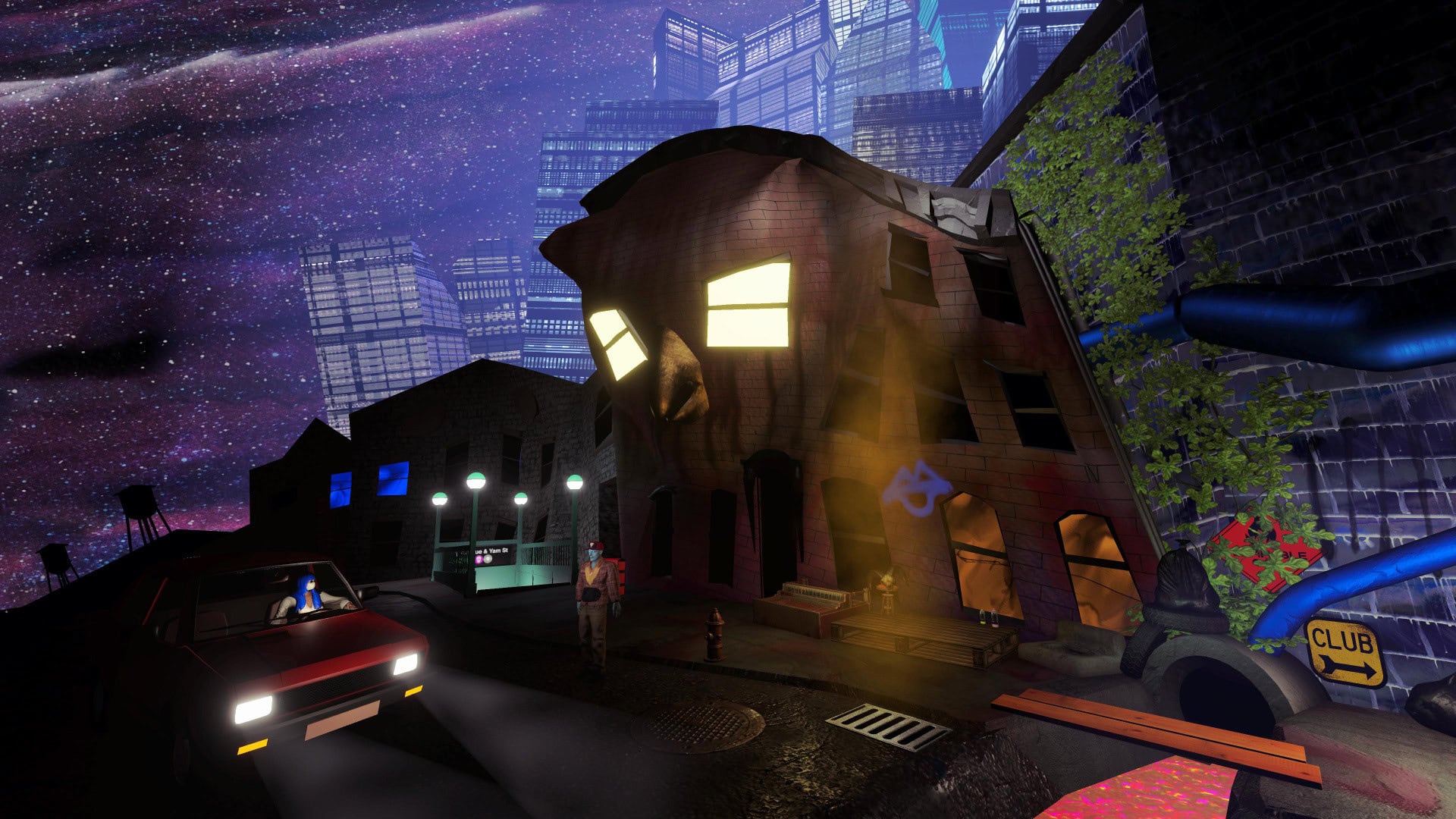
Chances are, if you’re familiar with the work of Cosmo D, including Off Peak and The Norwood Suite, then you know what to expect from his latest video game. He makes “walking simulators” of the most eccentric kind—first-person explorations of music-centered, pizza-obsessed pockets of the universe that suggest art installations. Until now, that is, because Betrayal at Club Low is fully and unambiguously a role-playing game, complete with dice rolls to determine how your skillset fares when you try to perform an action.
Of course, the Cosmo D signature remains. Not only does Betrayal at Club Low present a familiar-seeming world of chilled-out workers who are slaves to a daily grind, it imports a few recognizable assets and characters from his previous game, Tales from Off-Peak City Vol. 1. It would not be terribly surprising to find this RPG retroactively labeled Vol. 2, though the wacky story and the mechanics that accompany it are meant to stand alone.
We play an undercover pizzaiolo (which is, to give some idea of the tone here, emblematic of the kinds of words that the characters use throughout) on a mission to infiltrate Club Low, a former coffin factory turned nightclub. Once inside, we must extract an operative from the clutches of the local goon who occupies the VIP section. How the operation proceeds depends on our actions, as there are multiple ways inside beyond just cutting in line.
The success of those actions comes down to the aforementioned dice rolls, which, in turn, are ruled by the stats on a character sheet that gives equal importance to cooking, music knowledge, and comedic wit as it does to RPG staples like “physique” or “deception.” Each stat lists six numbers that correspond to the six dice faces when players roll the skill that corresponds to a specific action, and any acquired cash can be spent like experience points to boost the dice numbers, either all at once or on a face-by-face basis.
There are additional dice, too, like the pizza dice used on every roll that you customize with “toppings” found throughout Club Low. Most of these win you extra money, but a few can be integral to your success, like the peppers that let you reroll any of the opposing dice. You even get modifiers depending on whether you pass, fail, or tie the opposing dice roll. If you successfully drink from a puddle, the positive “refreshed” modifier awards you an extra single-use die that might add to your roll’s total, and if you fail, you get a negative modifier that can subtract from your total, thus simulating the ill effects of ingesting random fluids on the ground.
In other words, the game leaves a lot of variables left up to chance. On the default difficulty, though, you get two chances to reroll your own dice, which provides a further sense of control beyond how you’ve chosen to distribute pizza toppings and stat boosts. But like any good chance-based game, even this concession can make things worse in ways that you’ll then scramble to deal with, like getting a bad modifier because you failed to reroll your way out of a tie. It’s this detail above all else that cements Betrayal at Club Low as an impressive feat of design in its own right, more like a Disco Elysium in miniature than a superficial coat of paint.
Which isn’t to say this RPG experiment lacks room to grow. For a game with nine endings, rather few of its paths branch particularly far away from one another since many just substitute one skill for another. The most involved detours involve tracking down a permanent negative modifier to apply to the opposing dice roll that you had to tackle anyway, like finding a DJ’s contract so you can then demoralize him by explaining exactly what he signed.
Rather than providing distinct experiences for different skillsets, Betrayal at Club Low is more about tweaking the details on a linear route to victory. And yet, even then, going through the same motions hardly dulls the sheen of Cosmo D’s latest clever and wholly invigorating gaming experiment. Indeed, it’s hard not to leave the game buzzing with excitement about all the new and surreal directions that its developer might take from here.
The game was covered with a review code provided by Dead Good PR.
Since 2001, we've brought you uncompromising, candid takes on the world of film, music, television, video games, theater, and more. Independently owned and operated publications like Slant have been hit hard in recent years, but we’re committed to keeping our content free and accessible—meaning no paywalls or fees.
If you like what we do, please consider subscribing to our Patreon or making a donation.