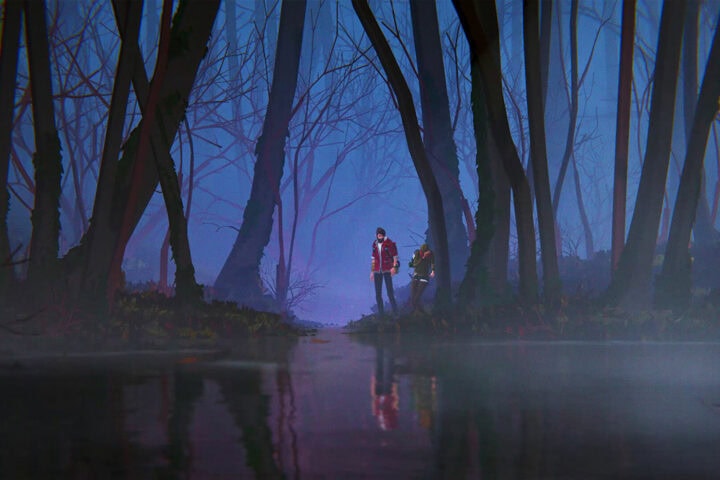
The entirety of American Arcadia takes place in the past, presented as a documentary pieced together from the testimonies of its protagonists. Several times in its first 20 minutes, the interviewer begs mild-mannered office clerk Trevor Mills to cut to the chase—that is, to what Trevor calls “that dreadful day.” This cinematic puzzle game even splices in a playable moment of Trevor fleeing through moonlit wetlands as police open fire on him, essentially promising viewers that there’s more interesting gameplay to come.
The developers at Out of the Blue Games could have certainly gotten to the good stuff a little faster. But they stick to their guns and make you slog through a playable montage of two weeks’ worth of Trevor’s dull routines to emphasize that the “good stuff” depends on your point of view. It’s the whole story, the so-called boring stuff included, that makes Trevor’s journey a must-play adventure. All the breakneck chases are just the exhilarating punctuation along the way.
The first of American Arcadia’s many twists is a literal breaking of the fourth wall, as the frame of your screen, which shows Trevor in the third person, pulls back to reveal that you’re actually watching Trevor via a computer monitor belonging to Angela Solano, whom you’re controlling in the first person. Trevor’s whole world—and that of Arcadia’s 23,414 other citizens—is actually a reality TV show, and Angela and the activist group that she works for are trying to dismantle it.
Trevor’s dullness means that the cost of employing him isn’t worth it to the producers, and in a coldly capitalistic calculation, they’ve decided to cancel him. Each scene/level of American Arcadia reinforces the view that Trevor’s life only has value if an audience wants to tune into it. And by the time that it’s revealed to us that his mission is to escape a carefully constructed Truman Show-style world that he believes to be real, the game has already offered up a stinging condemnation of entertainment that thrives on the suffering of others.
Angela’s presence massively elevates American Arcadia both in gameplay and commentary beyond the standard tropes of yet another moody Limbo-like third-person adventure. At the most basic, Angela’s hacking lets players shift camera angles or maneuver platforms around in real time as Trevor flees Arcadia’s enforcers; at best, players must multitask, as when Angela must both pass a security inspection while also guiding Trevor past a blockade.

Seeing Arcadia from two characters’ perspectives, sometimes at once, serves the narrative function of exposing Arcadia from both within and without. It’s in this respect, too, that American Arcadia benefits from its use of its chosen medium. As the game switches between third- and first-person views of Trevor’s escape, it practically functions as a commentary on the passivity that television engenders. And in American Arcadia’s final chapter, the writers draw a literal line between Trevor’s actions and the empty talk of those flooding the right side of the screen with all the superficial empathy (and emojis) of a live chat. That’s just one of the many too-plausible moments that dot this thrilling and smartly written cinematic puzzle game.
A lot of work goes on behind the scenes of reality TV (casting, editing, and producer prompting) in order to make the final product compelling. That was certainly the case in American Arcadia as well, and the team at Out of the Blue Games has gone above and beyond to make a place like Arcadia seem eerily possible, if not inevitable. There are plausible explanations given for how it legislates, operates, and monetizes. Most importantly, the level design excitingly makes these behind-the-scenes operations part of the puzzle-solving, like Angela’s sabotage of the It’s a Small World-like animatronic showcase of Arcadia’s history or Trevor’s attempts to blend in with the tourists who have paid good money to visit Arcadia as if it’s a theme park.
It’s indicative of the game’s clear messaging that despite multiple car crashes, a delirious dream sequence, a high-stakes infiltration, and more, the moment that most stands out is a relatively quiet one: Trevor sitting at a piano, playing an original piece that he’s composed. For all the time spent controlling him up to that point, this is the first time where Angela, and by extension the player, can see him as an independent person, one capable of making his own decisions (in this case, his art). That glimpse of his humanity is a moving little flourish that attests to American Arcadia’s belief that we all deserve freedom from coercion and an unreal life.
This game was reviewed with code provided by Sandbox Strategies.
Since 2001, we've brought you uncompromising, candid takes on the world of film, music, television, video games, theater, and more. Independently owned and operated publications like Slant have been hit hard in recent years, but we’re committed to keeping our content free and accessible—meaning no paywalls or fees.
If you like what we do, please consider subscribing to our Patreon or making a donation.