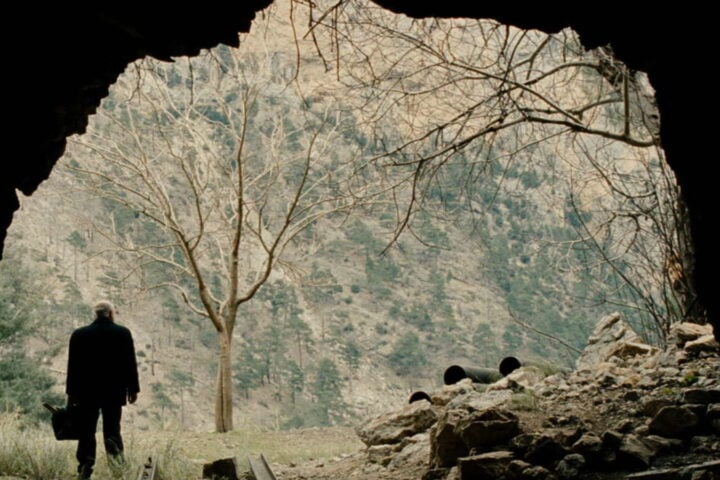
Set against a backdrop of social unrest in contemporary Turkey and crackdowns by the country’s authoritarian right-wing government, writer-director İlker Çatak’s Yellow Letters follows a once-revered TV actor, Derya (Özgü Namal), and playwright, Aziz (Tansu Biçer), as their marriage is tested in the wake of the latter’s politically motivated firing from his university teaching position. Forced to move in with Aziz’s mother (İpek Bilgin), the couple struggle to stick to their progressive principles while adapting to a loss of material comforts, a change that also widens pre-existing fractures in their relationship and threatens the future prospects of their teenage daughter, Ezgi (Leyla Smyrna Cabas).
As abstract introductory shots depict the climax of Aziz’s latest stage production, the film’s unconventional credits include not just names of cast members but also an indication of which characters they depict. This choice is soon revealed to be part of a kind of metatextual gag, when the first establishing shot of Turkey’s capital is accompanied by the caption “Berlin as Ankara.” Later deploying the same device to signal his casting of Hamburg in the role of “Istanbul,” the city where Aziz’s mother lives, Çatak is possibly hinting at the real-world cultural censorship in his ancestral homeland that precluded him from shooting this particular film there, or at least drawing parallels between his own artistic struggles and those of Aziz and Derya.
Unfortunately, the film’s formal playfulness and gentle provocation is mostly limited to this opening gambit, as the rest of the action proceeds in a more straightforward, strictly realist register. Demonstrating the same moral complexity and sense of political urgency as his Oscar-nominated The Teacher’s Lounge, Yellow Letters sees Çatak working with a notably larger canvas. However, his focuses on the everyday familial strife instigated by a nation’s broader cultural turmoil proves to be a choice that’s as frustrating as it is admirable.
Yellow Letters touches on a range of interesting issues, with gender roles, class conflict, and the possibility of revolutionary art all relevant to the characters’ predicament. Political concerns never fully recede from view, whether in the heated arguments that Derya and Aziz have with institutional authority figures whose attitudes vary from cynical to outright hostile, or in the debates over the family dining table that are so frequent they become a kind of leitmotif throughout the film. But it’s not fully clear what’s at stake for any of the characters, beyond Aziz grumpily resigning himself to a new job as a cab driver and Derya being forced to delete politically sensitive social media posts in order to get more acting work.
As Yellow Letters patiently attends to interpersonal dynamics and traces the subtle emotional shifts within every gathering or one-to-one conversation, it’s hard not to wonder whether it might have been better off as an even more compact character study, one with less commitment to saying something about the state of the Turkish nation. When it does resonate, it’s primarily due to the work by the solid cast. Namal’s controlled display of frustration, outrage, and maternal concern makes Derya a particularly engaging central figure.
While the film’s deft spinning of multiple plates is impressive for a good hour or so, what it’s serving up eventually starts to feel a little undercooked. With an anticlimactic resolution that squanders much of the tension that Çatak’s methodical approach builds, Yellow Letters ultimately proves to be much less than the sum of its parts, as a lack of focus prevents its political commentary and humanist drama from cohering in any meaningful way.
Since 2001, we've brought you uncompromising, candid takes on the world of film, music, television, video games, theater, and more. Independently owned and operated publications like Slant have been hit hard in recent years, but we’re committed to keeping our content free and accessible—meaning no paywalls or fees.
If you like what we do, please consider subscribing to our Patreon or making a donation.