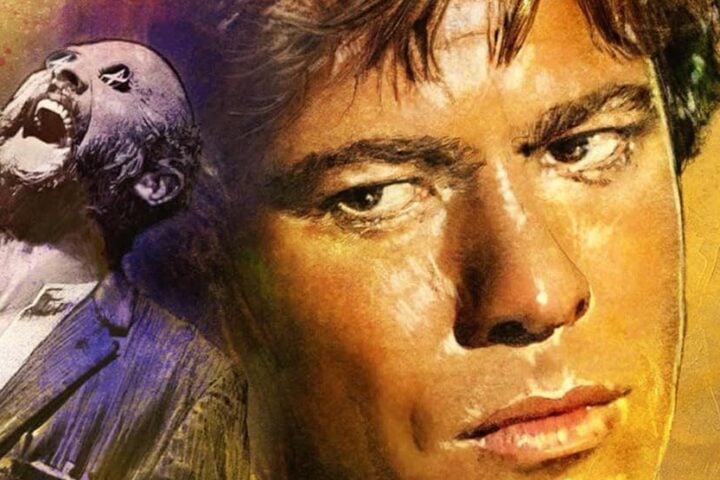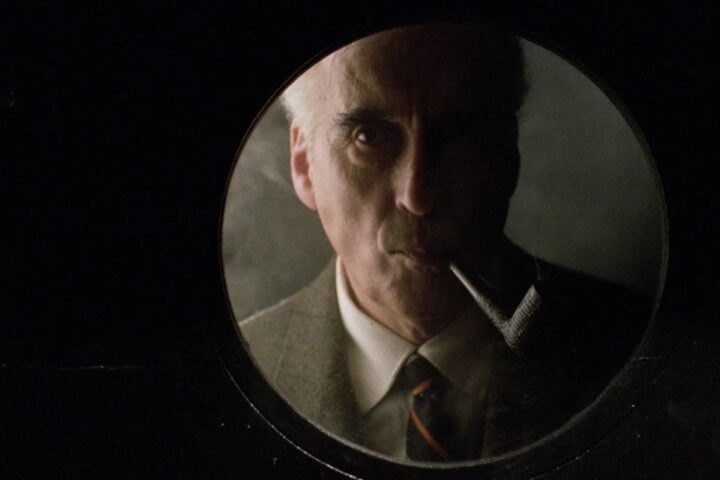
After competing for the Palm d’Or at Cannes in 1971, Wake in Fright’s distribution rights were snatched up by United Artists, which retitled it Outback and dumped it in a scant few North American cinemas. Even in its native Australia, the film acquired a reputation as something of a lost classic, due to its longstanding unavailability on the home-video market. Gussied up from the original negative, which was found in 2004 in a Pittsburgh storage facility, the subsequent remastering and rerelease of this early Ted Kotcheff feature marked a key moment in the history of the cinema of masculine brutality.
The film opens in a sun-bleached schoolhouse in the Australian Outback, where John Grant (Gary Bond) waits out the final minutes on the last day before the Christmas holiday. A cultured, accredited intellectual from Sydney, he stews under his deadening provincial tenure, his backwater posting the result of a financial bond he signed with the school board. Returning to Sydney to visit his girlfriend, whose existence becomes increasingly unlikely as the film progresses, John is waylaid overnight in a blue-collar mining town called Bundanyabba (more commonly known as the Yabba).
A cheery, beer-swilling policeman, Jock (Chips Rafferty, a character actor once called “the living symbol of typical Australian,” playing wildly against type), introduces John to the local’s backroom gambling fixation: two-up, in which bettors wager on how two tossed coins will land. Seeing a way to buy his way out of his teaching bond, John puts his travel money on the line and ends up flat broke, stuck in the Yabba, living off the hounding hospitality of the locals.
In the Yabba, basic friendliness and do-unto-others cordiality masks a deeper hostility. As John moves around between lodgings, coasting on the accommodations and gratis suds offered by the Yabbanese natives, his confinement acquires a suffocating existential dimension. Repeatedly, locals force bubbling cans of beer in John’s hands, which he grudgingly puts down so as not to affront anyone’s generosity and to beat the oppressive heat. When he sneaks off from the undying bacchanal for a tryst with a flirtatious local, he immediately begins vomiting.
Busted and with no real alternative, John timidly immerses himself in the Yabba’s devil-may-care lifestyle, swayed by the rowdy locals and the persistent flow of booze. As John’s situation devolves, Wake in Fright begins to feel like it’s operating under the influence of about six king-sized Fosters. John’s foggy decision-making culminates in a ghastly midnight kangaroo-killing spree, unfolding like a horrifying reversion of Warner Bros. Hippety Hopper cartoons, a gory slaughtering of Australia’s national animal.
A decade later, in First Blood, Kotcheff delivered a vision of a burly, shell-shocked Vietnam War veteran (Sylvester Stallone’s John Rambo) reinserting himself into nature, surviving off the land as he evades capture through the dense timberlands of the American Pacific Northwest. Wake in Fright’s vision is decidedly bleaker. The film’s vision of masculine self-sufficiency is built around—and on, via Australia’s own bloody colonial history—an elemental violence. Here, an evening boozing session descends into a violent Greco-Roman brawl, property is capriciously trashed, male-bonding slopes into bullying homoeroticism. Kotcheff’s film may seem similar to Deliverance or Straw Dogs in its white-knuckle lensing of masculinity under backwater duress, but there’s a boozy Buñuelian surrealism draping the proceedings.
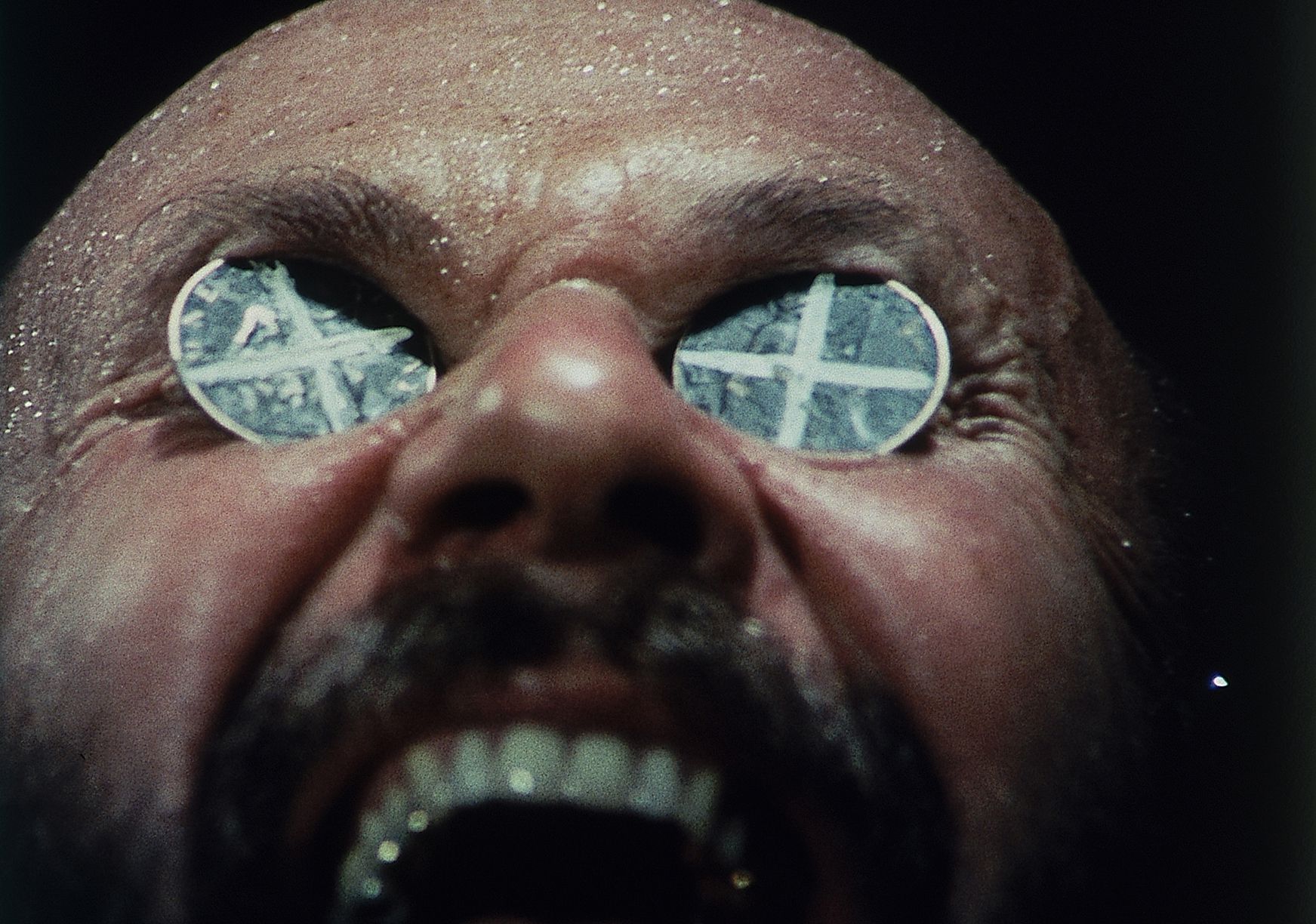
The key figure here is Donald Pleasence’s Clarence F. “Doc” Tydon, who abandoned his life in the city for what he sees as the more primal existence of life in the Yabba, where socially stigmatized alcoholism could pass unnoticed. Scraggly and shirtless, Tydon listens to opera records in his rough-hewn shanty house, maintaining his connection with the fineries of the society he deserted. (“She just opens her mouth and the notes come flowing out,” he says of the singer on the record, ascribing a vulgar, elemental dimension to culture.)

Tydon’s complex characterization provides a magnetism absent in films like Deliverance and Straw Dogs. Tydon’s savagery is self-ennobled: a conscientious, willful abandonment of the rhythms and rigors of civilization. And despite himself, John falls under the shit-faced spell of this anti-Livingstone, with Kotcheff and screenwriter Evan Jones developing the good doctor as equally seductive and repugnant—a vile Mephistophelean model tempting John’s aspiring culture vulture not with the eye-openers of divinity, but the base gratifications of earth. Under Tydon’s heckling thrall, John’s ability to escape the Yabba and return to Sydney and his probably-nonexistent girlfriend, who’s seen only in a battered black-and-white photo and series of idealized flashbacks, emerging from the ocean like some goddess, becomes seriously jeopardized. John’s crisis of the will manifests itself as a crisis of physical confinement.
It feels as if John physically can’t leave the Yabba. As in Luis Buñuel’s The Exterminating Angel and Roman Polanski’s Carnage, the terms of this entrapment seem to stem from an inherited sense of civility. Like a thoroughly conditioned commonwealth subject, John dreams of making off to England to work as a journalist, and his blasé, holier-than-thou air immediately distinguishes him upon his arrival in the Yabba. This heritage of courteousness, of not wanting to offend, is built to disintegrate, baring a truer, even more deep-rooted, legacy of brutality.
Watching these men sweat through their shirts, it’s a wonder why they’re wearing clothes at all. Given the at once raw and intricate pointedness of Wake in Fright’s critique (of barbarism, civility, masculinity, the entanglements knotting up the three), it’s little surprise that the film slipped through the cultural cracks, surviving by word of mouth and bootlegs as something forsaken: Some realities are too difficult to tackle head-on. The kangaroo hunt’s no picnic either.
Since 2001, we've brought you uncompromising, candid takes on the world of film, music, television, video games, theater, and more. Independently owned and operated publications like Slant have been hit hard in recent years, but we’re committed to keeping our content free and accessible—meaning no paywalls or fees.
If you like what we do, please consider subscribing to our Patreon or making a donation.