

The Black Emanuelle films aren’t really a series in the proper sense of the word. True, they all star Indonesian-Dutch actress Laura Gemser, and she usually plays a globetrotting photojournalist called Emanuelle. (The single “m” in her name was used to avoid infringing on the copyright of Just Jaeckin’s 1974 softcore sensation Emmanuelle starring Sylvia Kristel.) But there’s no notion of continuity between installments (often the product of different teams of writers and directors), and, even though a core group of actors does turn up time and again, they always play different, unrelated characters. What unites these films, apart from Gemser’s presence, is their dedication to exploring sexuality in a frank and uninhibited manner.
Severin’s new box set, The Sensual World of Black Emanuelle, brings together all 21 of the Laura Gemser films, most of them newly restored from 2K scans of the original materials, as well as several adjacent titles featuring cult actress Ajita Wilson. Severin also offers an exhaustive array of extras, including commentary tracks, video essays, on-camera interviews, and alternate cuts. Of special note are the feature-length documentary Inferno Rosso: Joe D’Amato on the Road to Excess, two soundtrack CDs, and the hefty Black Emanuelle Bible, a gorgeously designed and copiously illustrated 356-page tome that contains thematically oriented essays, a long interview with Gemser from 1996, and capsule reviews of all the films.
As its title should indicate, Bitto Alberti’s Black Emanuelle, from 1975, sets the template for the series. Emanuelle travels to Nairobi, Kenya, at the invitation of a diplomatic couple, Gianni Danieli (Angelo Infanti) and Ann (Karin Schubert), to do a story about the local color. Along the way, Emanuelle goes on a camera safari, participates in a drug-fueled ritual of dubious authenticity, and incidentally beds both Gianni and Ann. The film is unusual in that it’s the only one to actually identify Emanuelle as Black, however cursorily, when, in an early scene, she’s mistaken for a native by a fellow airline passenger. In later films, she’s fleetingly referred to as either “Asian” or “Oriental,” which isn’t really very accurate either.
Though Black Emanuelle does take the time to point up the colonial fantasy of wanton fornication with the natives, as when Ann knocks off a quickie with her local mechanic, it’s otherwise content to let Emanuelle “pass” as a professional white woman in its social milieu. Mostly it wants to focus on her sexual agency, her refusal to let love or other conventionalities interfere with her own private agenda. That’s also the point of Joe D’Amato’s 1976 follow-up, Emanuelle in Bangkok, where Emanuelle’s vagabond libertinage ends up causing heartbreak for inexperienced, impressionable young Debbie (Debra Berger).
Emanuelle in Bangkok is the first of five Black Emanuelle films that D’Amato made between 1976 and 1978, and it’s by far the most restrained, though certain scenes tend to indicate the shape of things to come, in particular a repugnant gang rape and a caged death match between a cobra and a mongoose (which is clearly unsimulated). Conversely, D’Amato’s Emanuelle in America, from 1977, is easily his most notorious, with Emanuelle investigating a zodiacally themed harem, a sex club for wealthy women, and a snuff film ring. Once again, the most extreme material here is entirely unfaked: a well-attended orgy replete with hardcore penetration and the truly disturbing sight of a woman jacking off a horse.
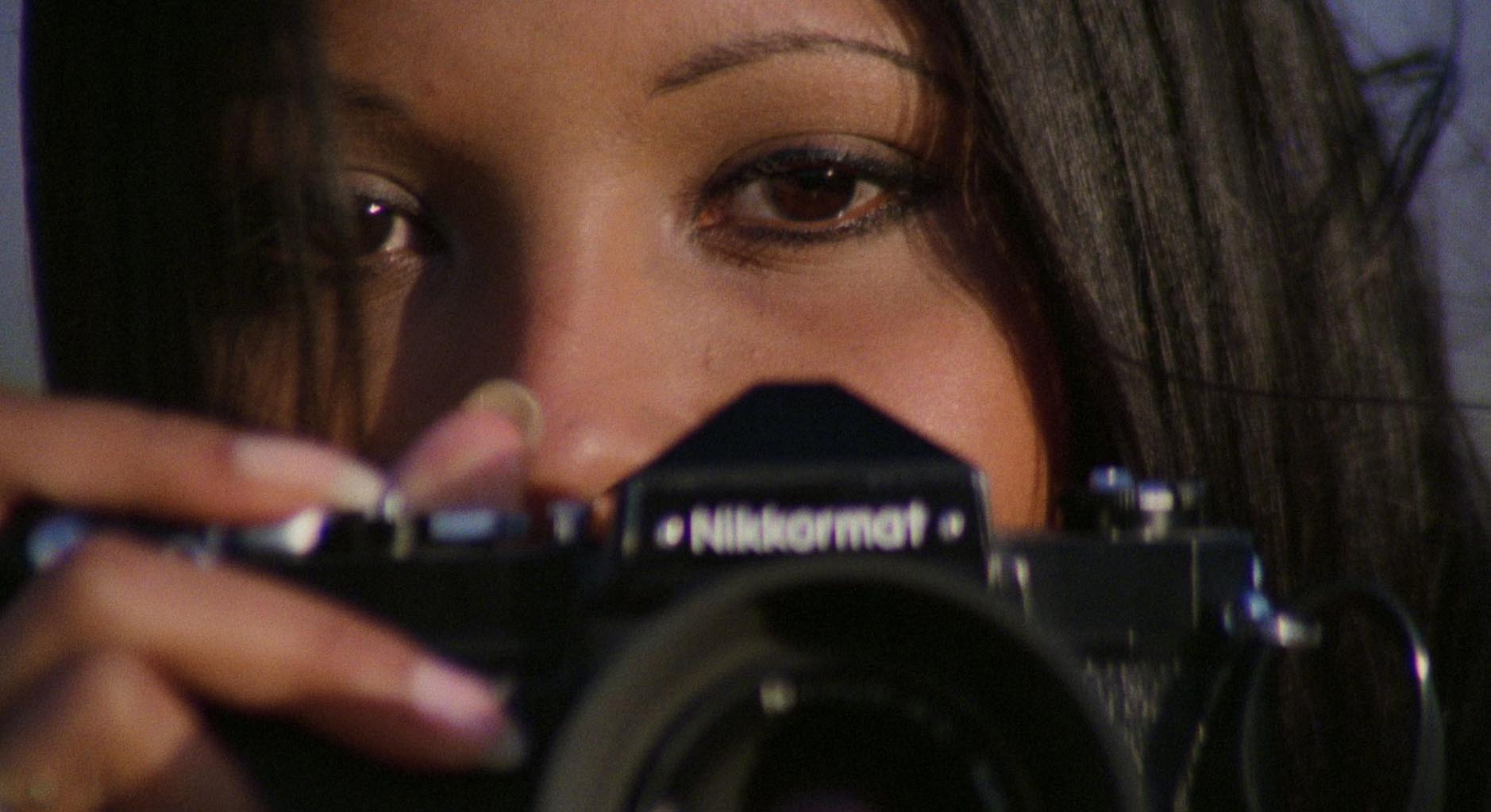
Emanuelle in America makes perfectly explicit a notion that runs through all the Black Emanuelle films: that Emanuelle’s compulsive picture-taking, whether using a fancy Nikkormat or one of her handy spy cameras, is rooted in her taste for voyeurism. You’d need a tally counter to keep track of how many times we see her peering through windows or half-open doors in these films. Her kink thus stands in for our own desire to watch whatever lashings of sex and violence D’Amato and his confreres might dole out. But then Emanuelle in America complicates matters by having Emanuelle come across something she doesn’t want to watch: a snuff film.
These apocryphal “documentaries” loomed large in the public consciousness at the time, especially after the 1976 release of Michael Findlay’s spurious but aptly titled Snuff. Emanuelle’s horrific discovery galvanizes her political engagement, and she proceeds to seduce a senator (Roger Browne) who’s involved in their production. Amusingly, every corrupt politico in these films is explicitly branded Republican, an association likely stemming from the recent Watergate scandal. In a nod to the pessimism and cynicism of the times, her exposé is promptly squashed “from above.” Emanuelle in America’s coda turns ironic when a film crew descends upon the tropical paradise where Emanuelle and her boyfriend, Bill (Riccardo Salvino), have sought a getaway from the travails of modern civilization.
The original Italian title of D’Amato’s next film, Emanuelle Around the World, also from 1977, translates as Why Violence Against Women?—and it continues Emanuelle’s political education in distinctly D’Amato fashion. After debunking a sex guru (George Eastman) in India, she heads to Hong Kong to expose human traffickers. The film contains no fewer than four rape scenes, including one involving (thankfully simulated) bestiality that plays out in an overblown Sax Rohmer fashion that’s almost risible. But the others are definitely no laughing matter, and the last is especially grim. At least in this case, the authorities are there to restore order, even if the well-heeled bigwigs most responsible for instigating the rape get away scot-free.
D’Amato’s Emanuelle and the Last Cannibals, also from 1977, continues the frenzy for flesh-eating unleashed by Ruggero Deodato’s Jungle Holocaust from earlier that year. It’s interesting to speculate whether D’Amato’s use of faked cannibal footage in this film had any influence on Deodato’s Cannibal Holocaust, which based its entire story on the recovery of “documentary” material shot by a lost expedition into the Amazon. After witnessing an act of anthropophagous brutality in a Manhattan psychiatric ward, Emanuelle teams up with Professor Mark Lester (Gabriele Tinti) to investigate the cannibal Apiacá tribe of Brazil. This is a serious step down from earlier films in terms of production values, shot almost entirely around a lake outside Rome, but it’s most notable for some truly gruesome special effects.
D’Amato’s final contribution, Emanuelle and the White Slave Trade, from 1978, is something of a diminishing returns retread, revisiting both a previous location (Kenya) and an earlier hot-button topic (indicated by the title) with precious little new to show or say in the matter. There’s an attempt at historicity by bringing in the notorious 1960s proprietress Madame Claude (Gota Gobert), who exclusively caters to dignitaries and bureaucrats. Easily the most interesting figure here is Stefan (Nicola D’Eramo), Madame Claude’s trans majordomo, who’s afforded a measure of dignity that’s surprising within the world of these often homophobic films, even if the character ultimately finds herself on the wrong end of a tenpin in a bizarre bowling alley brawl.
A fascinating one-off among the Black Emanuelle films, Giuseppe Vari’s Sister Emanuelle, also from 1977, taps into the subgenre of nunsploitation films unleashed by the controversy surrounding Ken Russell’s The Devils. Vari’s film finds Emanuelle cloistered in a convent school where she hopes to atone for her sexually liberated lifestyle, until she’s undone by the arrival of a young temptress (Mónica Zanchi) determined to thwart all authority. The “it was all a dream” ending actually works here as an expression of Emanuelle’s unconquerable id, which ultimately triumphs over the repressive injunctions of the Catholic Church.
The Black Emanuelle field laid fallow for several years until Bruno Mattei took up the mantle, churning out two gritty, grimy women-in-prison films. Violence in a Women’s Prison, from 1982, has Emanuelle going undercover at the behest of Amnesty International to expose institutional corruption, while Emanuelle in Prison, from the subsequent year, is an even more sadistic exercise that features a quartet of criminals breaking into prison. Both films nod toward social commentary along the way, but mostly they’re an excuse for Mattei to wallow in excessive acts of sex and violence, which provides, along with all the other Black Emanuelle films, irresistible manna from heaven for fans of so-called Euro-sleaze cinema.
The Sensual World of Black Emanuelle is available now from Severin Films.
Since 2001, we've brought you uncompromising, candid takes on the world of film, music, television, video games, theater, and more. Independently owned and operated publications like Slant have been hit hard in recent years, but we’re committed to keeping our content free and accessible—meaning no paywalls or fees.
If you like what we do, please consider subscribing to our Patreon or making a donation.