A young woman sits on the beach in Orkney, the sea stretching out endlessly in front of her, a pair of headphones strapped to her ears, blaring electronic beats. We see this image repeated a couple of times in Nora Fingscheidt’s The Outrun and, in many ways, it represents the whole of the film—a conflict between the new and the old, the noise and motion of the modern world and space and stillness of the old. And then there’s the woman caught between these two converging currents, trying not to be pulled apart by them.
Rona (Saoirse Ronan) is a recovering alcoholic who’s returned to her familial home in Orkney after spinning out of control as a biology student in London. The story flows seamlessly back and forth between this newly sober chapter of her life and flashes of her time in London. At first, it can be difficult to tell exactly where we are in the story. Rona provides a voiceover narration at times, but this is usually dedicated to explanations of Orkney’s natural phenomena, like its tides and its winds, or other biological facts, like the precise effects of alcohol on the human brain.
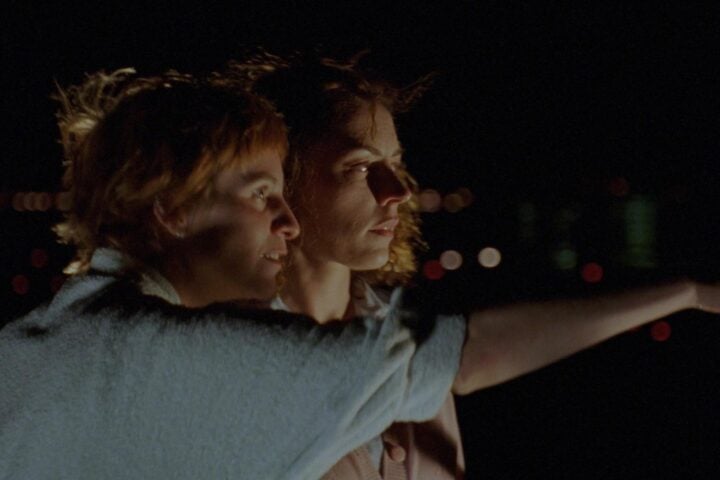
Quickly though, Rona’s hair becomes a way of finding your bearings in The Outrun’s narrative. In her university days, when the young woman parties with her boyfriend, Daynin (Paapa Essiedu), and best friend, Gloria (Izuka Hoyle), Rona’s hair is an electric blue. Back on Orkney, though, only the very tips of her hair indicate the life that she used to lead.
The way Fingscheidt captures two modes of life is one of The Outrun’s greatest strengths, as it doesn’t put them in simple opposition to one another. There are scenes of ecstatic joy where Rona loses herself in the pounding music and thrashing crowd of a club, submerging herself in life and love. And there are times when she loses control, and these parties turn to bedlam. There are times when Orkney is an idyllic retreat, blessed with a tranquility that soothes Rona’s soul. And there are times when the space and quiet is so suffocating that she seems to be using her headphones and the electronic beats emanating from them as a protective shield.
Fingscheidt and cinematographer Yunus Roy Imer beautifully capture the quiet and the loud parts of Rona’s story. Slow, still shots show the harmonious moments of Rona’s life in London as she dances with her friends or goes swimming with Daynin, the two of them wearing nothing but balaclavas, the light glittering just perfectly on the water’s surface. And, when things go wrong, the camera lurches and tumbles, matching Rona’s increasingly frantic state.

The Outrun is especially adept at capturing the controlled chaos of student experience—how the nightlife can be such a happy whirlpool of loud music, big smiles, and beautifully bad decisions. But also how easily—for those prone to addiction, or who have simply lost other footholds in the world—those alcohol-fueled nights can become a vortex, swallowing them whole.
The film invites us to be alert to such natural metaphors, as it thrums with them. In a flashback to even earlier days, we watch along with Rona as her father, Andrew (Stephen Dillane), shatters the windows to their home in the midst of a bipolar episode, allowing Orkney’s gale-force winds to come howling through their living room. There’s no escaping the comparison: Both he and the wind are erratic forces of nature, ever-present in Rona’s life as a soothing presence that can suddenly whip itself up out of nowhere and throw her world into disarray.
With The Outrun’s neat but poignant metaphor work in mind, mental illness and addiction are understood as natural responses to the conditions of a ravaged life. Throughout, we watch Rona try to slowly piece herself back together from the wreckage of her life, and the film’s nonlinear structure effectively conveys the tribulations of this process—the various parts of Rona’s life and the various versions of herself all washing over one another like rolling waves.
As Rona, Ronan delivers a performance that’s rawer and rougher at the edges than perhaps anything else the actor has done to date, while still retaining that twinkling charisma and elven charm of a figure drawn straight from Scottish folklore. She thrills us with the captivating person that Rona can be, then buries her beneath layers of pain, leaving us with a stinging and truthful sense of how a person can come to feel adrift from their sense of place and purpose.
Since 2001, we've brought you uncompromising, candid takes on the world of film, music, television, video games, theater, and more. Independently owned and operated publications like Slant have been hit hard in recent years, but we’re committed to keeping our content free and accessible—meaning no paywalls or fees.
If you like what we do, please consider subscribing to our Patreon or making a donation.