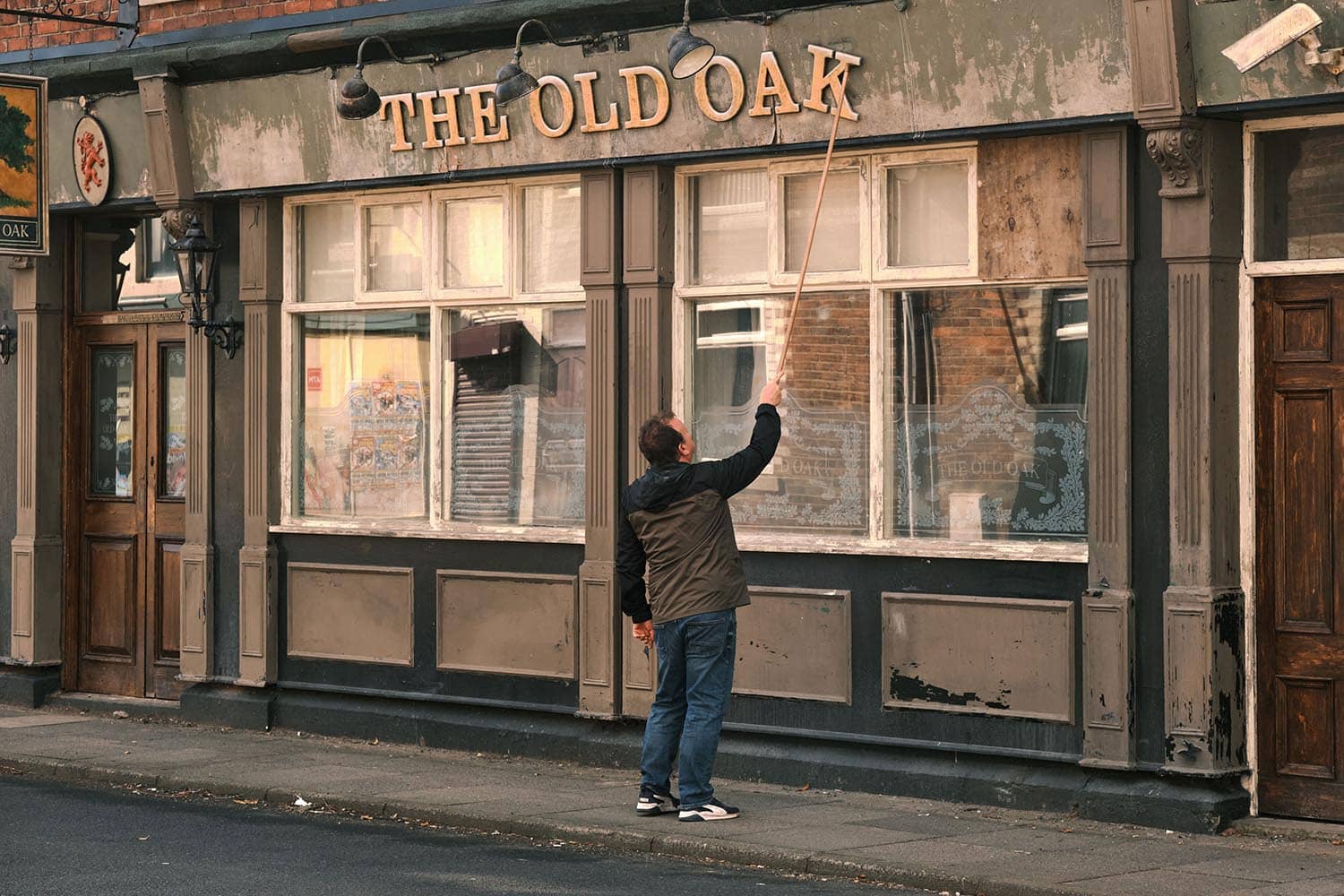
Ken Loach has said that The Old Oak will be his final film, and, in its humble way, it represents a good stopping point for the iconoclastic British filmmaker. The film isn’t some self-consciously summarizing coda but the latest in a long line of intimately scaled looks at the myriad ills facing Britain’s working class. Set, like many of Loach’s films, in the country’s post-industrial northern region, The Old Oak is alive to the decline that’s reduced a once booming mining town to a place with a decimated economy. But it also adds a crucial update to Loach’s long-running survey of domestic strife by incorporating the growing migration from the Middle East and the racial and nationalist tensions that have arisen from it.
The film opens with locals openly airing their scorn at a bus of Syrian refugees as one of the transplants, Yara (Ebla Mari), takes photos of her new surroundings. Of the cluster of people who vituperatively “greet” their new residents, only one man, TJ (Dave Turner), treats the refugees with any politeness. From the outset, TJ cuts a humble profile: a soft-spoken man who’s too young to retire but old enough that he’s started to mark time by the friends and loved ones who’ve passed away. Though he operates a pub that seems like one of the town’s last remaining storefronts, he exists in the same economic precarity as everyone else. When at work, TJ spends most of his time at work gazing around the typically empty room with a faint look of wistfulness as if he never knows which day will be his last before the creditors come.
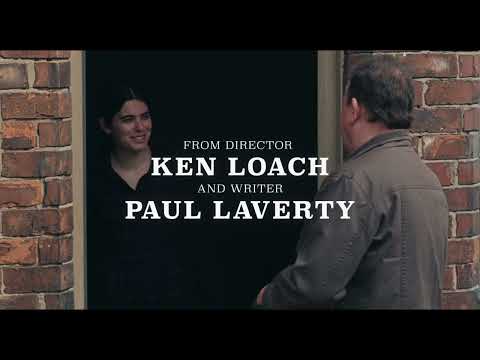
In sharp contrast to his few loyal patrons, who are all too eager to air their misery over their dire straits, TJ exudes a shy affability that the film connects to his enduring grasp of class politics. Having cut his teeth on socially conscious teleplays for the BBC in the 1960s, Loach has long treated characters as polemical mouthpieces for his ideas, an approach that’s only deepened across the films he’s collaborated with writer Paul Laverty on since 1995’s Land and Freedom.
Unsurprisingly, then, Laverty’s screenplay leaves little room to mistake where his and Loach’s social loyalties lie. As TJ strikes up a friendship with Yara, the pair often talk in stagey ways about their lives, be it Yara elaborating on ISIS destroying her home or TJ frequently discussing worker solidarity. When TJ shows Yara photos he has of the town’s long history of labor struggles, she remarks that the miners of previous generations look strong in their unified front. Later, she marvels at an elegant, Gothic cathedral that has stood in town since the Norman era, and TJ bluntly tells her that his father used to say that the building didn’t belong to the church but to the workers who constructed it. This kind of declamatory dialogue has long been a facet of Loach’s cinema, and it has understandably courted as much scorn as praise.
As far back as his 1969 theatrical debut, Kes, Loach has respected the idiosyncrasies of Britain and Ireland’s local dialects and accents, especially the north’s notorious drawl. The Old Oak, though, humorously pokes at the incomprehensible Pitmatic mumbles of some of the most xenophobic townspeople, pitting their angry demands that the Syrians speak English against the fact that Yara often speaks far more clearly and eloquently than any of them.
There are also quietly poignant images of streets lined with single-family homes, many of them with for-sale signs in front, that attest to the state of England’s neglected regions and subtly point to why the town is now a site of refugee resettlement. Even if someone could find a buyer for one of these homes, one resident notes that property values have cratered thanks to faceless corporate developers buying up properties at giveaway costs and letting them go to ruin to take advantage of byzantine tax breaks. The latter is the most pointed element of The Old Oak’s commentary: There are indeed malignant foreign forces draining the town of resources, but those forces are multinational investors and not impoverished refugees.
The film lets such larger observations about the sheer scale of exploitation at work on this community hang over the conflict while remaining firmly within the narrower perspective of its characters, even the most educated of whom cannot lift the suffocating weight of history and globalism off their shoulders to see much further than the immediate miseries facing them. And if Loach is still prone to making his political views impossible to misconstrue, he also knows how to keep his dramas from spiraling too far outside of plausibility.
The Old Oak’s second half introduces a potentially trite avenue toward community reconciliation in the form of regular meetings and food kitchens held at TJ’s pub, only to emphasize the precarity of such gestures. Fundamentally, communities that have already been economically devastated cannot resuscitate themselves no matter how admirable their devotion to mutual aid, and the ease with which a noble idea can fall apart without material support by the state makes Yara’s plan little more than a temporary patch on a deeper wound.
It’s fitting that Loach would end a career of decades-long engagement with political issues by finally turning to the migrant crisis that other socially conscious European filmmakers like the Dardenne brothers and Aki Kaurismäki have tackled for years. To be sure, the depiction of Yara and TJ’s relationship is scarcely as thorny as the one between the main characters in Kaurismäki’s The Other Side of Hope and Le Havre. Both Yara and TJ are morally upstanding, virtuous figures whose generosity never wavers even in the face of prejudice and shunning.
Still, The Old Oak, like the best of Loach’s work, isn’t so much a sermon as it is a plea: a depiction of people attempting to carve dignity out of undignified living that asks the viewer to see how, say, the scion of northern miners and a displaced Syrian woman are united in a shared struggle. As TJ says at one point when selling Yara’s idea of the food kitchen to locals, “this isn’t charity, it’s solidarity,” and it’s only by seeking connections with others at the bottom that the dispossessed can reclaim all that the last few decades have taken from them.
Since 2001, we've brought you uncompromising, candid takes on the world of film, music, television, video games, theater, and more. Independently owned and operated publications like Slant have been hit hard in recent years, but we’re committed to keeping our content free and accessible—meaning no paywalls or fees.
If you like what we do, please consider subscribing to our Patreon or making a donation.