

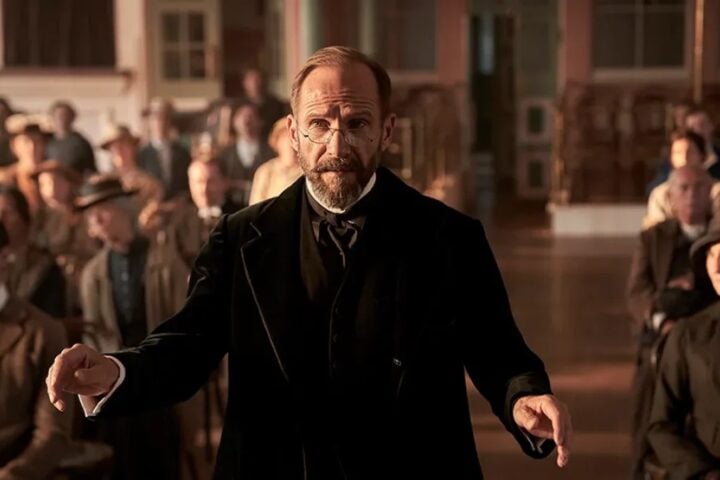
Early in Matthew Vaughn’s The King’s Man, young Conrad Oxford (Alexander Shaw) is told by his mother (Alexandra Maria Lara), a Red Cross volunteer, that he should always help others in times of crisis. Conrad’s pacifist father, Orlando (Ralph Fiennes), later admits that their ancestors were “horrible people,” seeming to further signal a conscious attempt on the part of the Kingsman series to pivot away from the reactionary tendency of the first two films to view England’s violent, imperialist past through rose-tinted glasses.
Alas, the xenophobic subtext of the prior films in the series soon rises to the surface in The King’s Man, which is set a century earlier than its predecessors. The film opens with a prologue that details the genesis of the Kingsman group, a secret service operating outside the purview of the British government. Ten years later, World War I has begun and Conrad (now played by Harris Dickinson) is itching to defy his father by joining the British Army. Where Orlando’s pacifism is initially seen as an extension of his presenting as a true gentleman, a “mark of honor” in his words, The King’s Man quickly shifts perspectives, seeing him as increasingly overprotective of his son and thus weak in a time when bravery is in high demand.
Orlando, of course, is soon revealed to be a Kingsman, and as such fighting for his homeland in his own way. It’s telling, though, that the filmmakers see the man’s desire to protect Conrad as problematic not because he uses his class privilege to try to keep his son out of harm’s way, but because his anti-war sentiments run counter to the supposed good of the British Empire.
As for the Brits, their leader, the stately King George V (Tom Hollander), stands in stark contrast to Germany’s Kaiser Wilhelm II and Russia’s Czar Nicholas II, both of whom are also played by Hollander, but with a distinctly more buffoonish, evil demeanor. In The King’s Man, England is at war solely for the benefit of the world, while Germany and Russia are operating under the control of a shadowy cabal hellbent on bringing England to its knees. And in a bafflingly tone-deaf move, the ruthless villain at the head of all things, lurking in the shadows until the film’s end, is a Scotsman who’s tired of the English oppressing his homeland.
The King’s Man’s uniformly sees the British as highly civilized, reasonable, and humane, while the rest of the world’s leaders are painted in a derisive light. They’re either ruled by clowns—U.S. President Woodrow Wilson (Ian Kelly) is blackmailed after being filmed getting a blowjob—or psychopathic, mystical madmen, like the seething Grigori Rasputin (Rhys Ifans), who “fucks like tigers,” or the monocled lunatic Erik Jan Hanussen (Daniel Brühl).
Were the filmmakers making a full-on historical parody, the cartoonishly unflattering depictions of everyone in power outside of England would feel more palatable. But they’re merely cogs in the machinery of his hyperviolent brand of jingoistic action, whose disparities between heroes and villains are outdone only by its disorienting shifts in tone. In one particularly egregious stretch, a comical fight between Rasputin and Orlando, set to the Russian folk song “Kalinka,” is followed immediately by a dire, brutally realistic scene where Conrad performs a heroic act in No Man’s Land that may turn the tide in the war.
The tonal clashes are enough to give you whiplash, as are the film’s swings from the snide to the sincere. But this is all part and parcel of this series’s worldview, which revels in the nobility of war, while supporting that notion by presenting a parade of barbaric tyrants and scoundrels that only the Brits can defeat on their way to restoring civility to the world. The King’s Man’s failure to even acknowledge Scottish grievances toward England, along with its propping up the aristocracy as protectors of the lower class (who form an underground group of domestic workers to perform much of the dirty work), is all in service of a regressive, distorted portrait of England as the moral compass (and police) of the world. It’s so caught up in its own idea of national exceptionalism that its tagline might as well be Make England Great Again.
Since 2001, we've brought you uncompromising, candid takes on the world of film, music, television, video games, theater, and more. Independently owned and operated publications like Slant have been hit hard in recent years, but we’re committed to keeping our content free and accessible—meaning no paywalls or fees.
If you like what we do, please consider subscribing to our Patreon or making a donation.



I can’t be bothered pulling this review apart, but I have to draw attention to the funniest part – when the author jumps to the defence of the Kaiser, a militaristic warmonger who we’d nowadays call far right (just ask Germans what the think of him). It’s taking that classic lefty self-hatred to whole new levels – and I love it!