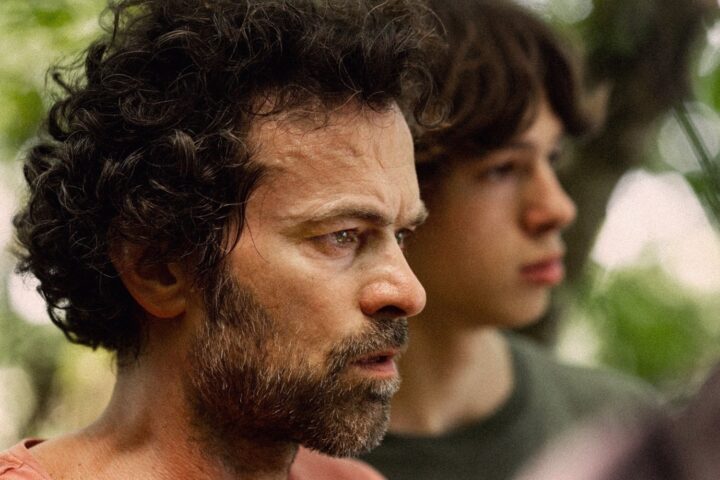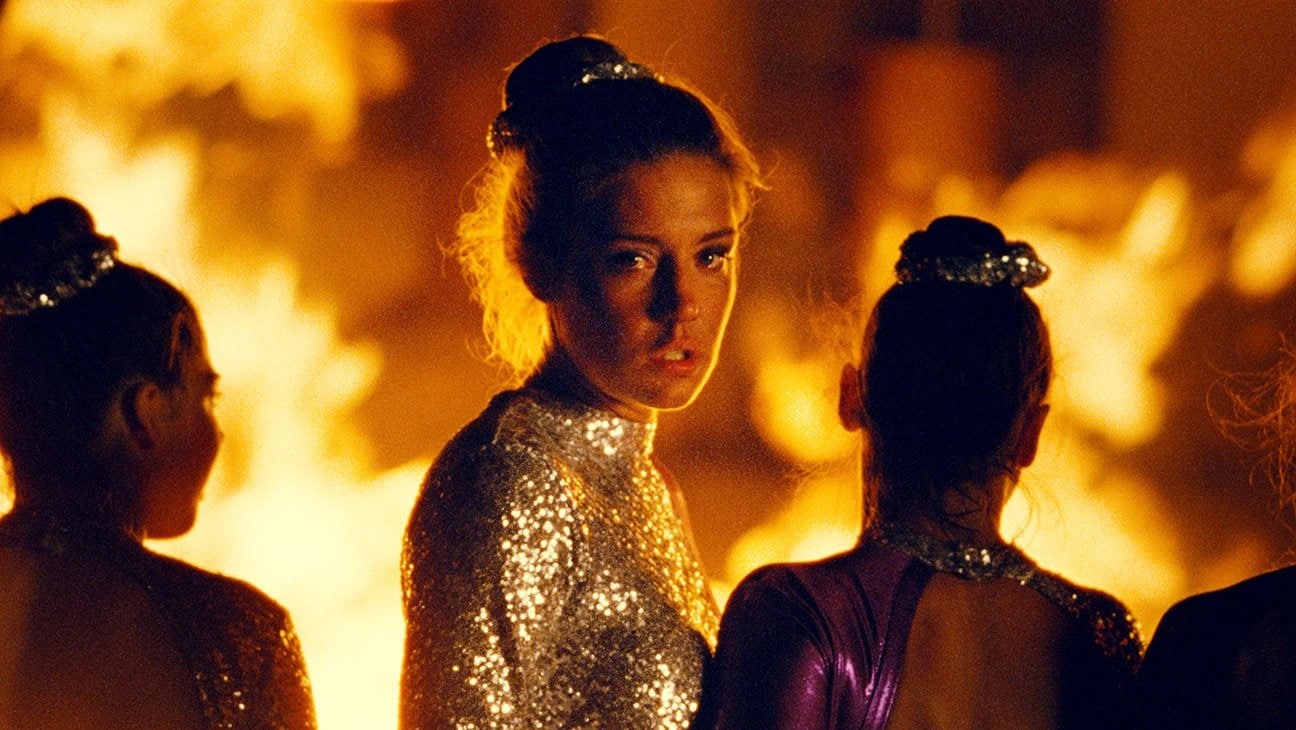
Léa Mysius’s sophomore feature, The Five Devils, feels like the work of a much more seasoned filmmaker. The film exudes an exquisite command of atmosphere and aesthetic language beginning with its moody opening images of a rural village’s community pool and a nearby alpine lake linked by the use of blue color grading. The cool tone undercuts the idyllic views of the countryside with a subtle eeriness that grows more pronounced as the film takes us deeper into the lives of twentysomething swim instructor Joanne (Adèle Exarchopoulos) and her biracial daughter, Vicky (Sally Dramé), who have a loving, if somewhat distant, relationship.
Joanne isn’t a single mother, but it often feels like she is, as her firefighter husband, Jimmy (Moustapha Mbengue), is emotionally absent even when he’s physically present. The emotional distance between the spouses emanates between them like a feedback loop, so palpable that even the prepubescent Vicky recognizes the inevitability of the relationship’s collapse.
Mysius keeps most of The Five Devils firmly rooted in Vicky’s perspective, favoring quick insert shots from the girl’s low-vantage point of view of her parents arguing in other rooms or close-ups of the child being jostled as her white classmates harass her for being mixed race. But what begins as a tale of doomed marriage from the perspective of the child caught in the middle, a la Henry James’s What Maisie Knew, takes a turn when Jimmy’s sister, Julia (Swala Emati), arrives suddenly at their home after her release from a long prison sentence.
The uneasy, fragile calm that barely holds together Vicky’s family is immediately thrown into disarray by the eerie blankness of Julia’s soft speech and distant stares. Her paradoxically intense non-engagement with anyone around her only calls further attention to how desperately Vicky and her parents have been projecting their own façades of detachment.

Julia’s re-emergence into Joanne and Jimmy’s lives heightens an element of supernatural fantasy first hinted at with the revelation that Vicky can reproduce any scent of her choosing. Even more remarkably, certain odors allow the girl to experience other people’s memories as if they were her own. This allows The Five Devils to delve into flashbacks of the older characters’ lives without leaving Vicky’s perspective as the child roams her parents’ and aunt’s memories as a spectator. Over time, it is increasingly hinted that Vicky may actually come to exist within those memories, making her more akin to a time traveler than mere viewer.
Even without this fantastical element, the quagmire of past relationships dragged out of hidden depths would make The Five Devils, as written by Mysius and Paul Guilhaume, a thorny exploration of how individuals’ personal ordeals can quickly merge into an impenetrable thicket of irreparable relationships. As we learn more about what Julia once meant to both her brother and sister-in-law, so, too, are more people from around the village implicated in their melodrama, including Joanne’s burn-scarred co-worker Nadine (Daphné Patakia).
Guilhaume, who also shot the film, and Mysius constantly find parallels between the present and past in the form of recurring events and images. When Julia first appears on the scene, she sports a swollen eye from what she claims is a drunken fall, and her bruised face calls to mind an early glimpse at Nadine’s scarred face staring daggers at Vicky. Elsewhere, Vicky sees echoes of the racial abuse that she suffers from peers in the treatment afforded to a teenaged Julia when she first transfers to the film’s Alpine village and meets Joanne and her classmates.
This gives The Five Devils the claustrophobic feeling of a closed loop of trauma. Nonetheless, the film subtly reveals ways that this loop can be broken. Vicky’s destabilizing impact on what otherwise would be endless cycles of regret and harm points toward a possibility of a resolution that, if by no means conventionally happy, nonetheless reconciles the messy compromises that one makes in life in order to embrace rather than deny one’s feelings for others.
Since 2001, we've brought you uncompromising, candid takes on the world of film, music, television, video games, theater, and more. Independently owned and operated publications like Slant have been hit hard in recent years, but we’re committed to keeping our content free and accessible—meaning no paywalls or fees.
If you like what we do, please consider subscribing to our Patreon or making a donation.