

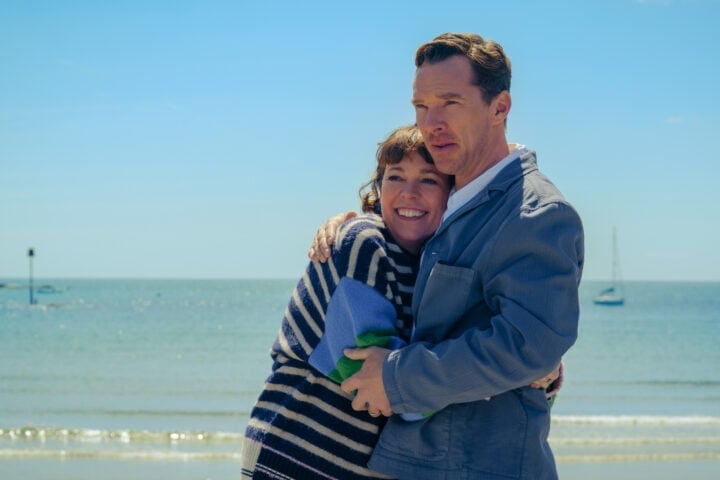
Will Sharpe’s The Electrical Life of Louis Wain is another biopic about a brilliant, misunderstood, psychologically addled Great Man starring Benedict Cumberbatch. Here the actor plays Louis Wain, the English artist who’s best known for his anthropomorphic paintings of cats. Wain was posthumously diagnosed with schizophrenia, signs of which the film whimsically, cloyingly believes to be at the root of his art.
Right out the gate, it feels as if the film is an excuse for Cumberbatch to lean on his vast arsenal of tics for his portrayal of Wain, which is evident in everything from the man’s struggle to make eye contact in conversation to his propensity to prattle on as if no one were in the same room as him. No less evident is the filmmakers’ belief that Wain was a walking scandal, functionally incapable of understanding, much less obeying, the strict Victorian codes of social propriety and etiquette. The latter is a particular liability for a man who comes from a noble family that long ago fell on hard times and whose place in high society is now tenuous.
Alienated from everyone, including and especially his younger sisters who view him as a social burden, Louis eventually finds a companion in the family’s new governess, Emily (Claire Foy). Emily is perhaps the most conspicuous standard-issue component of the film, familiar from countless biopics: the supportive woman with no life of her own, existing only to care for the tortured male genius. To steal from meme parlance, Emily teaches Louis that it’s okay to be weird, to embrace his foibles, and mutually they bond over a stray cat that they adopt at a time when the animals were mostly considered useful for catching rodents and unsuitable as pets.

Soon, cats become Louis’s muse and his anthropomorphic portrayals of the critters bring him much success, though his difficulties with interpersonal relationships leave him wide open for exploitation by publishers who finagle him out of royalties. Even more unfortunate, Louis and Emily’s relationship only lasts a few years before the latter falls ill and dies of cancer, leaving Louis unmoored just as he’d finally found a tether to the world outside his mind.
The second half of The Electrical Life of Louis Wain charts its main character’s slow, long mental breakdown in ways that tackily oscillate between the pitying and the whimsical. One scene visualizes an extended hallucination of drowning stemming from a broken sink that ends with Louis in his skivvies sobbing for his dead mother. Elsewhere, though, his obsessive fixation on cats and his belief in their supernatural nature is played mostly as charming and even relatable, suggesting that the film is very much appealing to our LOLcat times.
As Louis’s paintings become increasingly stranger, with their Fauvist palettes and patterned backgrounds, the film occasionally reflects his vision of the world in CG-enhanced, overlit fantasias that turn the real world into something overwhelming. But The Electrical Life of Louis Wain uncritically accepts that Wain actually did suffer from schizophrenia, perpetuating harmful stereotypes about mental illness even as its twee artistry seeks to destigmatize them. Sharpe’s film never illuminates the man, only whipping up visual gimmickery as if trying to meet Cumberbatch’s antic performance at its level, and its constant attempts at wry humor, almost all at Louis’s expense, only underline the fundamental thinness of the material.
Since 2001, we've brought you uncompromising, candid takes on the world of film, music, television, video games, theater, and more. Independently owned and operated publications like Slant have been hit hard in recent years, but we’re committed to keeping our content free and accessible—meaning no paywalls or fees.
If you like what we do, please consider subscribing to our Patreon or making a donation.


Autism spectrum and prism crystals…