Steven Soderbergh’s work is virtuosically expressive, and consistently so, but occasionally his focus on the craft of directing, cinematography, and editing comes at the expense of the big picture. For one, his recent Presence, a ghost story told from the camera-as-ghost’s point of view, was a technical marvel but practically frictionless on the level of storytelling. But with his new film, The Christophers, Soderbergh (again working in London, where he shot last year’s respectable Black Bag) delivers a less conspicuous directorial effort that, in turn, foregrounds the work of his collaborators, especially the screenplay by Ed Solomon, which defies expectations at every turn of its minutely calibrated plot.
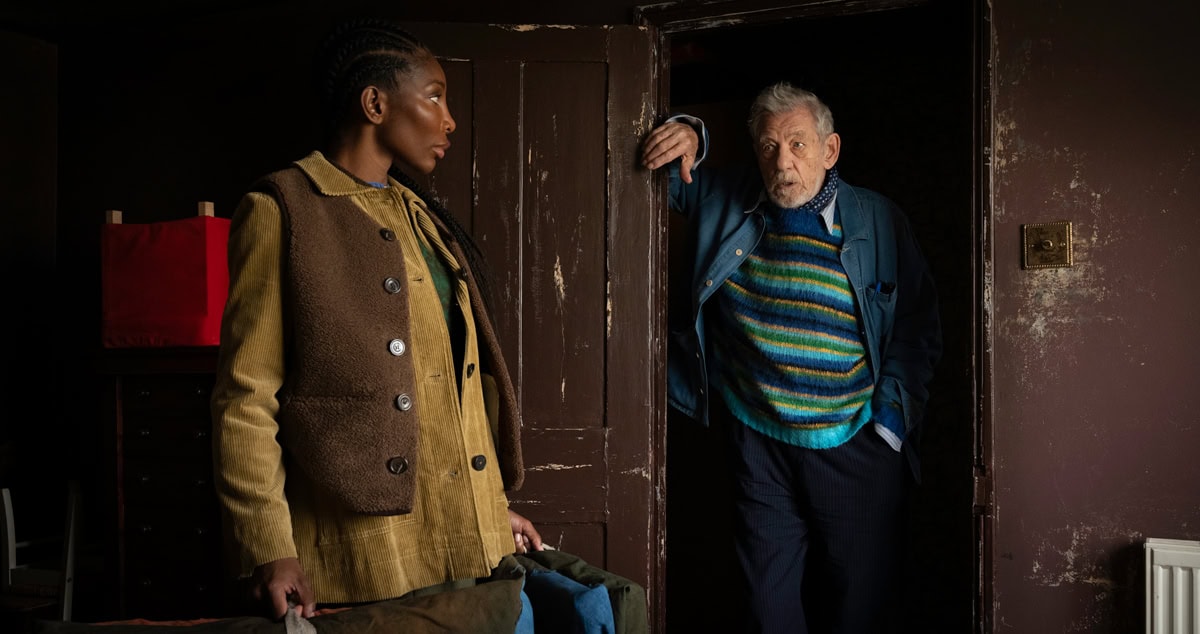
Ian McKellan plays Julian Sklar, an elderly, retired artist who’s as famous for his paintings as for his stint on a reality show, Art Fight, where he served as the art world’s Simon Cowell, mercilessly ridiculing young contestants’ creative work. These days, shut up inside his two adjoining townhouses, drinking and raging against his own faded relevance, he makes his living by recording 15-second birthday greetings and other videos commissioned by fans.
In a nice contrast to McKellan’s boozy bluster, Michaela Coel’s performance as art restorer (and sometimes forger) Lori Butler is more restrained and internalized. The Christophers is ultimately about their battle of wills, and the tentative bond that forms between these two characters separated by age, race, and class. The hard-won moments of mutual understanding they achieve feel authentic, with the script sidestepping the mawkish clichés that often plague such narratives. (There’s a moment where it seems as if Lori and Julian are about to start playfully flinging paint at each other, but the scene goes in a much different direction.)
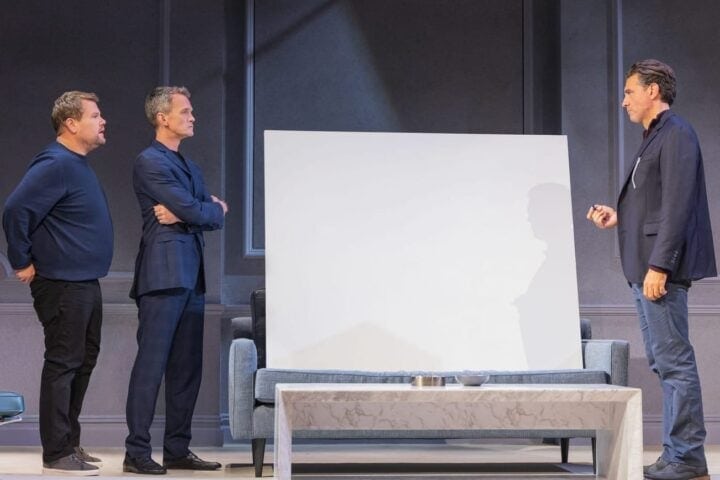
As the film opens, Lori is approached by Julian’s estranged children, Sallie (Jessica Gunning) and Barnaby (James Corden), who sense that their father is near death and propose a scheme to snatch a share of his legacy. Julian’s most acclaimed works are a series of paintings from the ’90s known as “The Christophers”—portraits of a lover that reflect the blossoming and eventual dissipation of their relationship. The final set of eight paintings in the series languishes, unfinished and unseen, in Julian’s locked storage room.
Sallie and Barnaby persuade Lori to take a position as their father’s assistant, sneak up to his storage room, and finish the paintings in the “Christophers” series so that they can be “discovered” and then sold after the old man shuffles off. Lori successfully secures the job, but when Julian tasks her with destroying the sought-after canvases, she devises a plan worthy of Danny Ocean himself to preserve them while convincing Julian that she’s followed orders.
Lori soon finds she has more in common with Julian than with the greedy offspring he justifiably despises, and they form a tentative alliance. Sallie and Barnaby, as written, are cartoonishly greedy, but Gunning and Corden have great fun in their roles as the dimwitted scoundrels who find their plans frustrated when Lori fibs that she’s shredded the paintings.
There are signatures that mark this as a Soderbergh production, from the reliance on natural light sources (the warm glow of a table lamp, the harsh glare of a ring light) and the cool blue of nighttime exteriors to the dreamy Fender Rhodes-aided score by frequent collaborator David Holmes. And there’s no question that Soderbergh can make just about anything cinematically compelling—that much was proven 30 years ago when he turned Spalding Gray’s man-at-a-desk performance piece Gray’s Anatomy into a wondrous spectacle of visual invention.
But, as a director who doesn’t write, Soderbergh is at the mercy of the material he chooses, and Solomon has come through with a fine script that brims with hilarious dialogue, lightly satirical observations of a culture that treats art as a commodity, and satisfying payoffs to a number of story elements planted early on. For such a dialogue-heavy film mostly centered on just two characters, The Christophers feels as rich and expansive as anything Soderbergh has ever done.
Since 2001, we've brought you uncompromising, candid takes on the world of film, music, television, video games, theater, and more. Independently owned and operated publications like Slant have been hit hard in recent years, but we’re committed to keeping our content free and accessible—meaning no paywalls or fees.
If you like what we do, please consider subscribing to our Patreon or making a donation.