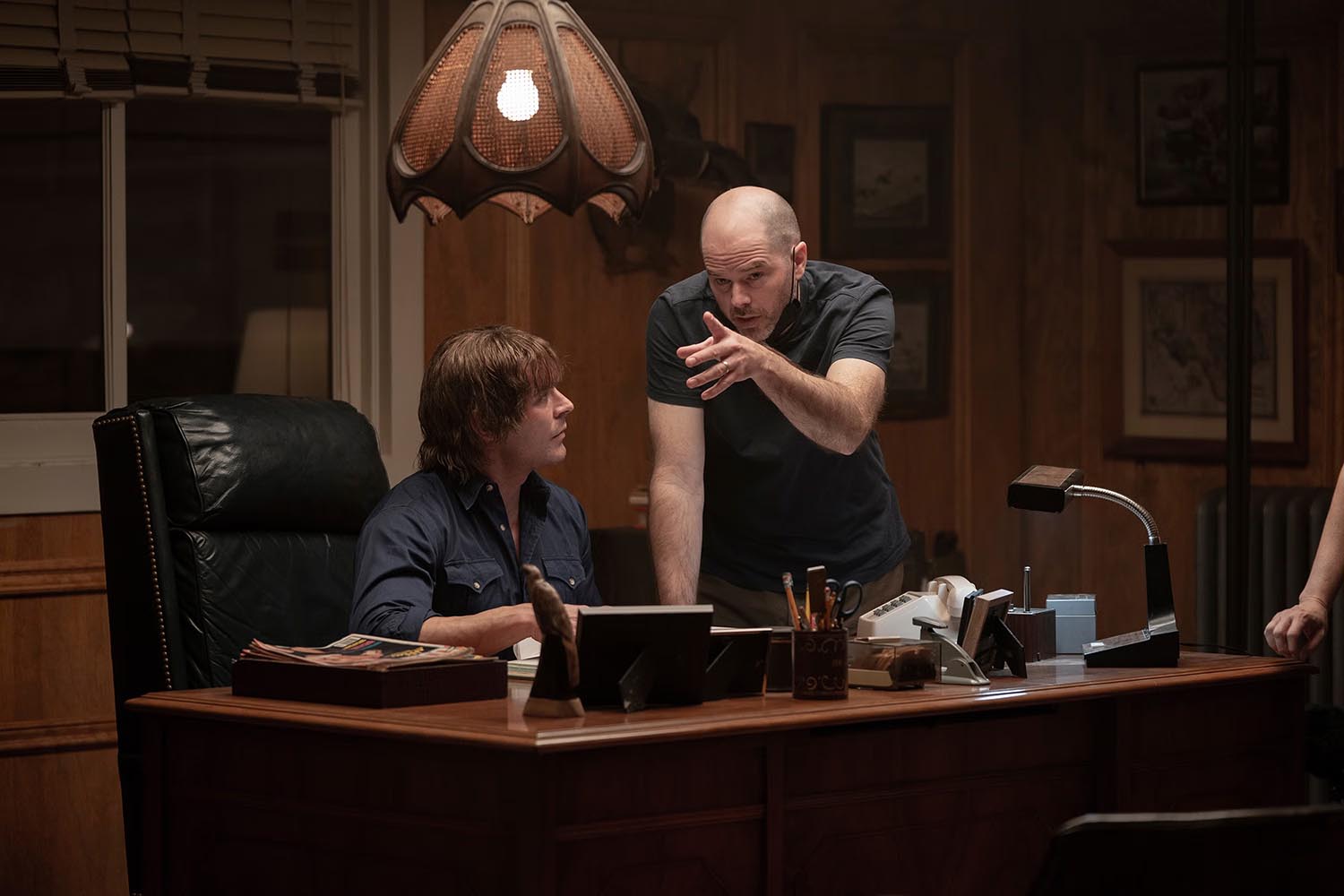
I was shocked to learn from writer-director Sean Durkin that he hadn’t watched Raging Bull’s legendary commentary track with Martin Scorsese and his longtime editor, Thelma Schoonmaker, before stepping into the ring himself to direct his third feature, the sports drama The Iron Claw. Durkin’s concern with masculine melodrama, sullenly repressed in life and violently expressed in competition, has the aura of true discipleship. But, it turns out, absorbing the lessons of a film without intensely studying it is more in line with Durkin’s style of feeling his way through a project, as he described in our interview.
In The Iron Claw, Durkin locates the story of a gender and a nation within the story of wrestling’s Von Erichs. The quartet of brothers, anchored by Zac Efron’s eldest Kevin, strive to rise to the top of their sport as well as out of their domineering father’s shadow. This success spurs setbacks as a supposed curse on the family rears its head and threatens to derail an entire generation of Von Erich men. Without dipping into sensationalism or sentimentalism, Durkin spins his own cinematic tragedy made from rich specificity and grand emotionality alike.
I spoke with Durkin shortly before The Iron Claw opened in theaters. Our conversation covered how he approached genre in the film, where he sees thematic overlap with his previous work, and why depicting the lives of real people allowed him to tell a deeply personal story.
How were you, director of photography Mátyás Erdély, and editor Matthew Hannam conceptualizing the different wrestling matches?
Always [around] the emotion Kevin’s going through. So the first match with the Sheik is, first and foremost, an introduction to wrestling—just the chaos of it. The feeling of it is just about being with the wrestler, versus [the match against] Harley Race, which becomes much more of a televised spectacle. We’re introducing the television angle for the first time, but then dipping into the subjective. It’s trying to both signify the event of the moment but also always looking at what the emotion of Kevin is. We basically approached it like any other scene. We choose to put the camera where it best tells the story and best deals with the emotion of the moment.
As a wrestling fan, how were you managing your own relationship to it? Were you thinking about the sport as a subject, backdrop, or metaphor?
It’s sort of everything. I think [it was about] both wanting to celebrate wrestling and to fill the movie with details that I love that I think other wrestling fans will love. Some things are obvious, while other things you have to look to spot. There’s a fun to really giving it the respect that I think it deserves as an art form. I really want that to be a part of it as well—really questioning the masculine values that have really been placed on wrestlers and hurt a lot of young men over the past however many years. It’s all of those things, the beauty and the tragedy.
I was shocked you don’t have ties to Texas given how well you nail the regional culture. Is that something that you were digging into in research for specificity?
I worked very, very hard [on that]. Obviously, when you make something about wrestling, the bar is high, and wrestling fans are going to want to take you down if you don’t do it right. But I also know the same [is true] of Texas. If you decide to portray Texas, you better get it right. There was a lot of detail that went into making sure that I got that right.
I was at the 10-year anniversary screening at Metrograph that you did for Martha Marcy May Marlene, and I recall you observing that the movie was the way that it was to some extent because it was your first film. Because you didn’t necessarily know any better, you took risks and swings that you wouldn’t necessarily have with more experience. How are you keeping that spark of curiosity alive?
I think a passion for cinema and keeping that alive is the thing. Trying to always do something different, even if it’s within a form that isn’t. I’m really embracing the sports movie format, but I’m trying to undercut it with a different emotional trajectory. We’re combining elements and just trying to not be afraid and keep that energy from the beginning of being a filmmaker.
Were you thinking about The Iron Claw as a genre film?
Yeah, but also a film about a curse. This building sensation that a curse is going to strike, even if that curse isn’t real. It’s a sports movie, a family drama, a psychological drama. It’s all of that.
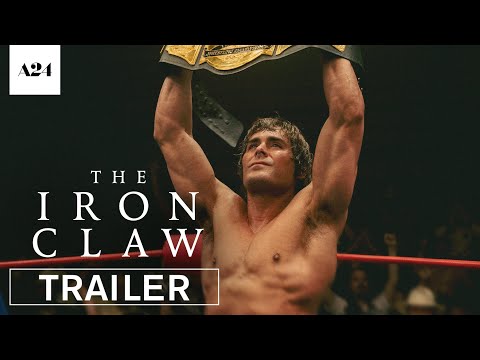
In The Nest, you flirt with genre by teasing at a haunted house. Was anything from that experience helpful when depicting the concept of a curse in The Iron Claw?
Definitely. It was taking what this version of that would be, losing brothers, and the ranch becomes haunted in another way with loneliness and quietness. Given the family’s spiritual belief and how strong it is, it felt right to cross over into something that wasn’t entirely natural.
A favorite film of yours is Rosemary’s Baby. Are these films both oblique ways of paying tribute or homage?
[laughs] Absolutely!
Peeling back scripted dialogue before shooting was something you realized you could do more after Martha Marcy May Marlene—was this helpful with these men who might not be the most communicative or expressive?
Yeah, and I think in this case, that [ever-evolving] experience was interesting to me because these characters weren’t articulate. They didn’t know how to talk about what they were feeling, never mind they weren’t allowed to talk about how they’re feeling. They just didn’t necessarily think in those terms. Writing characters that were very much physical first and intellectual/emotional second really drove them, and it was an interesting challenge of how to put someone in a scene where they might be feeling something but not know how to say it.
Is that attention to the appeal of cults and the abuse of family structure something that you think has carried through from Martha Marcy May Marlene?
It’s all about questioning where we come from, what we believe, and why we believe it. Are they truly our own beliefs? Are we our truest selves, or are we this way because we’ve been told to be? Those are questions and themes across all the work, and ones I think I’ll continue to explore.
You have a background in casting, and one of your goals was trying to work with a lot of unknowns with whom the audience didn’t have any baggage. But now you’ve cast movie stars like Jude Law and Zac Efron with specific personas that inform their characters. What does that extra layer you can’t control add to your process?
I don’t know if it’s different. With Jude and Zac, they’re two incredible actors who want to do good, challenging work. I’m just looking for people to collaborate with who want to do the work. Not everyone wants to go there. I don’t really know beyond that. It’s so much about the detail of the work and just getting in with people who want to collaborate and are on the same page.
Is there an element of Borderline Films, your former film collective, in the Von Erichs? Here are three guys who find joy and success in uniting and supporting each other in a somewhat individualized craft. It couldn’t help but remind me of what you had with Antonio Campos and Josh Mond.
Sure. My experience of brotherhood is one of my found families along the way, and that’s certainly one of them. From my middle school days, I still have a group of guy friends, and we’re very much like brothers. When you make a film, even about real people, you’re never going to know what their dinner conversations were or what their phone calls to each other were. It all becomes very personal as a writer when you fill those gaps and draw on your own experiences. The film, even though it’s about famous wrestling families, is very personal to me.
What is the interplay of drawing on that personal imagination and bringing it to something that’s based on real people?
You take what is out there, absorb it, and you start forming the character. You connect something to it; that’s why you’re telling it. So you find your own way in, but also you start to fill in the gaps and find out later there are things you think you made up that actually were true. You didn’t have access to those details, but they turned out to be true. What happens is this amazing thing of just understanding and getting inside the character and, therefore, your own connection of the character lets you bring your own thing that actually happens to overlap with what they went through. It’s incredible, and that does happen.
Since 2001, we've brought you uncompromising, candid takes on the world of film, music, television, video games, theater, and more. Independently owned and operated publications like Slant have been hit hard in recent years, but we’re committed to keeping our content free and accessible—meaning no paywalls or fees.
If you like what we do, please consider subscribing to our Patreon or making a donation.