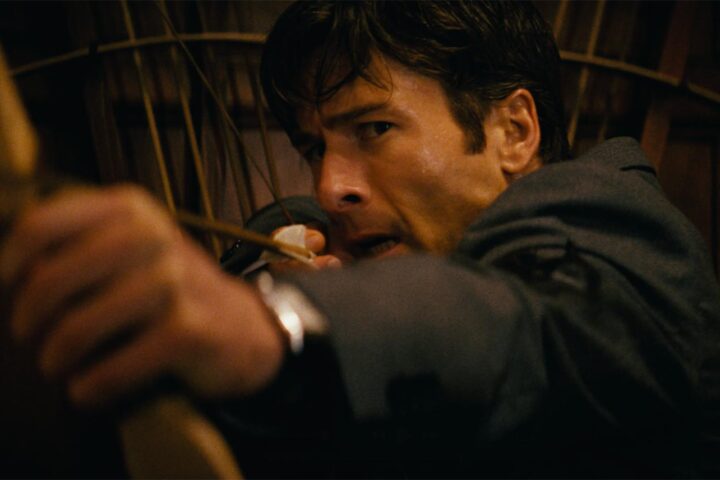
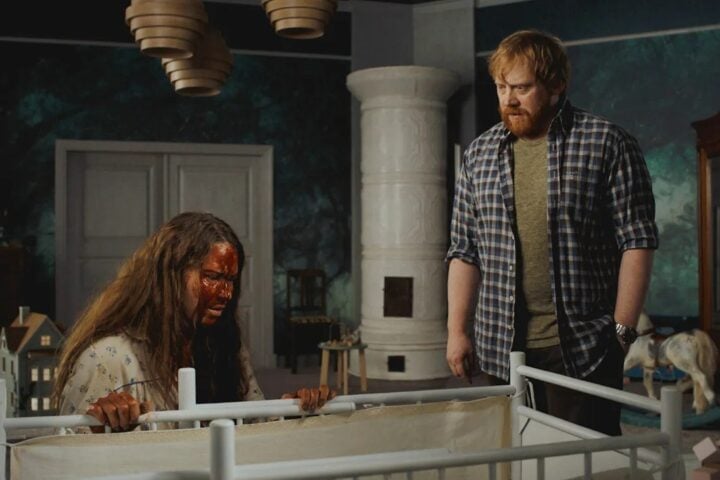
Freudians will have a field day with Markus Schleinzer’s 17th-century-set Rose, which traces the rise and fall of a mysterious soldier (Sandra Hüller) who, upon arriving in a rural community after inheriting a small fortune, buys property there and employs locals to work the land. Rose has successfully comported herself as a man, but after one of the villagers offers her his daughter, Suzanna (Caro Braun), for marriage, the intimacies that follow the union make it increasingly difficult for Rose to sustain her gender expression.
Cinematographer Gerald Kerkletz’s monochrome images are rendered with studious precision, recalling Paweł Pawlikowski’s Ida. Across spare monochrome images, people of the German Protestant village toil the inhospitable land and go through the motions of a highly scripted social theater that reduces women’s worth to that of the land itself: only good enough if it bears fruit for men. No one is going anywhere but the place where they were assigned.
The film conspicuously avoids masculinizing Hüller with make-up, prosthetics, or hairstyle. That means that the performance of masculinity that convinces all other characters in the film that Rose is a man falls entirely on Hüller’s demeanor. She, too, refrains from exaggeration to compensate for her androgynous features. Rose’s masculinity passes as such because of the way she walks and talks, her ability to always know exactly what to say as a man, and like a man. But all of that begins to crack, ever so tragically, once one of the housemaids peeks at the master’s genitals, then promptly gathers the villagers and announces, “The master is no master!”
That striking line sets off a moral panic that rushes the film toward Rose’s gender reveal. Until then, the film is at its most captivating tracing the fallout from Suzanna finding out that her husband doesn’t have a penis either, and an unlikely bond between the two develops. But their almost holy-seeming bliss eventually gets the short shrift as Rose begins to tend to the more sensationalist aspects of the narrative, leading to the somewhat expected sequence where Hüller’s gender-bending Joan d’Arc must expose her genitals to authority figures.
It’s easy to be enthralled by the film’s sublime performances and cinematography. But it must be said that there’s a perhaps unintended yet highly consequential political resonance to Rose’s measured, controlled aesthetic experience. Despite the protagonist’s own account of feeling like themselves as soon as they started wearing pants (literally and symbolically) as a child, the unidentified omniscient narrator, which works as an atemporal and unbiased voice of reason telling the audience the facts, insists on dragging Rose back to their gender assigned at birth.
The more we’re convincingly transported into the 17th century, the more that century reminds us of our own: from the mob mentality of locals versus strangers to the vilification of anyone who exposes gender to be not more than a collection of everyday performances. And yet, unless we’re closer to the mob of villagers than we’d like to think, there’s something discomfiting about the mismatch between Rose’s sense of self, which Hüller so expertly affirms, and the lack of ambiguity with which the narration’s pseudo-neutrality treats Rose’s gender.
Since 2001, we've brought you uncompromising, candid takes on the world of film, music, television, video games, theater, and more. Independently owned and operated publications like Slant have been hit hard in recent years, but we’re committed to keeping our content free and accessible—meaning no paywalls or fees.
If you like what we do, please consider subscribing to our Patreon or making a donation.