Phil Lord and Christopher Miller put a comedic spin on Andy Weir’s more straightforward 2021 novel Project Hail Mary, recasting the author’s hopeful vision of productive communication with extraterrestrials as an unlikely buddy comedy. Given that the film’s premise is a go-for-broke deep-space mission to discover a means of stopping a mysterious particle from blacking out the sun, it’s remarkable how well this tonal shift works.
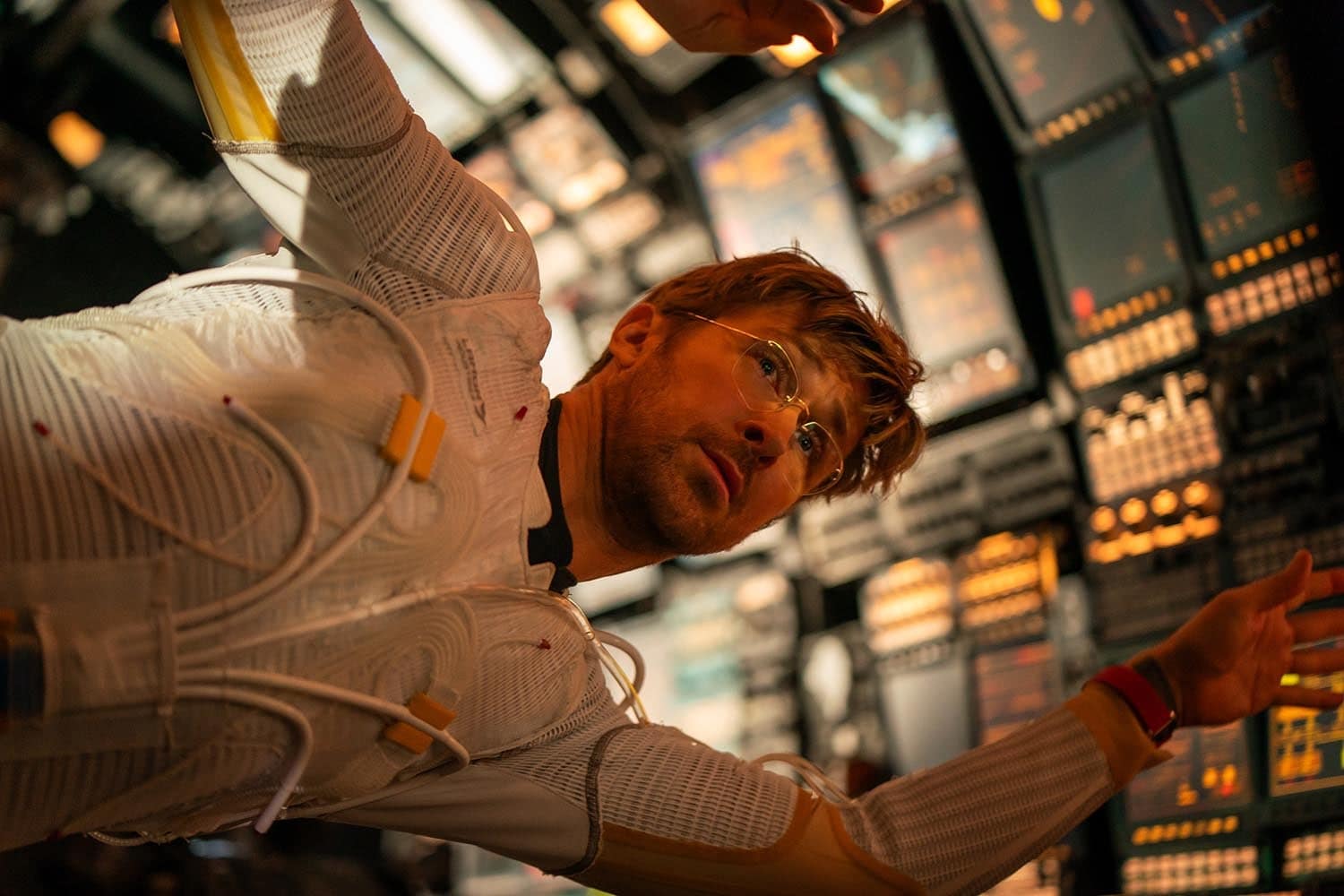
Beginning at the end of the extrasolar journey to a star system that has proven resistant to the sun-eating substance, the film reveals that only one member of the crew, biologist Ryland Grace (Ryan Gosling), survived the induced comas into which they were placed for the years-long trip to interstellar space. Untrained in any aspect of operating a spacecraft and accompanied only by corpses, Grace awakens in a realm of pure horror, but the film immediately plays up the slapstick humor of the man awkwardly flopping around on atrophied muscles. The stakes of the mission, and the near-impossibility of its success, take a back seat to Gosling’s adroit physical comedy as he teeters and splays like a newborn foal taking its first steps.
No sooner does Grace get his bearings than he realizes that he’s not alone in the new solar system he finds himself in, ultimately connecting with a colossal, tesseracted vessel that contains a multi-limbed, faceless alien whom Grace dubs Rocky due to its stony makeup. Rocky’s planet faces the same stellar threat afflicting Earth, and the two parties forego the usual tensions of two alien beings meeting to cooperate on finding a way to help their home worlds.
As with the novel, the film plays out within hard sci-fi parameters of physical possibility before largely shifting into a less realistic adventure. The arduous process of two completely unrelated species working out a method of communication is elided in a brief montage, leaping from the first, completely gestural exchanges between Grace and Rocky to an ad-hoc translation program that gives the latter a chipper A.I. voice to match its eager personality.
If the film too quickly establishes a conversational rapport between Grace and Rocky, it nonetheless uses this level of communicability to settle into its strongest section. The tonal imbalance of the early scenes finally resolves, settling into a comedy enlivened by moments of straightforward jubilance when the characters make a research breakthrough.
Gosling’s enduring boyish charm lends credibility to Grace’s guileless acceptance of Rocky; our hero embraces the alien as a genuine friend, though he occasionally bristles at the being’s clingy affection. The animation of Rocky, too, is a real feat, compensating for the creature’s lack of facial features with expressive limb movements that convey a surprisingly wide range of emotional and meaning even without the benefit of Grace’s jerry-rigged translator. The film only occasionally falls back on comedy of errors produced by gaps in language between the pair, and indeed it’s often the abstract concepts that require a careful explanation that are the most touching parts as two species learn to share more philosophical ideas about life.
Compared to the breezy pace of the characters’ interactions, though, the frequent interruptions of flashbacks of Grace’s life back home are stultifying. One can easily glean Grace’s personality and feelings about this longshot mission from the first few clips of his initiation into the project, leaving the rest to belabor the point of the discrepancy between the shy, cowardly man on Earth and the outgoing, increasingly heroic attitude he demonstrates in space. Even the intriguing revelations about the project’s calculating head (Sandra Hüller) fail to justify how badly these flashbacks disrupt the flow of the second half and sap the climax of tension.
In its mixture of lighthearted adventure and more thoughtful cosmic reflection, Project Hail Mary most resembles the original Star Trek films, especially the lighter The Voyage Home. The film shares with that series the indefatigable optimism of an earlier time when the genre reflected our broader hopes for the possibilities of science and the potential of humanity to not merely contact the other species of the universe but win their approval.
Since 2001, we've brought you uncompromising, candid takes on the world of film, music, television, video games, theater, and more. Independently owned and operated publications like Slant have been hit hard in recent years, but we’re committed to keeping our content free and accessible—meaning no paywalls or fees.
If you like what we do, please consider subscribing to our Patreon or making a donation.