Presented as a propaganda film for a mysterious colony in Chile, The Wolf House tells the story of Maria, a girl who accidentally lets three pigs escape from the community. To avoid her punishment, she flees through the woods and into an abandoned house, where a wolf looms beyond the walls. Maria is alone, save for two pigs she discovers inside, but she’s gifted with strange powers of creation, seemingly able to make and unmake things within the house at will. Based on the history of the sect and agricultural commune Colonia Dignidad founded by German pedophile and fugitive Paul Schäfer, the film conveys Maria’s shifting perspective through mixed-media stop-motion, where characters and furnishings appear chalked or painted onto the walls of the house, their appearances constantly transforming and dissolving into things like three-dimensional papier-mâché sculptures.
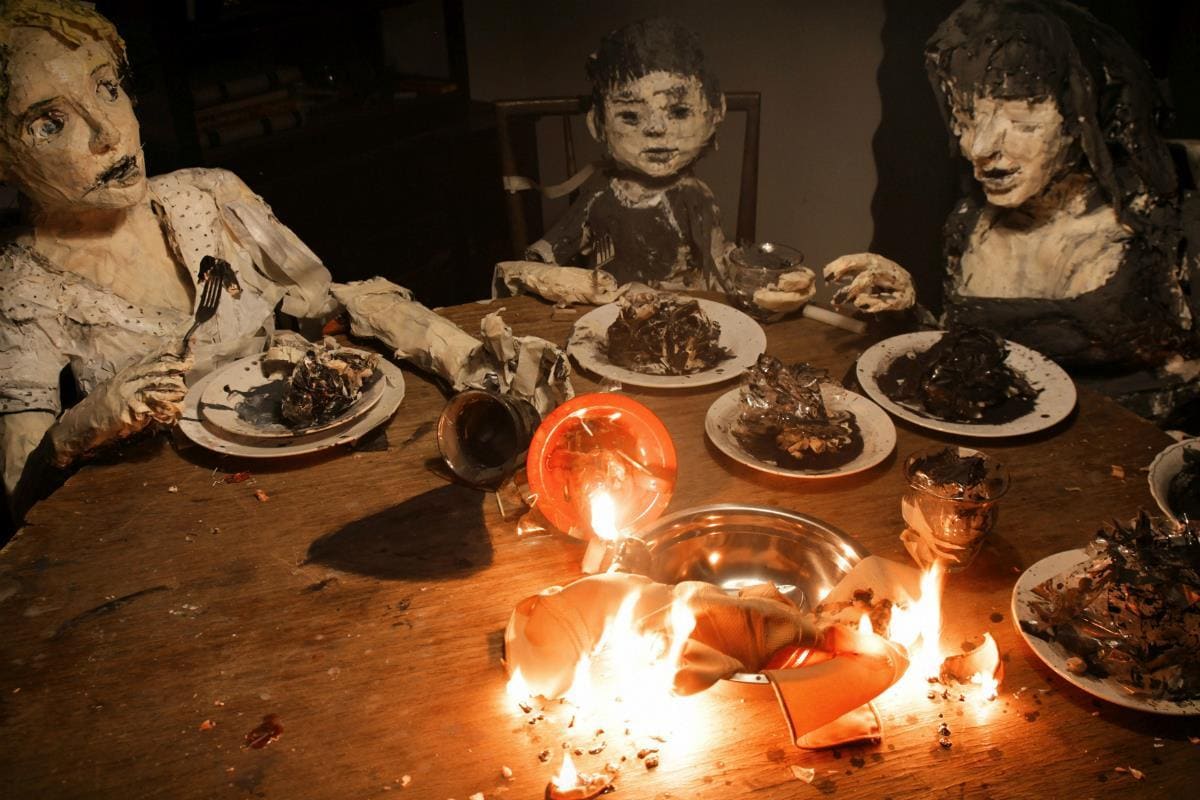
So much of The Wolf House feels like a hallucinatory, out-of-body experience for the way the camera slides in and out of Maria’s point of view, mimicking a single take. Directors Cristóbal León and Joaquín Cociña use an entire house as a canvas for their astonishing artistry, mingling sculptures and paintings with life-sized objects. They portray a state of existence that seems to be in constant flux, as Maria melts in and out of the wall or the pigs adopt entirely different appearances. The house’s interior is ambiguous, appearing quaint and inviting in some scenes yet dirty and disused in others, the table set with blackened food that doesn’t match Maria’s narrated description while eyes appear on the walls.
The film’s animation leans into its most jerky, artificial qualities, all the better to enhance the atmosphere of bizarre unreality. You can see the wires that abruptly appear to yank a sculpture into position, while the marks of animators—the indentations on the outside of the characters, the shifting positions of objects on the ground—reflect the constant destruction and reformation of the house and its characters as the story continues, like their reality has just been cobbled together. In one scene, real candles are used at a dinner table, and they burn away and then reappear out of continuity with the characters, muddying the passage of time.
In some moments, The Wolf House can be strikingly pretty, like when the painted pigs on the wall play with a three-dimensional ball outside their two-dimensional plane. But coupled with narration that sounds whispered into your ear, the film’s animation frequently takes on a horrific, unsettling quality. The things it depicts are often disturbing without feeling self-consciously grotesque, as though their most upsetting elements are incidental: the empty eye sockets of the animals, the human limbs that grow on the pigs, the human heads that grow to bulbous sizes as though overcompensating for their personhood. Maria constantly grows bored of her creatures, reshaping them into idealized forms. And when the creatures take her lessons to heart, they fixate on the wrong messages as they prioritize isolation itself over survival.
León and Cociña’s film functions as a fascist parable, portraying a growing strain of isolation and the shifting whims of those in power through allegory and an eerie, ever-shifting art style. Indeed, The Wolf House abstracts the terror of Colonia Dignidad and Augusto Pinochet’s totalitarian regime, historical context that remains unspoken beyond the opening minutes that frame the film as propaganda. The outside world is to be feared and the colony to be valorized according to the framing device, though we soon recognize that the horrors of Maria’s home in the Chilean wilderness equally represent life under dictatorship.
Since 2001, we've brought you uncompromising, candid takes on the world of film, music, television, video games, theater, and more. Independently owned and operated publications like Slant have been hit hard in recent years, but we’re committed to keeping our content free and accessible—meaning no paywalls or fees.
If you like what we do, please consider subscribing to our Patreon or making a donation.