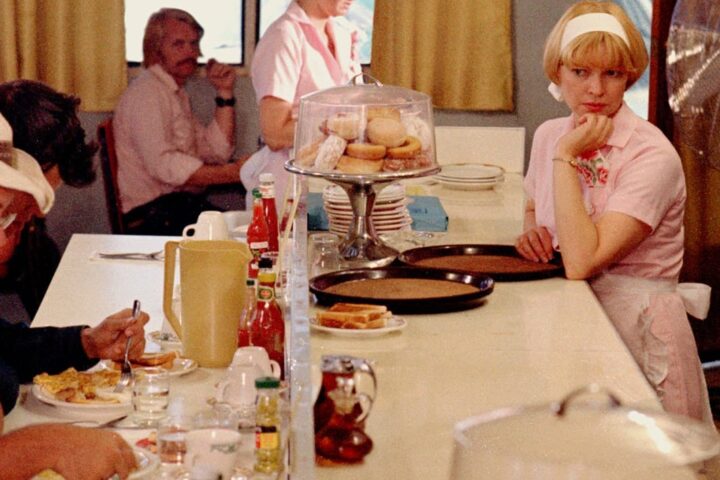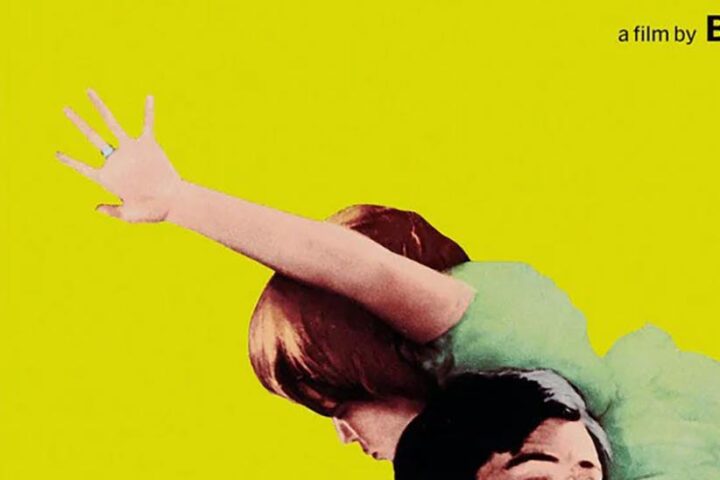
With 1977’s New York, New York, director Martin Scorsese took the formulas of classic 1940s and ’50s American movie musicals and infused them with his private obsessions. The film is a fascinating hybrid of vintage and modern aesthetics. Its sets are deliberately artificial, with streets wide enough to serve as readymade stages and cityscapes that are painterly and geometrically perfect. The crowd shots are clearly choreographed, and they’re captured in swooping dolly and tracking shots that are so virtuosic as to be subjects in themselves. Opening on V-J Day, Scorsese immediately mounts an epic blow-out set piece, as Americans celebrate the figurative end of World War II, as the camera takes us from the streets into a vast ballroom overseen by the Tommy Dorsey Orchestra. For a few minutes, it seems as if Scorsese is going to offer a more or less “straight” cover of the MGM and Warner Bros. musicals that he adores, giving the audience a nostalgic bath.
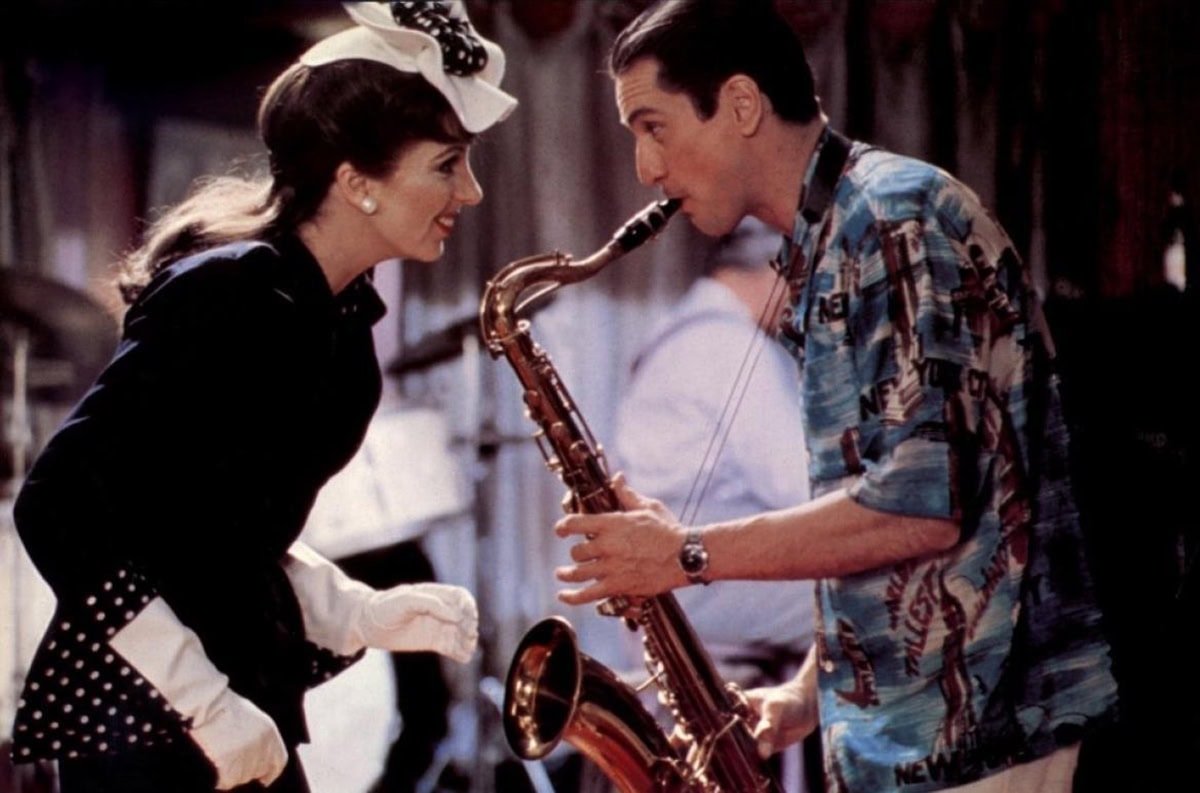
One element is at odds with these theatrics: the character of Jimmy Doyle, who’s played by Robert De Niro in his alienating ’70s-era weirdo mode. It’s often said that New York, New York is an attempt on Scorsese’s part to bridge fantastic sets and songs with a realistic acting style, but there’s nothing conventionally realistic about most of De Niro’s performances for Scorsese, especially in their collaborations from the ’70s and ’80s. Darting into Scorsese’s intoxicating compositions, Jimmy moves with fervent speed, like Johnny Boy and Travis Bickle before him. Jimmy also has a one-track mind, and his aggressive insatiability for attention, underscored by a loud blue NYC Hawaiian shirt, stokes our unease. A dreamy epic has apparently been rested on the shoulders of a lout, which turns out to only be partially true.
The heroes of so many American musicals—as played by the likes of Gene Kelly, Fred Astaire, Frank Sinatra, and so on—had aggressive streaks. Those films were often built around elaborate sexual manipulations, but their characters were charmers, testaments to America’s grifting spirit. De Niro doesn’t usually do charm. At this point in his career, the actor was occupied with aggression and masochism above all other human qualities; even in his greatest performances of this era, he essentially acted against himself. (An exception is his weirdly touching rapport with Jodie Foster in Taxi Driver.) As Jimmy initially drives the plot of New York, New York, one can’t entirely tell if the protagonist’s brashness is meant to be endearing, and this leaves a hole in the film’s first half, as we don’t enjoy the central meet cute as we do in even routine musicals. When Jimmy tries to pick up Francine Evans (Liza Minelli), a tension emerges: He’s a creep and she knows it, but he gradually wears her down.
Scorsese is often discussed as a visual maestro, but he’s always loved verbal acrobatics too, especially arias of repetitive, literate absurdism that suggest profane variations of Abbott and Costello’s “Who’s on First?” routine. The early portions of New York, New York are often devoted to Jimmy and Francine’s bickering, which is mildly amusing until it grows hostile. This is one ’70s influence on the film, as the emotional violence of the relationship isn’t euphemistic. There’s a relatively lighthearted moment where Jimmy, a jazz pianist, is failing to impress a nightclub manager (Dick Miller). The manager wants something lighter, where Jimmy plays aggressively as an extension of his eager-to-prove-himself personality. Francine steps in and begins to sing with him, softening Jimmy’s playing in the process, which becomes a lovely metaphor for her effect on him and for what she must see in him, in the tradition of many women inexplicably drawn to abusive, self-absorbed men: She has a hero complex.
Watching the first half of New York, New York, it’s easy to understand the film’s reputation as a strange disappointment. It’s perverse to build a glitzy musical on a dysfunctional relationship, and Scorsese’s direction lacks the sprightliness of the movies he’s emulating. He’s as obsessive as De Niro, and he’s striving for a masterpiece, stretching scenes out, trying to unearth shards of emotional truth, all against the glorious old-school backdrops. (A couple of snow vistas are straight of Swing Time and Meet Me in St. Louis.) The disjunction between tone and style engages the intellect rather than the heart, especially as Jimmy and Francine’s relationship is driven to the breaking point by her pregnancy and his drinking and drugging and infidelity.
As Jimmy’s career falters while Francine’s skyrockets, New York, New York achieves an astonishing clarity. What Scorsese is truly striving for is a remake of A Star Is Born, the greatest version of which featured Minelli’s mother, Judy Garland. At first, Minnelli is a poignantly vulnerable foil for De Niro’s thrashing about, but she gradually takes over the narrative, and the film splinters into various cinematic realities. Francine’s ascension as a movie star is dramatized via one long and brilliant sequence, the inter-movie “Happy Endings” number in which she plays a character who mirrors her own rags-to-riches story and own heartbreak over a man who can’t handle it. The sequence fuses multiple songs, multiple dance styles, offering many movies-within-movies to suggest nesting legacies of bullied women who transcended their caddish yet pitiful men. It’s even more powerful for the tonal noodling of the film’s first half, as we needed to feel Francine/Liza’s repression in order to revel in her rebirth.
An auto-critical element inevitably slips into New York, New York, imbuing it with primordial power. The film is less about Jimmy and Francine than Scorsese’s need to work with Minelli and wrestle with the legacies of her parents. (Vincente Minelli, her father, directed Garland in various musicals, including Meet Me in St. Louis.) Scorsese needs to know if he can give Minelli a vehicle worthy of all of them, and this anxiety, this need to prove oneself, is mirrored by Jimmy’s fear of being less of an artist than Francine, which is particularly embodied by an extraordinary moment in which Jimmy leaves Francine and their boy forever in a hospital.
In the “Happy Endings” sequence, Scorsese takes A Star Is Born and crosses it with the free-associational dance scene in Singin’ in the Rain, fashioning a hall of mirrors that reflects female agency and male inadequacy. Scorsese’s films have always had a deep awe and terror of women, and here Scorsese transcends that fear to give Minelli the film she’s earned and the pedestal she has been too often denied. Belting out “New York, New York,” Francine/Liza capture the glories of singing in your own voice, of being allowed to be heard and in believing in what you’re saying, and discovering that your most unlikely fantasies of your talent might be true. But Jimmy co-wrote the song, and so it’s the one child that he and Francine had that he could acknowledge. The song is their merging, their relationship boiled down to its collaborative best. This unwieldy, ultimately quite moving musical epic is essentially about the creation of one song, and the pain that was required to forge it. In other words, New York, New York, like most Scorsese films, is about the trials and glories of making art.
Since 2001, we've brought you uncompromising, candid takes on the world of film, music, television, video games, theater, and more. Independently owned and operated publications like Slant have been hit hard in recent years, but we’re committed to keeping our content free and accessible—meaning no paywalls or fees.
If you like what we do, please consider subscribing to our Patreon or making a donation.