In a 1985 interview with DeeDee Halleck conducted at the Chelsea Hotel, filmmaker Shirley Clarke stated that she made films about African-Americans as a way of working through her own ambivalence about being a woman in a male-dominated culture: “I identified with black people because I couldn’t deal with the woman question and I transposed it. I could understand very easily the black problems, and I somehow equated them to how I felt….I always felt alone, and on the outside of the culture that I was in.” One can detect a similar tendency in the work of Ida Lupino, whose independently produced dramas of the 1940s and ’50s tackled hot-button issues such as rape, bigamy, and unwanted pregnancy. These films are no mere homilies on contemporary social problems, but complex and deeply personal explorations of what it means to be an independent woman in a world ruled by men.
Lupino’s pioneering work is suffused with a profound sense of alienation and self-doubt. Her films are about people whose conventional middle-class existence is suddenly, sometimes violently, upturned, causing them to feel completely unmoored. No longer sure of where they’re going in life or what they truly want, these people find respite away from their old life, in an unfamiliar place with a new potential lover. And Lupino tells these stories with an empathy that’s striking for its directness and lack of condescension.
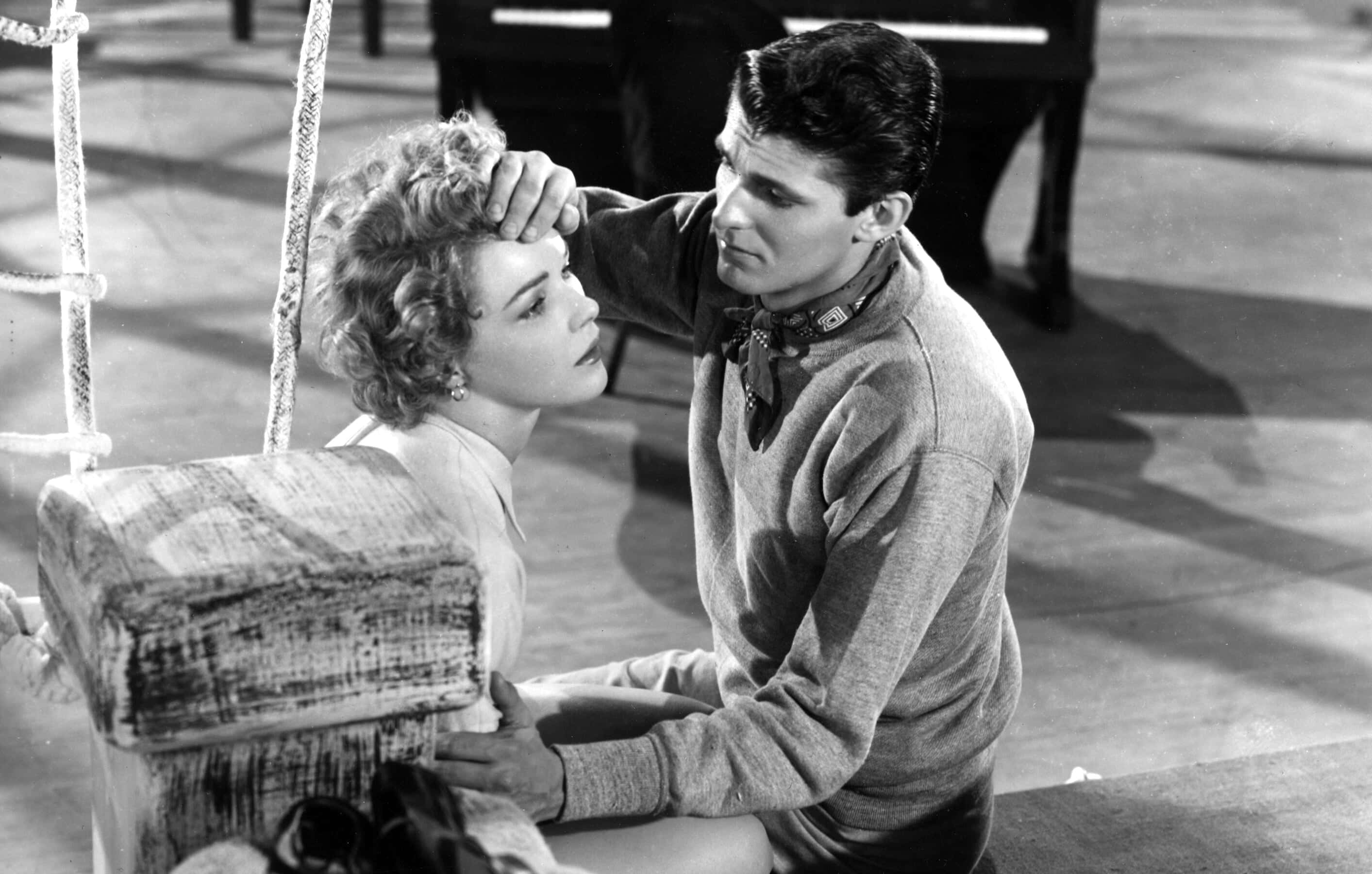
Such is the case with the first film Lupino directed completely on her own, Never Fear, an emotionally complex drama about a young dancer, Carol (Sally Forrest), who seems to have it all, as she’s just gotten engaged to her partner, Guy (Keefe Brasselle), and their careers are on the verge of taking off. But then, all of sudden she’s stricken with polio, and everything changes. Carol, depressed and bitter, enters a rehab facility where she eventually makes strides toward walking again, thanks in part to the inspiration of a hunky fellow patient named Len (Hugh O’Brian). As Carol struggles with her own will to get better, she grows increasingly distant from Guy, urging him to keep pursuing his dancing career rather than settling down into a conventional job selling pre-fab “Happy Homes” as he waits around for her to recover.
Free of the noir-ish inflections Lupino brought to her other films—most notably The Hitch-Hiker, and the rape sequence in Outrage—Never Fear is directed in a simple, straightforward style that bears comparison to the stripped-down neorealism of Roberto Rossellini. Lupino is captivated by the process of physical rehabilitation, offering detailed observations of Carol’s stretching routine, swim therapy, art classes, and, in one show-stopping sequence, a square dance featuring lines of wheelchair-bound patients twirling each other around in consummately choreographed synchrony. Carol is clumsy and awkward as she struggles to operate her wheelchair, a marked contrast to the film’s opening scenes, in which Carol and Guy move together with lithe sophistication as they perform a romantic swashbuckling tango.
Never Fear’s subject matter was personal for Lupino, who survived polio after an attack in 1934. But the filmmaker isn’t merely interested in the physical ailment itself, but also in the complicated pressure that recovery places on Carol. There’s a tension in the film, which was released at the height of the U.S. polio outbreak, between what Carol wants and what the men in her life want for her. When Carol begins to reject her own treatment, it’s in part because she’s rebelling against the expectations that her doctor, her fellow patients, and especially Guy have placed on her. “Be a woman for me,” Guy asks of her, but the demand is counter-productive, as Carol can only truly recuperate when she decides to do it for herself.
In Carol’s dilemma, one can sense Lupino wrestling with her own artistic ambitions, coming to grips with the reality that as the only woman director working within the Hollywood studio system in the ’50s, she too would have to accept the guidance of the men around her, and in so doing she would be forced to bear the weight of their expectations for her—their demands, hopes, dreams, and pity. Unfortunately, Never Fear closes with a cop-out, a last-minute reconciliation that cheapens Carol’s hard-fought struggle to learn to live on her own terms by suggesting she’s fundamentally lost without a man. Almost as if the film is embarrassed by its own denouement, the final screen assures us, “This is not THE END. It is just the beginning for all those of faith and courage.” If the film ultimately seems to question Carol’s courage, there’s at least no doubt about Lupino’s own. Never Fear wasn’t the end for her either, but merely the start of one of the most unique and pathbreaking directorial careers in Hollywood history.
Since 2001, we've brought you uncompromising, candid takes on the world of film, music, television, video games, theater, and more. Independently owned and operated publications like Slant have been hit hard in recent years, but we’re committed to keeping our content free and accessible—meaning no paywalls or fees.
If you like what we do, please consider subscribing to our Patreon or making a donation.