The controversy of authorship that continues to engulf Orson Welles’s Citizen Kane hinges on whether or not Herman J. Mankiewicz deserves primary credit for the film’s sensibility. Such insistence rests on the naïve notion that screenplays are pearls that remain unchanged and uninfluenced by other craftspeople throughout a film’s production. Mankiewicz’s acerbic wit is very alive in Citizen Kane, but so is Welles’s beautiful brio—his formal flourishes and innate instinct for lacing a punchline with ironic tragedy. These two elements combust, in fact, to yield a film that suggests a link between the fast-paced, no-bullshit American newspaper comedies of the 1930s, many of which Mankiewicz worked on, and the German expressionism of the 1920s, among other things. This irresistible union brokered a new idea of the American auteur.
David Fincher’s Mank opens in 1940 with Mankiewicz (Gary Oldman) en route to a ranch in Victorville, northeast of Los Angeles. This idle has been arranged for Mank by Welles (Tom Burke) so that the former may recover from a broken leg, as well as, more pressingly, dry out from booze so as to knock out a draft of a project called American in three months, which is to be Welles’s cinematic debut after blazing a glorious trail in the worlds of theater and radio. Riffing on the flashback structure of Citizen Kane, Fincher jumps around in time throughout the ’30s, as Mank alienates himself from Hollywood and its true, subterranean source of power, which is represented by publishing giant William Randolph Hearst (Charles Dance).
With his sharp tongue and profound alcoholism, Mank gradually works his way toward a fate of sitting in a cabin, ailing, essentially alone, penning a screenplay that’s probably intended as a form of revenge against those who rejected him over the years, while also serving as a Proustian expression of longing over lost days and unrealized promises. In real life, the script would be retitled, stripped down, haggled over and shot—transformed into a film that would be viciously contended with, hailed as a classic, and debated endlessly throughout the epochs of time. For cinephiles, Mank may rekindle such a debate.
As he was in The Social Network, Fincher is conscious of the explanatory clichés of the biopic and avoids them. Penned by his late father, Jack Fincher, Mank is a stubbornly glorious work of inside baseball, with appearances by the likes of Josef von Sternberg (Paul Fox), Ben Hecht (Jeff Harms), Charles MacArthur (John Churchill), David O. Selznick (Toby Leonard Moore), Charles Lederer (Joseph Cross), and Mank’s younger brother, Joseph Mankiewicz (Tom Pelphrey). Though they portray Joseph pitilessly as a politico, the filmmakers tell the audience little about the interrelationships between these and other influential people. One won’t learn of the Algonquin Round Table from Mank, though it’s alluded to, and an amusing pitch meeting involving von Sternberg and Hecht is even funnier if one knows that Hecht previously co-wrote a picture for the director—1927’s Underworld—that’s the sort of genre fare that von Sternberg appears to want to transcend in Mank.
These sorts of barely articulated cross-associations suggest a bygone society driven by an infrastructure of unknowable vastness. And the opportunity to conjure such a labyrinthine and increasingly sinister impression of community is what excites Fincher throughout Mank. Like many of his other films, especially Fight Club, Zodiac, and The Social Network, Mank is a parable on the limits of control, fashioned with rueful self-awareness by one of Hollywood’s most famous contemporary control freaks. As a cartoonist had to live with his inability to crack the riddle of the Zodiac killer, Mank must live with an existence, fashioned in part by his own self-loathing and lack of discipline, in which he’s to ineffectually bear witness to the flexing of American corruption as represented by an intersection between the press, Hollywood, and the government. Such a theme also very consciously aligns Mank with the “fallen, not-quite-great man” themes of Citizen Kane.
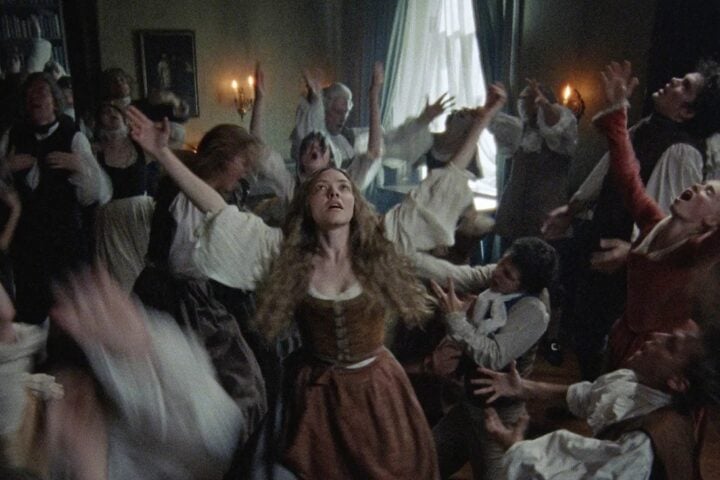
Mank’s most haunting sequences are self-contained arias in which characters grapple with their powerlessness, which is amplified by their vices and need to be comfortable and in the know. At a Hearst dinner party—where Mank reliably serves as a harmless voice of liberal dissent in a room full of Republicans resentful of socialists like author and California gubernatorial candidate Upton Sinclair—Hearst’s young lover, actress Marion Davies (Amanda Seyfried), chillingly observes that “Pops” chose Franklin Roosevelt’s cabinet as if in a casting call. This isn’t the sort of information one bandies about, especially with FDR’s people in the room, and Marion is essentially cast off, spending the remainder of the night wandering about San Simeon and drinking and talking of secret alliances and mergers with Mank, who’s smitten with her and relishes playing the role of debauched truthteller. (His Falstaff appears to be as good as Welles’s.) While taking the piss out of the myth of Hollywood as a liberal refuge, this poignant scene also serves as one of Mank’s few moments of true connectedness, among glorified bystanders who embody the complicity and complacency that hounds America then and now.
Later, part of a cross-cutting sequence that serves as the film’s climax finds Mank, drunk even by his standards, making a fool of himself at another Hearst dinner party, pitching to the crowd a variation of Don Quixote that clearly suggests the origins of Citizen Kane. Mank is alone this time—Marion sneaks drinks at the dinner table but otherwise plays the part of the good lover and employee—as he rails against Hearst, a man whose respect he craves and whose exertions of power Mank naïvely sees as a betrayal. Like most cynics, Mank is a dashed romantic; he’s also a coward who wishes to play the role of rebel without taking the commensurate risks. He’s like most of us, except he was able to corral his frustration into the seeds for a masterpiece, and, according to this film, in tandem with stories Mankiewicz told which Welles refuted, Mank stood by his guns and demanded credit on Citizen Kane as a refutation of the cowardice and shame that saddled him.
Mank’s outburst toward Hearst and those in the newspaper magnate’s company, including the former’s thorn-in-the-side, producer Louis B. Mayer (Arliss Howard), is heartbreaking, while his showdown with Welles, which mirrors Charles Foster Kane’s explosion of rage in Citizen Kane’s third act, indulges the sort of biopic patness that Fincher seems to fancy himself above. One can forgive the sleight that such scenes aim at Welles, who was every bit as experienced as Mankiewicz in the high society that Citizen Kane dramatizes, as Mank is rooted intensely inside its protagonist’s own headspace, sharing his bitterness, however justified or not. But to make Mank a conventional avatar of righteousness this late in the film is to undermine, via sentimentality, the power of Oldman’s performance, which up to this point is the closest this film comes to capturing the lively sense of tragedy and sleaze that marks many a Hollywood production during the ’30s and ’40s.
Ironically, Mank doesn’t “combust” as Citizen Kane did because it lacks the very thing that Fincher seems to underrate as secondary to Mank’s writing and life experience: Welles’s showmanship. While Fincher brings a past society rich in political implications to vivid life, he has virtually no governing interest in making us feel for Mank as a human. Individual scenes are astonishing without somehow flowing into one another; instead of feeling as if we’re being drawn into in an inescapable psychological vortex, as in Citizen Kane, we’re given the impression of watching a few dozen short, intellectualized films on the subject of Mank and his cronies.
Even the witty dialogue is often quote-marked, by Erik Messerschmidt’s fetishistic black-and-white cinematography, and by rigid framing that approximates Gregg Toland’s deep-focus compositions for Citizen Kane while lacking the Welles film’s glorious sense of grace and poetry. Some part of Welles knew that Citizen Kane was a hambone rise-and-fall story, and he leaned into that quality without apology, connecting the resentments of a rich and lost man with our own. Citizen Kane conjoins an old-feeling boozer’s shame with a young man’s love of tricks, magic, and shtick; it’s a formally hopeful dramatization of collapse, a contradiction that cuts to the heart of the sort of ambiguities that hound people’s lives. Fincher, who thinks he’s superior to melodrama even if he steps in it anyway, fossilizes such themes rather than dramatizing them.
Since 2001, we've brought you uncompromising, candid takes on the world of film, music, television, video games, theater, and more. Independently owned and operated publications like Slant have been hit hard in recent years, but we’re committed to keeping our content free and accessible—meaning no paywalls or fees.
If you like what we do, please consider subscribing to our Patreon or making a donation.