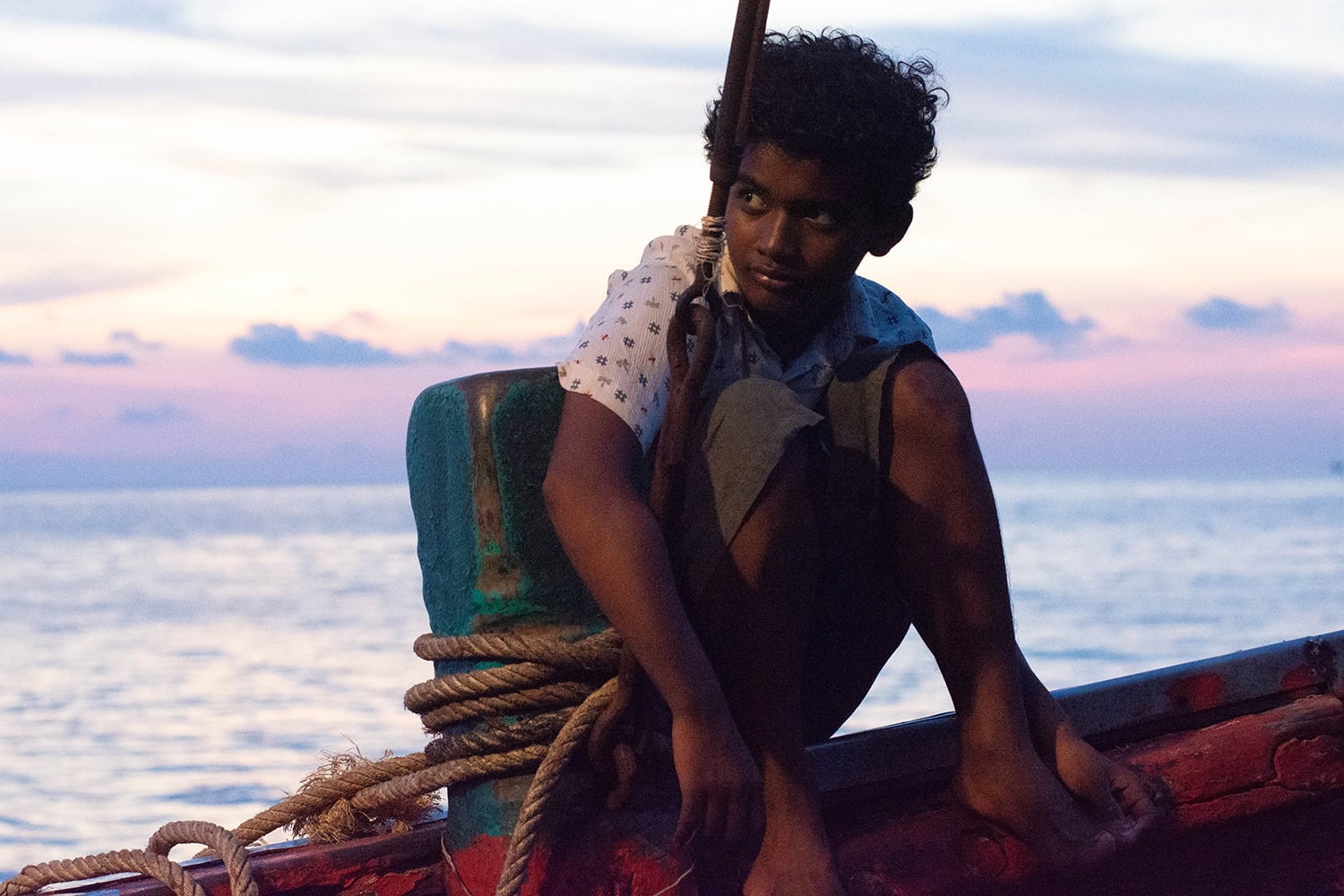
Rodd Rathjen’s harrowing debut feature, Buoyancy, views the modern slave trade in Southeast Asia’s fishing industry through the eyes of a stoic 14-year-old, Chakra (Sarm Heng), who’s held captive on the boat that was supposed to take him to an overseas factory job. The character is fictitious, but he could just as well be any one of the estimated 200,000 men and boys currently enslaved on the region’s fishing vessels.
This unsettling statistic is offered up at the end of the film, along with a quote from an anonymous Cambodian survivor that reads: “No one can hear you out there…nobody knows you exist.” And that crippling sense of isolation and anonymity forcefully echoes throughout Buoyancy, with the help of a cast of nonprofessional actors, including Heng, whose muted performances are defined almost solely by their pure physicality.
The film opens right before Chakra sets out on his own, briefly contextualizing the life he’s turning his back to, including his strained relationship with his imperious father (Sareoun Sopheara), who forces him to work harder in the local rice fields than the boy’s siblings. It’s a brutal, monotonous existence that even the young Chakra knows he must escape, even if that means taking the biggest of risks by traveling far away in search of better opportunities.
After Chakra accepts the factory job, the film meticulously details the boy’s increasingly terrifying journey from land to sea as he and other would-be workers are passed from one person to another and driven for hours at a time with no knowledge of where they’re going or when they’ll arrive at their destination. The disorienting nature of this trek is part of the slavers’ plan to make the workers completely dependent on their help—a long-term brainwashing process that results in the complete, unquestioned obedience of the workers.
Once on the boat, Chakra turns to Kea (Mony Ros), a middle-aged man looking to earn money for his family, for moral support and physical protection from the other captives, who try to take some of his food as well as his comfier sleeping spot. Kea’s obvious function as a much-needed, father figure for Chakra is starkly contrasted with the sadism of the ship’s captain, Rom Ran (Thanawut Kasro), who also takes the boy under his wing but only as a means of taking advantage of his youth and malleability in order to mold him into a future slaver.
Buoyancy is most effective when it homes in on the specificities of Chakra’s experience, from his groveling acts of kindness toward Rom Ran to his more rebellious outbursts toward other captives looking to exploit his weaknesses. And while the film is painstaking in its detailing of the men’s exhausting 22-hour daily grind and the cruel and callous ways their captors treat them, it operates at such a remove, even from Chakra for much of its running time, that it plays less like a gripping, emotionally rich portrait of captivity and more like an objectively truthful depiction of the many processes involved in widespread human trafficking schemes.
Rathjen admirably sidesteps the mawkish trappings that often accompany such tragic subject matter, with a very minimal use of music and mostly subdued performances, preventing the film from ever veering into rote melodrama. The horrors at the core of Buoyancy certainly warrant being faithfully documented, but in leaving its protagonist as something of a blank slate, the film never quite pushes beyond the archetypal nature of its scenario or characters to fully unearth the psychological turmoil they’re experiencing.
Since 2001, we've brought you uncompromising, candid takes on the world of film, music, television, video games, theater, and more. Independently owned and operated publications like Slant have been hit hard in recent years, but we’re committed to keeping our content free and accessible—meaning no paywalls or fees.
If you like what we do, please consider subscribing to our Patreon or making a donation.