The confused nature of the theatrical window for streamer-owned films reached a new level of absurdity with Zack Snyder’s Rebel Moon – Part One: A Child of Fire. Not only is this blockbuster behemoth merely the first installment of a two-part film—the second, subtitled The Scargiver, is set to be released in April—it’s a truncated version of its maker’s substantially longer preferred cut, which makes the film two-thirds of one-half of a story.
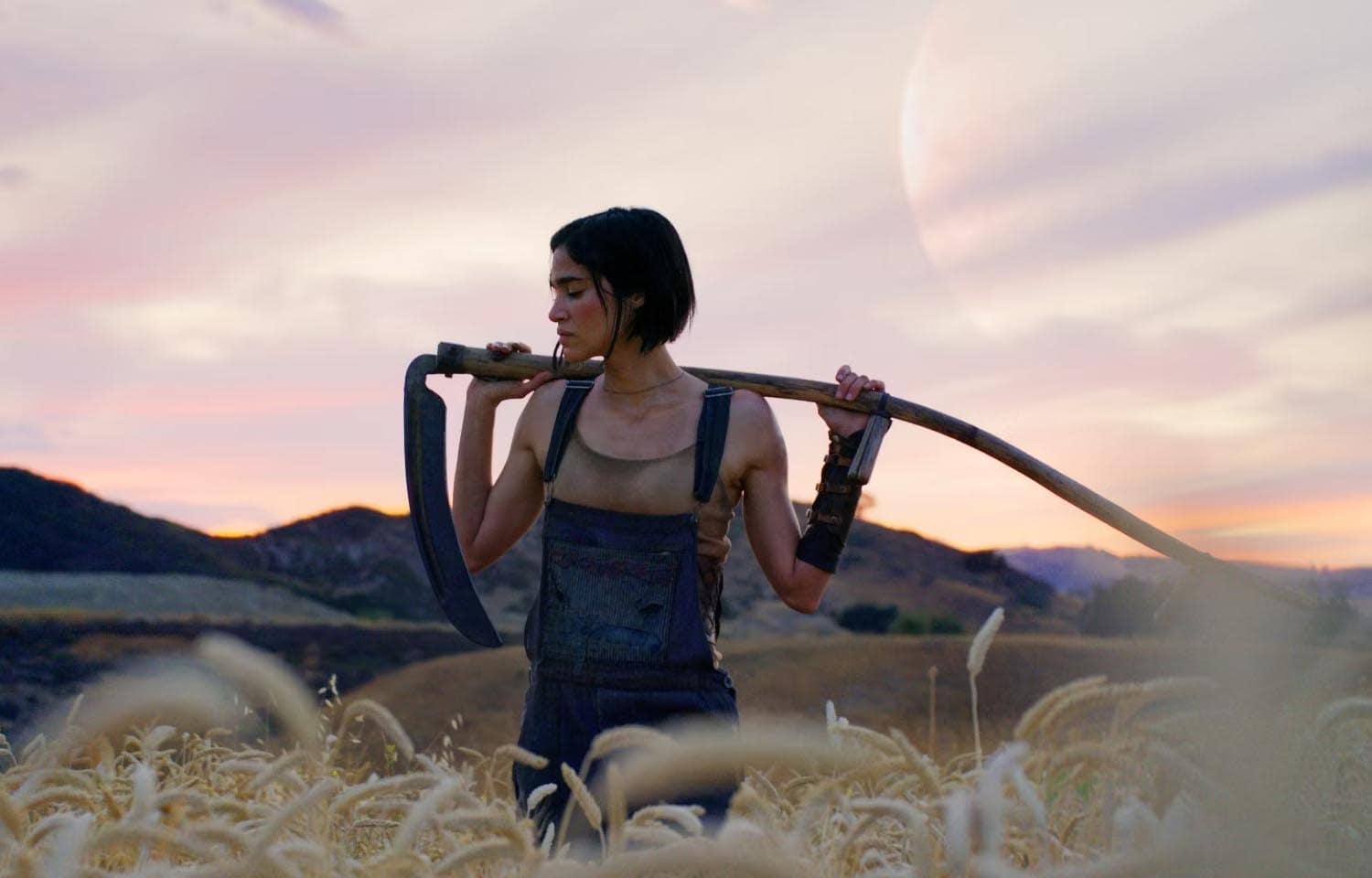
Rebel Moon began life as a Star Wars project before Snyder’s concept was turned down, and the resulting film often sounds as though the director and co-writers Kurt Johnsta and Shay Hatten did little more to their draft than perform a find-and-replace for any terms trademarked by Disney. The film even piggybacks off of George Lucas’s indebtedness to Kurosawa Akira: Its protagonist, Kora (Sofia Boutella), is a disillusioned veteran of the “Motherworld” autocracy who, in a blatant nod to Seven Samurai, resolves to raise an army to defend the farming community that’s taken her in and now faces subjugation by their galactic overlords.
Taking a cue from the original Star Wars trilogy’s contrast of a diverse rebellion against a homogenous empire, Snyder assembles a rich cast to play the resistance fighters on the remote moon of Veldt, from Djimon Hounsou to Doona Bae to Justice League’s Ray Fisher, who stand tall against a pointedly all-white cast of foes decked out in the most explicitly Naziesque uniforms to grace a sci-fi film since Paul Verhoeven’s Starship Troopers.
Snyder has a fine cast of actors to work with, but the film’s script saddles them with such lugubrious exposition dumps that everyone ends up sounding like a purely functional video-game NPC. The awkward dialogue is made worse by jagged edits that skip erratically over basic narrative developments. More than once, characters simply join Kora’s party without ever clearly stating their support, and elsewhere A Child of Fire careens from planet to planet in the space of a single cut, giving no sense of the scale of the story’s galactic setting.
The film’s visuals are another showcase for Snyder’s personal brand of metal-toned, alternately dazzling and exhausting sensibilities. Some of the environments that the heroes traverse are mesmerizing, most notably a colossal cobalt mining operation that’s turned the surface of a planet into a shimmering haze as global warming bakes the cityscapes of extraction facilities.

Elsewhere, however, certain locations were clearly not been envisioned beyond the narrow confines of the scenes that utilize them, making some planets seem as if they’re little more than a floating ship dock shrouded in the fog of a gas giant. There are also persistent tics, like an anamorphic blur at the edges of the frame, that, coupled with the aggressively flattened CGI backgrounds, undercut the opulence of Snyder’s compositions.
The action scenes are a highlight of A Child of Fire, and if Snyder had been able to make this a Star Wars-branded film as he originally intended, it would easily boast the most coherent, well-executed stunt sequences since Star Wars: Episode III – Revenge of the Sith. Doona Bae’s mysterious assassin, Nemesis, wields knockoff lightsabers with a practiced smoothness that’s matched by the elegant manner in which Snyder captures the warrior’s hair-trigger reflexes and precise attacks. Similarly, Boutella puts her dancer-honed control of body movement and gesture to great use to convey Kora’s prowess as a sharpshooter and fighter.
Snyder, as ever, over-relies on slow motion and speed-ramping to maximize the “cool” factor of gunshots and stabbings. There are numerous instances where he’s clearly had to cut around intended gore to get a PG-13 rating, but even so, there’s an up-close brutality to the combat here that’s worlds removed from the sanitized nature of so much contemporary blockbuster action.
But the relative grace of A Child of Fire’s action direction only underscores how disjointed and generic the rest of the film is. A longer cut may correct the frequent lapses of narrative logic, but that leaves the issue that these characters and their conflicts aren’t compelling enough to generate much interest in spending more time with them. Snyder relies on the audience’s pre-existing knowledge of space-opera conventions to do the heavy lifting of character development in lieu of providing any novel takes on well-worn tropes, which calls into question why it will take roughly the length of a miniseries just to fully introduce this property.
Since 2001, we've brought you uncompromising, candid takes on the world of film, music, television, video games, theater, and more. Independently owned and operated publications like Slant have been hit hard in recent years, but we’re committed to keeping our content free and accessible—meaning no paywalls or fees.
If you like what we do, please consider subscribing to our Patreon or making a donation.