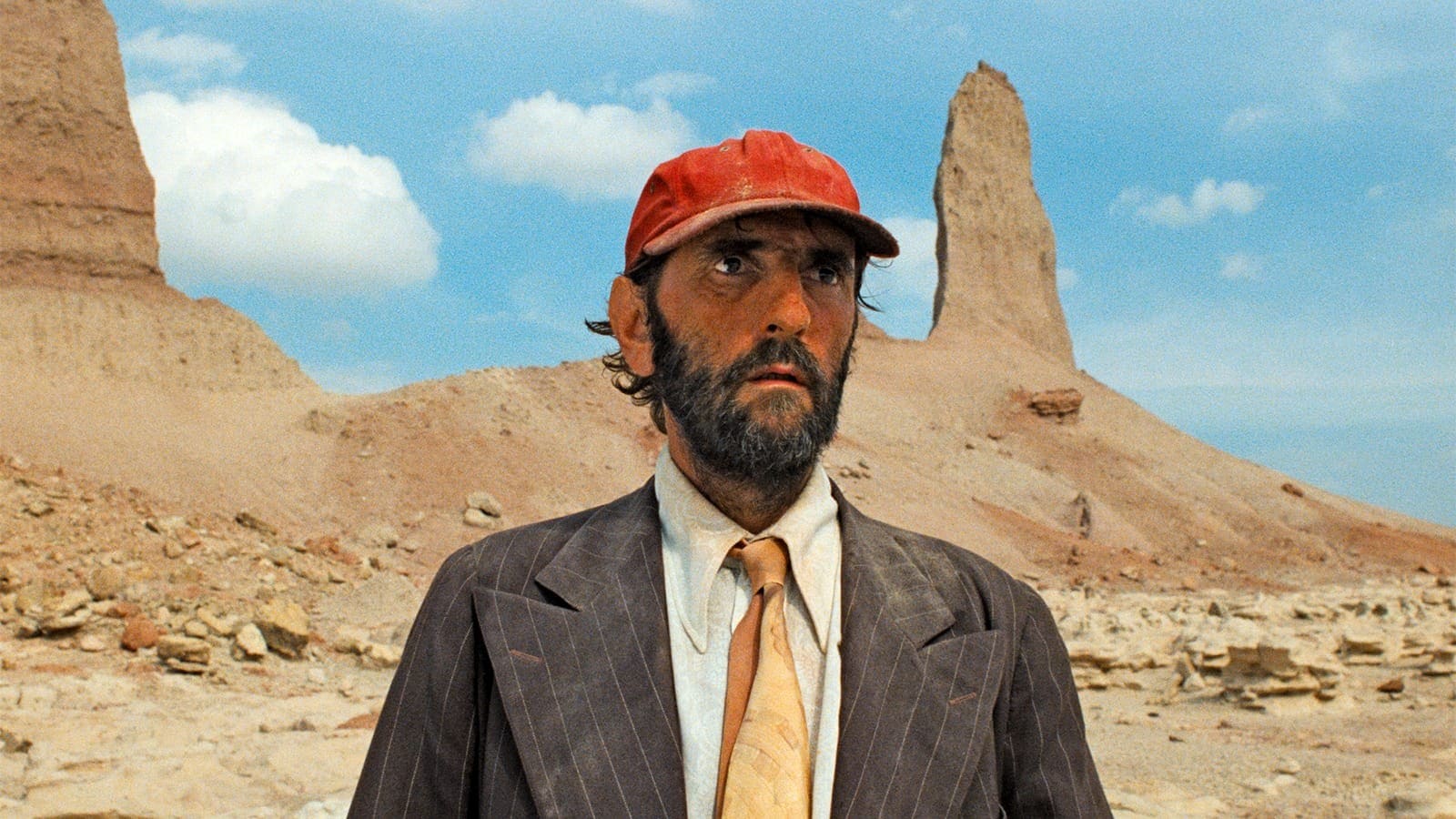
From its Southwestern skyscraper surfaces to its bush- and junk car-pocked bedrock, there’s something slightly off-kilter about the America of Wim Wenders’s Paris, Texas. The solidly masculine cast is nothing if not indigenous: For one, when the sun-punched Travis Henderson, played by Harry Dean Stanton, first stumbles into frame, his uncultivated, hirsute face and dusty red cap seem like natural geological formations that have been patiently waiting, cragged and craterous, for us to anticlimactically discover them. And the relationship-oriented, plot-shunning dialogue by multihyphenate creative Sam Shepherd taps into dialectal heartbrokenness without a shred of disassociating local lingo.
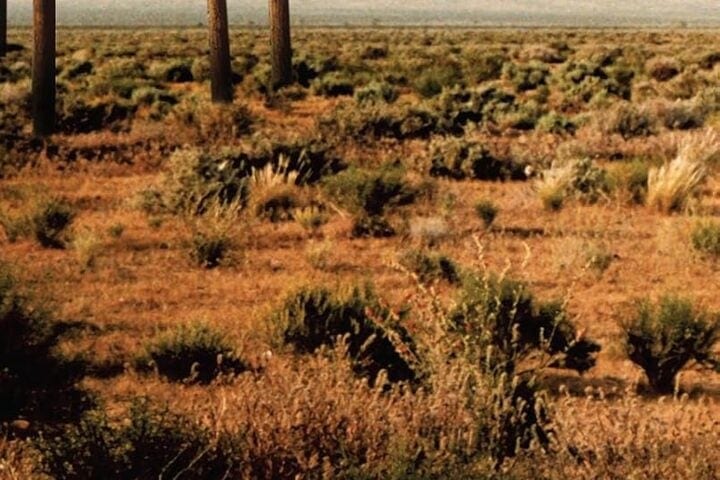
But there are tellingly alien factors out there. How did Travis and his brother Walt (Dean Stockwell) wind up with women who drip sophisticated European sex appeal from their ripe lips and honey hair? And why does every truck stop along highway 10 emit the same sickly green aura that glows like a clumsy, wistful metaphor against the ferociously red sunset? And how do aridly panoramic, sneeringly and smokily man-made Los Angeles skylines upstage the parched siltstone and yucca tree of God’s creation in a film with Texas in the title?
Perhaps we’ve forgotten already that “Paris” is in the title, too, and that it comes first. It’s meant to be an ironic juxtaposition, of course; none of the film takes place in the actual city of Paris, Texas, and the lot of stagnant tumbleweeds that Travis purchased there years ago on a whim provide little more than a conventional objective correlative onto which we can project Stanton’s subdued patriarchal anguish. But the angular name pairing additionally and eloquently encapsulates the film’s tension between the hopelessly foreign and the unforgivingly familiar.
Just as Ry Cooder’s soundtrack of plaintively metallic glissandos is a white academic’s soulful dissertation on authentic Black pain, the tenderly talented look and feel of Paris, Texas provided by Wenders (a German) and cinematographer Robby Müller (a Dutchman) elides spiritual resonance for human curiosity at every possible turn. This means the camera’s persistent hunt for beauty can adopt the detached yet voracious reverence of tourism, but in the film’s most memorable scenes this tendency infuses the talkative inaction with heart-halting anticipation.
Wenders and Müller stage the torturously prolonged conversation between Travis and his estranged wife, Jane (Nastassia Kinski), at the peep show where she works under sullen blue lights, a two-way mirror dividing them, that reminds us of soon-to-be-closing supermarkets, framing the ex-lovers as if they’ve never heard two Americans speaking so honestly with one another before about their mutual history or their feelings. The punctiliously wide-eyed wonder infects even those of us who are weary of trailer park tragedies with an empathic impatience for how the loose ends will tie up or simply slacken through the conversation.
Where Wenders attempts to find his common, stabilizing ground—his personal identification with the international material—is in the paradoxical fusion of family cohesion and the search for independence, a tug-of-war embedded not only his languid “Road Trilogy” (also shot by Müller), but also in domestic influences on Paris, Texas such as 3 Women, Robert Altman’s opiatic ode to California. As with the warped, often menacing faux-sisterhood binding Sissy Spacek and Shelley Duvall’s characters in that remarkably American movie, the unorthodox bond between Travis and his abandoned son, Hunter (Hunter Carson), rests tenuously on a foundation of bewildering regret and the irrepressible lamentations of a shamanic id.
Travis’s transformation throughout his trek from low desert to high and back again is subtle enough to entirely ignore, though he does go from refusing to speak to his haplessly responsible brother to embracing a newfound fluency in the language of imperfect reconciliation by film’s end. Wenders’s emphasis, as usual, is on the volatile mutation of the journey rather than its lasting effects on the journeyman. Unlike many a Jim Jarmusch travelogue, we don’t fantasize Travis or Jane as autonomous beings with lives that assert themselves past the end credits.
We instead think back on winding dirt roads exhaling furious clouds, the gray concrete of freeways caught in an impromptu firmament with a disinterested sky, and multi-layered, nocturnal rainbows of meretricious neon. Paris, Texas may be missing a crucial piece of authentic Americana, but it still evokes a thorny America that most Americans yearn to gaze on. That is, an America that’s as carnivorous as a hawk, as raw and smug as a downtown mural, and as sweetly enigmatic as a vacant lot that doesn’t—that can’t—exist.
Since 2001, we've brought you uncompromising, candid takes on the world of film, music, television, video games, theater, and more. Independently owned and operated publications like Slant have been hit hard in recent years, but we’re committed to keeping our content free and accessible—meaning no paywalls or fees.
If you like what we do, please consider subscribing to our Patreon or making a donation.