
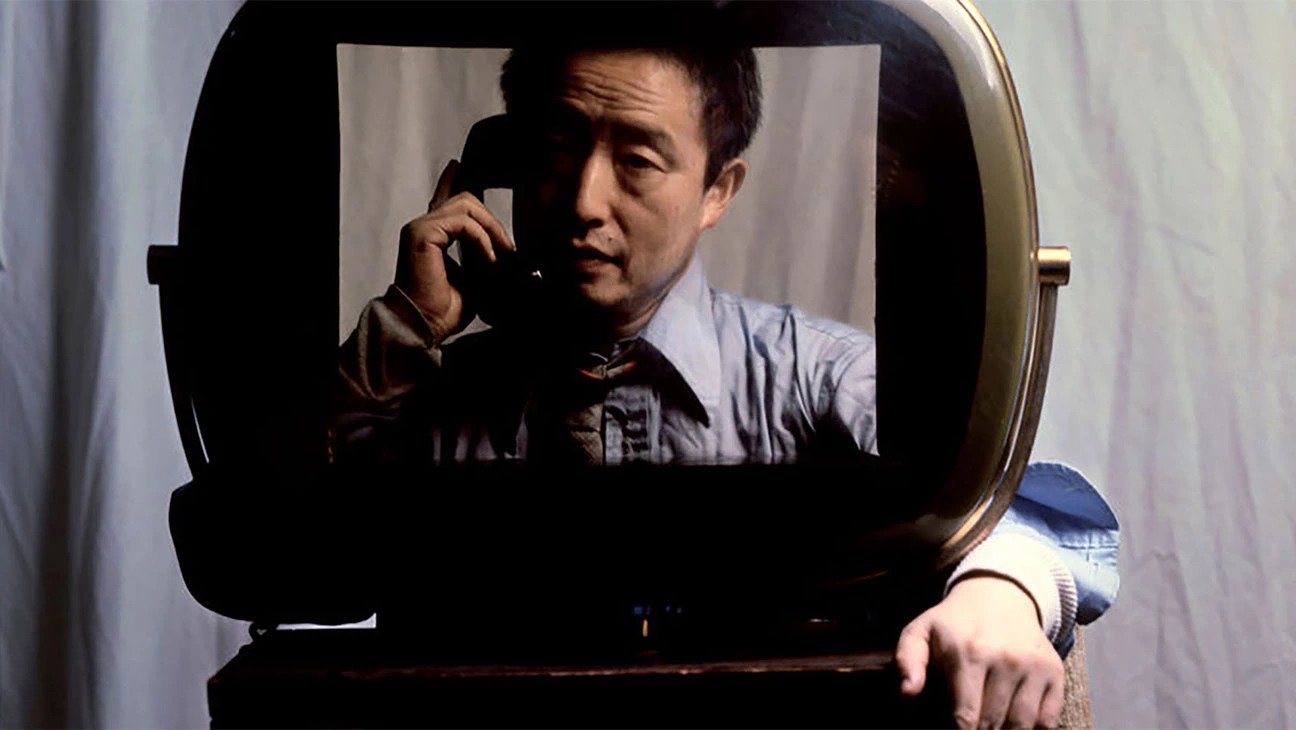
Nam June Paik’s Global Groove, one of the most radical and forward-thinking pieces of video art ever produced, opens with a rather bold proclamation: “This is a glimpse of the video landscape of tomorrow, when you will be able to switch to any TV station on the earth, and TV Guide will be as fat as the Manhattan telephone book.”
Over its remaining half-hour runtime, Paik’s 1973 piece wholesale delivers on this promise by providing what amounts to a modern-day approximation of scrolling through random feeds of internet-generated content. That is, one where you’re just as likely to witness cellist Charlotte Moorman playing TV Cello—a 1971 sculpture that Paik made consisting of three TV monitors wired together, with four bass guitar strings laid on top, in order to replicate a “normal” cello—as you are a spoken-word interlude by experimental musician John Cage.
For almost any other artist, this game-changing tour de force would cast a long shadow over the rest of their artistic career. But for Paik, it’s a mere footnote in a vast and influential body of work, one that continued to push boundaries for a solid three decades until his death in 2006. By the time Global Groove is even mentioned in Amanda Kim’s affectionate Nam June Paik: Moon Is the Oldest TV, the documentary has already hit its midpoint, with plenty of ground still left to cover, including, but not limited to, the equally ambitious “Good Morning, Mr. Orwell,” an internationally broadcast satellite “installation” that occurred on New Year’s Day, 1984.
Like many artist documentaries, Moon Is the Oldest TV is an exercise in selection and emphasis, where what it chooses to focus on at any given moment is guided more by available interviewee subjects and whichever estate-owned footage was secured than by telling a comprehensive chronicle of history. For those who know little about Paik’s beginnings as a classically trained pianist in South Korea, and that he eventually turned to the avant-garde after chance encounters with Cage and Karlheinz Stockhausen in Germany, the film will prove illuminating. But that’s mostly insofar as many of the talking heads who pop up during the film’s first leg will be relatively unknown entities to those coming at this from an art history background.

The film begins to lose some of its focus after Paik meets artist George Maciunas and, later, joins Fluxus, an interdisciplinary collective of international artists that was co-founded by Maciunas. From there, Kim proceeds to zig-zag through the story of Paik’s life, closely scrutinizing his privileged upbringing and focusing heavily on his, quite literally, starving-artist period right before his ascension into international acclaim. But Kim doesn’t provide much context about the art world that Paik inhabited, and scant attention is paid to his lesser-known known work (and none to any of his many early collaborations with experimental filmmaker Jud Yalkut).
Other pioneers of the video art field, such as Ed Emshwiller and Lillian Schwartz, aren’t even so much as mentioned or referred to as Paik’s contemporaries. Neither of them are the focus of Moon Is the Oldest TV, but the omission proves how narrow the film’s scope can seem at times. Still, better to be outright excluded than included in the defaming manner that Kubota Shigeko, a formidable artist in her own right, is: as a hanger-on groupie of Paik’s who, after wearing him down long enough, was able to finally convince him to marry her.
Worse than any of these apocryphal attempts at reiterating history, especially when it comes to detailing the last two decades of Paik’s life, is Moon Is the Oldest TV’s bombastic formal approach, as there’s very little breathing room for the viewer to appreciate any of Paik’s work whenever it’s shown. Just about any time that Paik’s video pieces are showcased, it’s usually accompanied by some intrusive voiceover provided by Steven Yeun reading Paik’s own written words on said piece, a rapid cut to some other tangentially related stock or news footage to these writings, or a poorly placed music cue—or worse, a noxious combo of all three.
The film might have benefited from taking a page out of 1965’s Zen for Film—another one of Paik’s best-known works that’s all but completely ignored here—and slowed down its flow. But like the rest of Moon Is the Oldest TV, its later segments feel paradoxically overstuffed and undercooked, trying to tell the audience a bit too much in regards to the scant archival materials glimpsed throughout, while also failing to provide a comprehensive picture of Piak’s entire career for the material to matter much in the grand scheme of things.
Since 2001, we've brought you uncompromising, candid takes on the world of film, music, television, video games, theater, and more. Independently owned and operated publications like Slant have been hit hard in recent years, but we’re committed to keeping our content free and accessible—meaning no paywalls or fees.
If you like what we do, please consider subscribing to our Patreon or making a donation.




A kind review of extreme wastefulness of PBS resources. Likely a result of their devotion to diversity at any cost. I would detail further why it’s such a waste and destructive of the support of beauty but it isn’t worth the effort to craft a detailed reply at this time. Should be a wake up call about PBS and how they spend our donations.