“The feeling is very strong,” describes Pascal Greggory’s Georg Kinzler of his dementia in One Fine Morning, the latest film by Mia Hansen-Løve. “I wait for the thing that should come, and we don’t even know when it will stop. Or begin.” Paradoxically, the same description could apply to the filmmaker’s style of cinematic remembrance. Across her eight features, which frequently draw from her own life experiences, Mia Hansen-Løve has emerged as one of the foremost cinematic emissaries of the everyday. Her supreme talent lies not in the accumulation of events or emotions but in their juxtaposition.
One Fine Morning is her latest work to locate drama outside of a conventional narrative arc as it chronicles a widowed single mother, Sandra Kinzler (Léa Seydoux), navigating a curious confluence of forces in her life. Sandra finds unexpected romance with the married Clément (Melvil Poupaud) during a trying period in which she must care for her ailing father (Greggory). Hansen-Løve lets neither development define the character’s story, instead showing how their coexistence forces Sandra to work her way through the confusion to find contentment.
I chatted with Mia Hansen-Løve prior to the stateside theatrical release of One Fine Morning. Our conversation covered how she approaches autofiction, what draws her to characters with strong vocations, and why she envisions her body of work as a cinematic family.
Last year, I spoke with Charlotte Wells after the two of you were in dialogue at the New York Film Festival. She said something when thinking about Aftersun in tandem with your film, about the relationship that film has to memory and what it means when a person is no longer there to fill out that experience with you. How do you think of the relationship between the film and the memory of your father, especially now that he’s unfortunately no longer here to share it with you?
Well, actually, two days ago, I made this observation while I was thinking exactly about that. While I transform parts of my everyday life into fiction with some of my films, this is a very healing and hypnotic process for me. At the same time, while the fiction becomes very real to me, reality tends to become less real. It’s almost disturbing or confusing to me to [think about the] people who inspired the characters in my film. It’s not that I don’t think of them anymore. I do, I think of them a lot. But the memory I have of them is influenced by their existence on screen and the way they were transformed. I wonder if this is like a process of using film as a way to put a distance between you and reality and protect you from those memories.
You’ve described your films as “imagination and experience meeting,” which is an apt description because it encapsulates the personal and artistic dimensions of your work. How do you know when you’ve come to this point? Many filmmakers, I would argue, don’t and make audiences sit through their therapy session.
The films are never just like an imitation of reality to me. They want to find the truth, the quintessence of an experience. But to find that, it’s a process that involves a reinvention and using your imagination. It’s never purely transparent. And you cannot be transparent when you make a film, even if it’s realistic, because it’s always a recreation. There are some things you choose to tell, and some things you don’t. It’s actors playing a part. And I was never interested in doing a documentary on parts of my life. For instance, I was never inspired to make a film that would look exactly the same [as] I see my everyday life. It can sound paradoxical because, on the one hand, I’m always trying to recreate a presence, reality, or memory. But, on the other hand, there’s always a part that involves intensification or invention.
I also spoke with Vicky Krieps when she was promoting Bergman Island, and she raved about how she was able to enrich her character in that film through her own personal experience. She said, “I think Chris and making the movie rubbed off on me a lot, in ways I cannot even say. And the character became the character also because of what I was going through.” Do you think that’s a phenomenon particular to that specific role and film, or do you think that’s an experience that Léa Seydoux or any other performer in your films might also encounter?
In her case, it really has to do with the part in Bergman Island that’s really special in terms of how much of the film deals with the dialogue between fiction and reality for directors. I think it spoke to her a lot. And the fact that she was playing the director made her feel that even more. I don’t know if I could say that it’s true about all actors, although I think most of the actors who I work with would probably say that there was some deep connection between them and their past. But that really belongs to them, and I don’t want to sound like I’m speaking for them.
In the case of Léa, I don’t think she would say that she feels very close to the character in terms of her life or personality. She has a different story. She doesn’t have the same kind of relationship to her father like Sandra has in the film. But I think she felt like [she was being] filmed more nakedly than usual—not because of the story of the film, but more because of the style. The fact that she was filmed as a real person and not just the fantasy of a man. The fact that she had a daughter, an everyday life. That she would wear sweaters and had short hair that didn’t allow her to act with her hair like many actresses do. There was a nudity about the way I was filming her and a minimalism that made her feel like the camera came, in some ways, even closer to her or looked at her more intimately. But, as a lot of directors have said before, all films always have a dimension of a documentary [about] the actors. Even if the actors are very different from the characters, [the films] always tell you something about the actors.
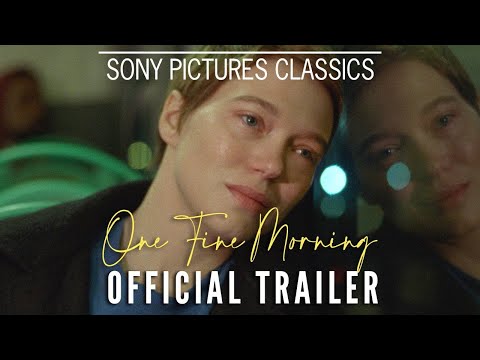
As I re-watched the film, I was struck by how much time we spend with Sandra in transit, which feels like a key to understanding how she’s processing these competing forces of joy and tragedy that are converging in her life. How do you and Léa approach these to ensure they didn’t just feel like throwaway moments?
It’s funny because I didn’t realize when I was filming her coming out from a bus, going to a building, getting on the metro, walking the streets, that [I was doing that]. To me, they were [like a natural] part of her path in the film. I needed to see her moving to see her presence, to feel who she was. For me, it was just an obvious part of the story. Afterward, people mentioned it a lot—that it’s uncommon to see so much transportation in a film. And then I realized that there’s a lot of that in all of my films. If you’re interested in filming the life of people when it’s not spectacular—because I’ve always thought that there’s more truth about our life when we show moments that aren’t always dramatic—you have to film people walking or taking the bus.
You don’t go back and watch your previous films, but how do you consider them in relation to creating new works given that you talk about your cinema as if you were building new floors in a house? I’m thinking in particular about how One Fine Morning might be in conversation with Things to Come, which also centers around a woman losing a parent and contemplating a new romance.
I did think of Things to Come when I was writing this one, and it helped me to see them as a diptych. And, for instance, when I wrote Goodbye First Love, I had the feeling that three of my first films formed a triptych. They belong together as portraits of young women. So, yes, I still have the same desire to build a body of work where all the films not only work as themselves—and I hope they do—but also work together and become like a family. In families, not everyone has a good relationship with everyone! [laughs] It doesn’t mean that it has to be in perfect harmony, but I like the idea that everything is a part of a big whole. I’ve always had the desire to make films that were one big film, like the film of life! That inspires me to write on, actually.
It’s your version of a cinematic universe! The MCU, but the M stands for “Mia Hansen-Løve” instead of “Marvel.”
[laughs] In a way, yes. Bergman also did that with his films, not only because he would work with the same actors over and over. But also, he was always repeating the same names. There were just like three full names that they would all have again and again, and it always gave you the feeling that there were just three or four couples that he was actually filming nonstop.
So many of your films end with a character beginning to wander out of frame or giving some other indication that life continues even after we stop looking at them. Why did you choose to end One Fine Morning on a freeze frame?
I did finish another film on the freeze frame before, Maya. Actually, to me, it’s the same [ending]. I think all of my films actually end the way you say: in a way that you can feel life as if continues afterward. They end on some kind of horizon opening [in the characters’ lives]. This one, too, it’s also geographic because you see them walking up the stairs to the Sacré-Cœur, and you see all Paris at their feet for the first time. You see the bright horizon. To me, I like trying to capture an instant, the beauty of a moment, and try to make it eternal. The last word. And to stop in a movement, actually, so it’s freezing but it actually has to do with movement. And the moment where it freezes in the film is a moment where the character of Clément puts his hand on Léa’s shoulder. I stop, but it’s actually about movement and gesture.
Your films all center around a character’s vocation, many of which feel like veiled representations of your relationship to filmmaking. Whether it’s a DJ, an architect, or a translator, is it important to represent those crafts faithfully? Or is it more about how you or your characters come to understand their own relationship to their own work?
First of all, I like using cinema as a tool to learn more about the world and things I’m interested in. So when I was filming music, or architecture, or even philosophy in Things to Come, these are [subjects] that I am familiar with but superficially. Making a film with characters who are involved in [those things] is a way for me to enlarge my experience of life and my knowledge. The other thing is that I have always felt, almost like a handicap, that I could never make a film where a character doesn’t have some kind of vocation. I wish I could finally make a film where somebody has just a boring job that’s really not interesting, where real life comes after the job. A lot of people have jobs they don’t like and just do it in order to make money, and in most of my films, characters can go through that at some moments. But, in the end, they always have this vocation that they really want to pursue. I think it has to do with the way I grew up with parents who were so fascinated by their jobs, and that’s something that transmitted to me: the idea that you have to love to work, and you have to find a way to work in something that you really love.
You talk a lot about how your life informs your art, but does your art inform your life? Does making films like One Fine Morning that view euphoria and melancholia as forces that can coexist give you resilience in dark moments?
I think I’ve learned a lot from my films. I think they’re much wiser than me. Sometimes people think I’m very wise because my films are seen as quiet, and I’m not quiet at all. Or, at least, I’m less quiet than the films. Yes, I do feel like the films helped me see my life in a better way or find a better distance to my experiences. That’s probably true about One Fine Morning, which helped me so much in coping with my father’s death. But Bergman Island, for instance, made me understand many things about being an artist and mother at the same time and how much it could nourish my work. It’s something that became clearer to me after. Maybe it was there in the script from the start, but I became more aware of it after the film was finished.
Since 2001, we've brought you uncompromising, candid takes on the world of film, music, television, video games, theater, and more. Independently owned and operated publications like Slant have been hit hard in recent years, but we’re committed to keeping our content free and accessible—meaning no paywalls or fees.
If you like what we do, please consider subscribing to our Patreon or making a donation.