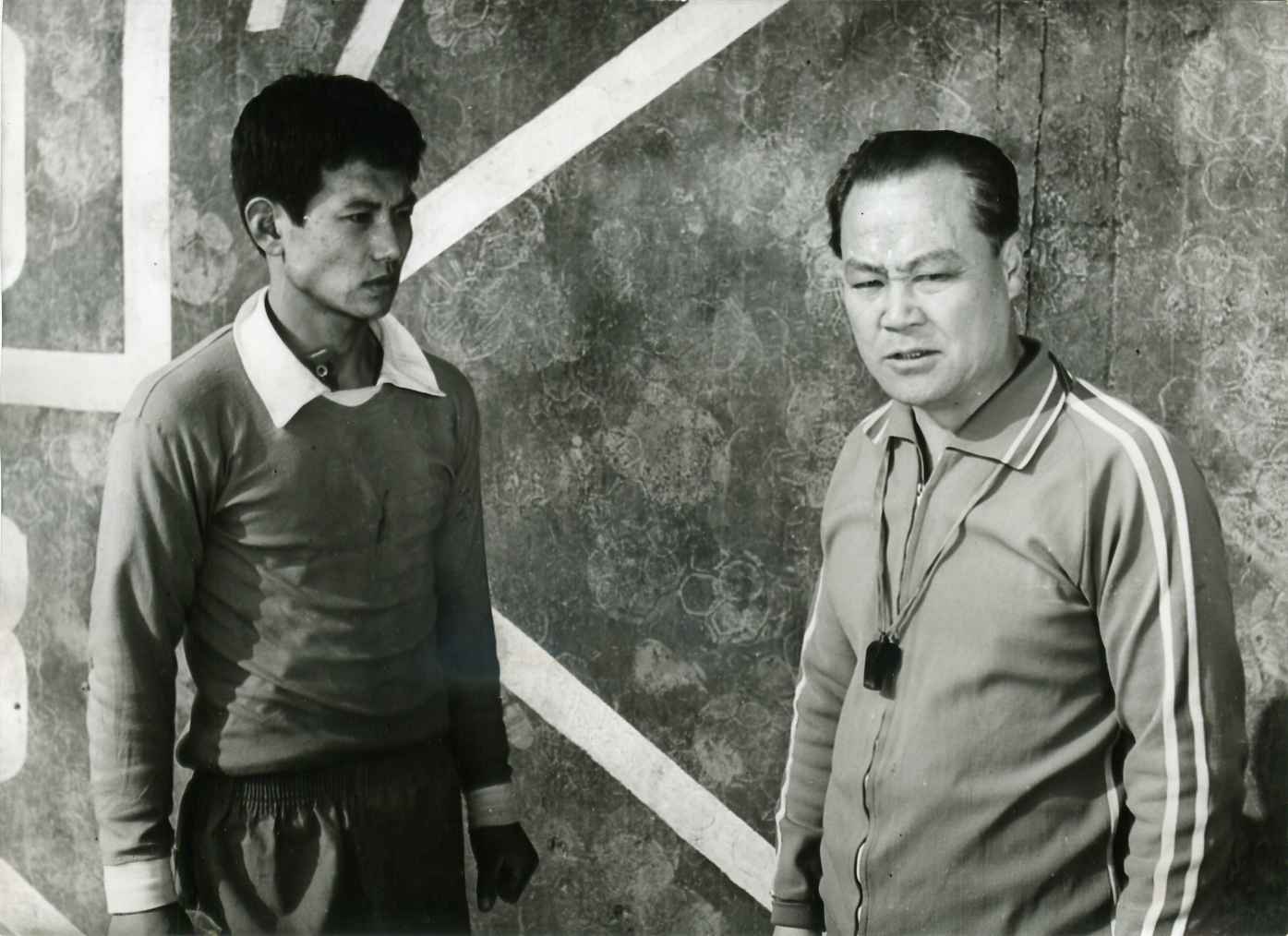
As a propaganda film, Pak Chong Song’s Centre Forward confirms every nebulous assumption one might have about how all cultural roads in North Korea lead to stolid, state-mandated kitsch. Shot in 1978, this stiff but entertaining melodrama is utterly transfixing thanks to its quaint ability to take a seemingly innocent subject—a soccer player’s drive toward becoming a striker—and elevate it to nigh-Olympian importance. The film climaxes prematurely during a brutal training montage in which the film’s aspirant young protagonist forces himself to shoot 100 consecutive goals while his coach eggs him on. Anything less and he would be forgetting his “responsibility to your team and the motherland.”
The fate of the team, the game, even possibly the country rests on the slender shoulders of In Son. He’s just recovered from a bad injury, but is already considered to be a hopeless cause after he underperforms during his first game back. He has to get motivated again and fast because if he doesn’t, he’s letting the great leader down. Even In Son’s mother eventually becomes convinced that he has to eat, sleep, and poop soccer 24/7. “A soccer player should practice so much that he can score a goal with his eyes closed,” she intones solemnly. Her mother agrees: “Definitely.”
The aforementioned training sequence is Centre Forward’s most violent scene, which tells you a lot about the delicacy of the film’s tone and its depiction of filial duty. This is the North Korean state as we like to imagine that it likes to imagine itself: Good citizens prefer to constantly tell each other that they’re letting each other down, making verbal assault a more pervasive crime than physical battery. Then again, images of In Son launching volley after volley of balls at a scoreboard at night are surreally noirish as the scene is underlit by the stadium’s lights. It gives you a brutal image of self-sacrifice that says more than a scene of traditional violence might.
That grim image is also juxtaposed with an earlier scene of In Son practicing alone at dusk. His coach interrupts his routine and reminds In Son of how much his efforts mean and why he needs to attention during the game. It’s important to note that In Son’s coach never really compliments him, just makes sure that he knows not to screw up. He does it in such an amiable and paternal way, as if he weren’t telling In Son that the fate of the entire soccer match directly revolves around his performance. His hyperbolic pleas will escalate later to the point where he warns In Son that their great leader has “taught us to make the country a kingdom of sports. Let’s accomplish his teachings by working even harder.”
But that earlier moment at dusk is downright romantic: A Norman Rockwell-esque lake complements a small copse of trees as the coach gives In Son his pep talk. The rift between this image and In Son’s nighttime practice is vast and more than wide enough to accommodate the huge gaps in our knowledge of North Korean culture, gaps that movies like Centre Forward only serve to enforce. If anything, In Son’s plight only serves to further mystify our understanding of the country, providing a portrait of life in Bizarro World that’s impossible to look away from.
The Korean American Film Festival New York runs from March 17—20.
This article was originally published on The House Next Door.
Since 2001, we've brought you uncompromising, candid takes on the world of film, music, television, video games, theater, and more. Independently owned and operated publications like Slant have been hit hard in recent years, but we’re committed to keeping our content free and accessible—meaning no paywalls or fees.
If you like what we do, please consider subscribing to our Patreon or making a donation.