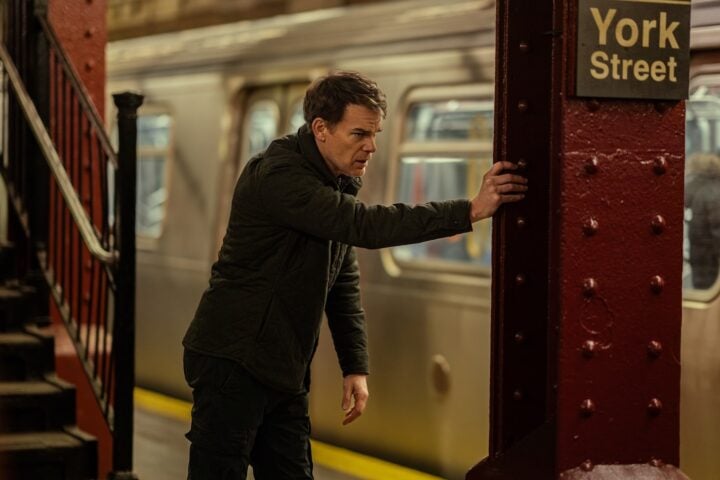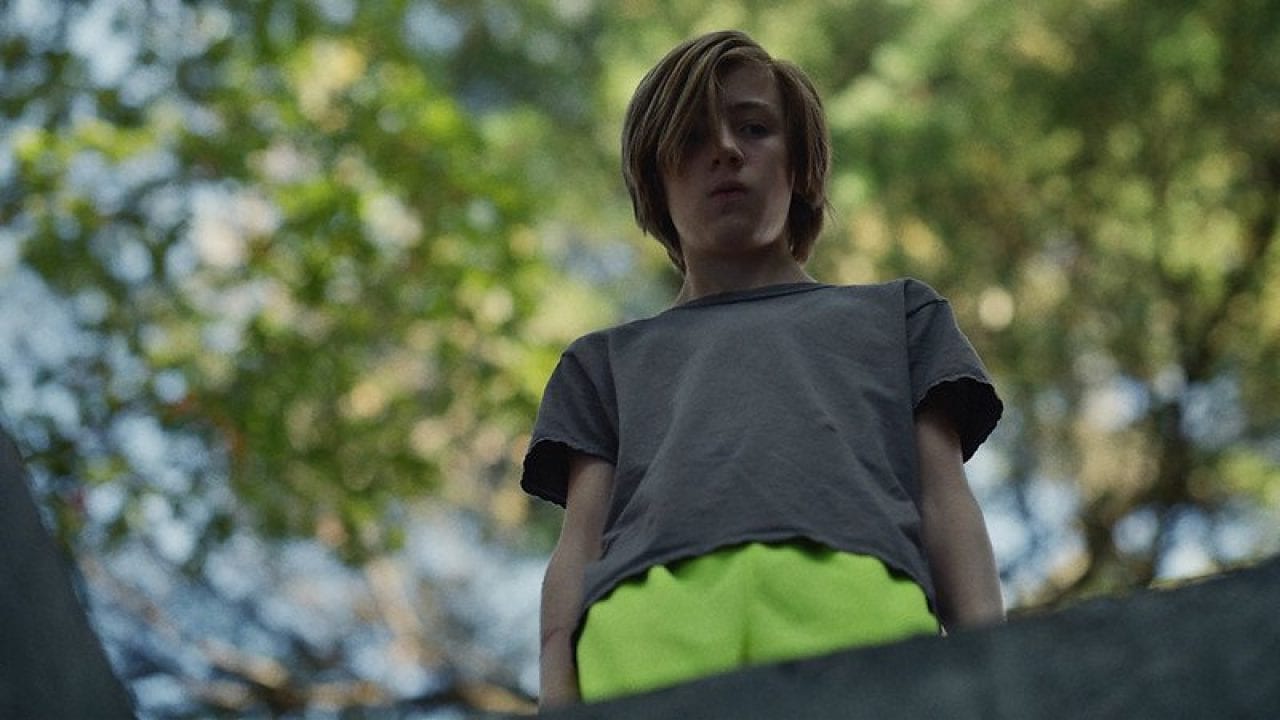
At the start of John and the Hole, Pascual Sisto’s refreshingly strange account of a transference of power and reversal of roles between a child and his parents, 13-year-old John (Charlie Shotwell) finds a hole in the forest near his family home while playing with his drone. Not long after, John will, one my one, take his drugged parents (Jennifer Ehle and Michael C. Hall) and sister (Taissa Farmiga) via wheelbarrow to the hole and drop them inside. Once awake, his parents and sister are confused, scared, and incapable of crawling out. When John shows up, looking down at them and offering them provisions like a kidnapper, he provides no explanation as to why they’re in the hole and he isn’t.
John and the Hole recalls Marco Dutra and Juliana Rojas’s Hard Labor, which also features an allegorically charged hole as a major plot point: a fissure in the wall of a grocery store from which strange smells and other things materialize. In Sisto’s film, though, the hole is an unfinished concrete bunker deep in the ground, a place to go “in case something bad happens,” as John is told. For him, it seems, that translates to a kind of time-out space for grown-ups to think about their actions while the child enjoys the freedoms that adulthood allows.
Like all fantasies, though, this one isn’t sustainable. Throughout the film, the family home slowly deteriorates without the adults to tend to it. John has to also dodge the inquisitive gaze of his mother’s friend, Paula (Tamara Hickey), and the family gardener, Charlie (Lucien Spelman), who wonder where everyone has gone, why the grass is no longer manicured, and how the swimming pool has gone to filth. Sisto and screenwriter Nicolás Giacobone understand that this is the sort of behavior that dooms teenagers to their misery: their knack for using the most irritating of means to call on others to pay attention to them.
Sisto’s artistic sensibility is reminiscent of Angela Schanelec’s, what with his careful attention to language, poker-faced humor, and trust in the fruitful affects of dead time. Early in the film, John asks Charlie what “weeding” is with the deep interest we normally see in children. John also wants to know from him specific examples of “pests,” a word the gardener uses, and whether or not rats fall into the category. In another discretely absurd scene centered around a word, John makes risotto for his family and drops it into their concrete prison, before then encouraging them to try the wine that he brought them. In a lesser film, such moments would be creepy for their own sake, but Sisto and Nicolás liberate their scenes from a purely narrative function, allowing them to idiosyncratically hint at everything that’s shaped this family and the things they would likely prefer to not acknowledge about their lives.
John and the Hole is most impressive when it proceeds as a series of confounding and uncanny situations, when it’s shaped by that deadpan farcicality that distinctly recalls Schanelec’s work. But it loses its mysterious luster at times, as when the simmering drama of what John is doing to his family is interrupted by an overtly dramatic and ultimately superfluous framing device in which a mother (Georgia Lyman) tells her young daughter (Samantha LeBretton) the story “about the hole” before later telling her that she’s old enough to live on her own. Elsewhere, the film too explicitly tries to articulate John’s motives when his mother tells his father that she remembers the boy asking her what it feels like to be an adult.
The narrative of the bunker as a prison is so rich that it’s best served when Sisto stays in its vicinity, waiting for something indelible to emerge from it. In one sequence, the camera slithers into the slick family home ever so smoothly, as if on the back of the drone that John lost in the woods, and lands on the boy playing a piano. It seems as if the sequence is of no narrative consequence, until John stops playing the piano for a few seconds, hearing a storm in the distance. We know the family continues to wallow in muck at the bottom of the bunker, trying to forge an escape to no avail as John continues to play the “adult music.” For a moment, the music suggests a sort of pupil’s ode to having outsmarted his masters.
Since 2001, we've brought you uncompromising, candid takes on the world of film, music, television, video games, theater, and more. Independently owned and operated publications like Slant have been hit hard in recent years, but we’re committed to keeping our content free and accessible—meaning no paywalls or fees.
If you like what we do, please consider subscribing to our Patreon or making a donation.