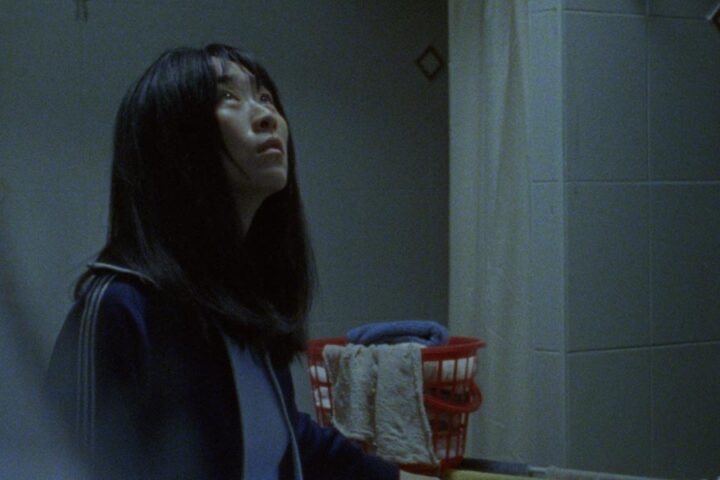
Though there was no explicit theme across its broad variety of films, much of the international competition at the 2023 Jeonju International Film Festival seemed to address a particular type of alienation in contemporary society. A real standout was Chinese filmmaker Wu Lang’s debut feature, Absence, which premiered earlier this year at Berlinale. Starring frequent Tsai Ming-Liang collaborator Lee Kang-sheng as Han Jiangyu, a man attempting to build a new life with his estranged partner (Li Meng) and the child (Liang Wangling) who only recently learned of his existence following a 10-year prison stint, it owes a clear debt to Tsai’s work, with elements of Jia Zhang-ke also noticeable in its DNA.
As the film’s central story proceeds, seemingly dissolving into obscure fragments following a relatively linear, economical opening stretch, Wu’s richly textured imagery turns the decaying urban environment of modern-day China into a lyrical evocation of Han’s own struggle to recapture lost time and a sense of identity. Though it might ultimately be a little too elusive for its own good, limiting its potential for lingering emotional resonance, Absence’s impressionistic beauty definitely announces the arrival of a promising new cinematic talent.
A notably more optimistic mood animates the documentary Orlando: My Political Biography, which presents the unstable, nebulous nature of modern selfhood as something to be admired and passionately defended. Written and directed by contemporary queer theorist Paul Preciado, it’s a multi-faceted exploration and celebration of trans identities and the struggle against the ever-evolving demands of a patriarchal society, one that blurs the boundaries between reality and fiction with clear socio-political intent.
Preciado’s film takes inspiration from Orlando: A Biography, Virginia Woolf’s 1928 proto-feminist satire, which itself drew on the turbulent life of the author’s aristocratic friend and lover Vita Sackville-West. The novel follows the adventures of a poet who undergoes an unexpected sex change from male to female and goes on to live through over three centuries of English history, meeting many of its most iconic literary figures, and My Political Biography shares its slippery intertextuality and playful disregard for convention.
Both an ongoing conversation with its source material and a loose adaptation of it, Preciado’s semi-autobiographical essay film interweaves quotes and plot points from Woolf’s work into the intimate, self-reflective personal testimonies and ruminations of a number of trans men and women, often jumping between different registers and narratives within the same scene. As each of these individuals is introduced they announce that they will be playing Orlando, and My Political Biography suggests a potential liberation in this identification with a mythical figure, a consciously performative self-authoring that defies normative social categories and expectations. Throwing together elaborate period costumes, archive footage of 20th-century queer trailblazers, abrasive musical cues, and bucolic nature imagery, Preciado’s postmodern collage has a scattershot dynamism that prevents it from ever becoming overly didactic.
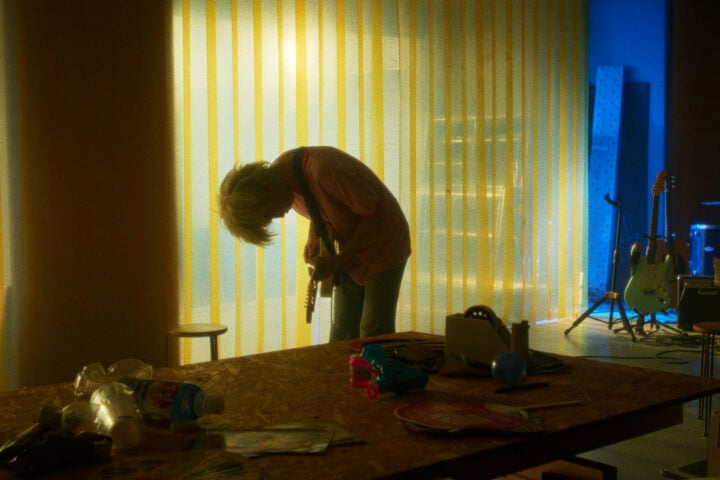
Awarded the grand prize by the international competition jury, Ota Tatsunari’s There Is a Stone employs a much more muted palette, though as a portrait of social outsiders and misfits it’s no less affecting and humane. The film revolves around an unnamed woman (Ogawa An) from Tokyo on an excursion to an anonymous town in the rural suburbs. After wandering around aimlessly for a little while, struggling to find any tourist spots of interest and reluctantly joining a football game with some local kids, she gradually strikes up a friendship with an oddball (Kanou Tsuchi) who she sees skimming stones on the opposite side of a river.
Unfolding mostly in real time, There Is a Stone taps into a surprising depth of feeling with the most barebones of stories, relying largely on sensitive, nuanced performances by its two leads. Their characters are briefly able to find some meaning and purpose in the comfort and companionship that they can offer to each other, in an even more desolate, nondescript version of Absence’s hollowed-out urban landscape. Ota’s film is content to merely observe the mundanity of life in this place, and its patient approach succeeds in paying proper homage to the kind of chance encounter that an isolating modern world rarely allows to emerge.
The Jeonju International Film Festival runs from April 27—May 6.
Since 2001, we've brought you uncompromising, candid takes on the world of film, music, television, video games, theater, and more. Independently owned and operated publications like Slant have been hit hard in recent years, but we’re committed to keeping our content free and accessible—meaning no paywalls or fees.
If you like what we do, please consider subscribing to our Patreon or making a donation.