Connect with us

Film

Review: Donkey Skin

The films of Jacques Demy take adolescent romantic dreams and utterly vindicate them.

3.5

Published

on

Donkey Skin
Photo: Janus Films

The films of Jacques Demy have nothing to do with reality; they take adolescent romantic dreams and utterly vindicate them. His first four films (Lola, Bay of Angels, Umbrellas of Cherbourg, and Young Girls of Rochefort) are all masterpieces. After stumbling a bit with his fifth film, Model Shop, Demy regained his footing with 1970’s Donkey Skin, a cool, shimmering version of a classic French fairy tale by Cinderella author Charles Perrault. It features the crème de la crème of French actors (Catherine Deneuve, Delphine Seyrig, Jean Marais, Micheline Presle, and Jacques Perrin) and a score by Demy’s frequent collaborator Michel Legrand. For the past few years, Demy’s wife, Agnès Varda, has been meticulously restoring Demy’s films and then premiering them at Film Forum in New York. She skipped the problematic Model Shop, but hopefully she has plans for Demy’s seventh film, The Pied Piper, and Une Chambre en Ville, which is supposedly the best of his late movies.

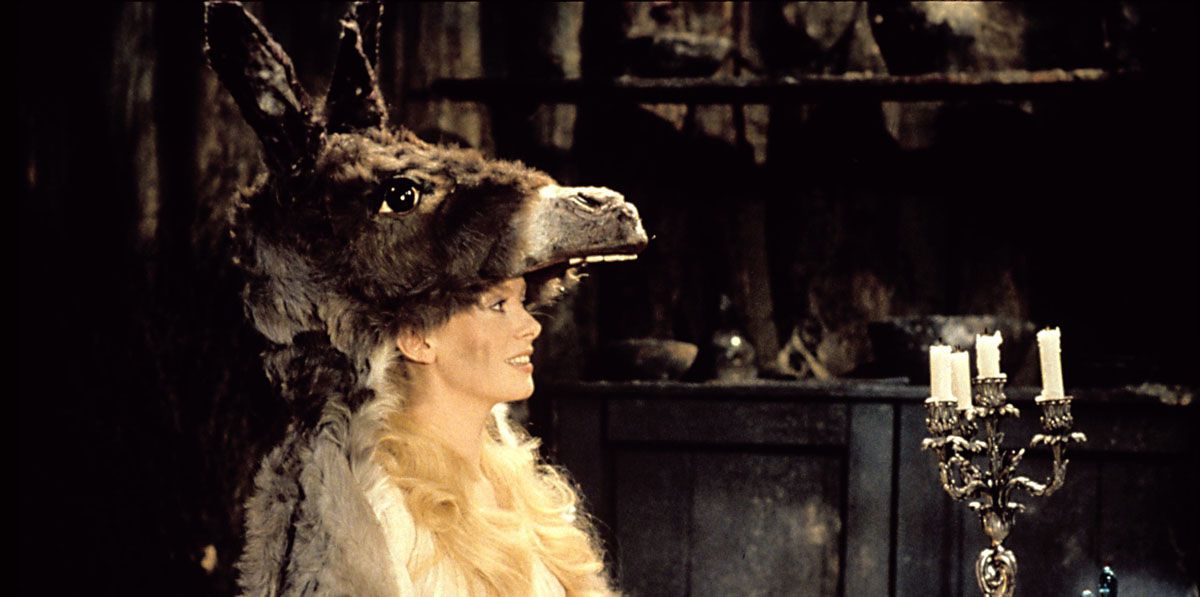
Donkey Skin begins with the sweet words, “Once upon a time,” but the narrator’s voice sounds rather detached, almost creepy. Demy focuses intensively on different shades of blue throughout; many in the film’s fairy-tale kingdom have blue faces, including some dwarves who look like early oompa loompas. The King (Marais) is distraught when his wife (played by Deneuve in a brown wig) dies. In his grief, he turns to his daughter (Deneuve at her blondest) and insists on marrying her, at which point everyone watching should get out their Penguin Freud. Aghast, the Princess is counseled by the Lilac Fairy (Seyrig, wearing her Daughters of Darkness blond marcel weave) to stall her father by asking for lots of specific gowns, then by asking for the skin of his magic donkey, who shits gold and keeps the kingdom in funds. To her horror, he obliges, and the Princess is forced to take refuge as a scullion in the provinces. But a handsome prince in red (Perrin) comes to her rescue, eventually.

Legrand’s score is not up to his usual standard for Demy, and there isn’t enough of it. But the actors and Demy’s color scheme, which includes blue and green iris shots, are striking enough to hide some of the film’s weaknesses. Demy’s films set in ordinary French seaside towns emphasize the magic of movies and music to romanticize the most provincial locales. In Donkey Skin, he takes a romantic fairy tale and brings it down to earth with prosaic details (modern personal foibles, a late-arriving helicopter). When the old crone the Princess works for spits out toads, it seems the most natural thing in the world, as does the blue and yellow parrot that continually squawks Legrand’s anxious love theme.

There’s plenty of disguised sex in Donkey Skin. Perrin’s prince is addressed by a very vaginal pink rose, the center of which talks at him with a woman’s mouth and looks at him with a woman’s eyes. When he’s trying to find the Princess, he has all the maidens in the kingdom come try on a ring, and the phallic implications are clear. Perrin and Deneuve, who were the perfect blond couple always missing each other in Rochefort, are pampered and infantile here, but in a way that gives pampered infantilism its due. These spoiled kids are used to indulging themselves; in one wonderful sequence, Perrin does backward somersaults up a hill while Deneuve rolls herself up. Once on top, they stuff themselves with pastries and sing narcissistically of their immortal love. The whole film seems to take place in a refrigerated Disney movie filled with elaborate and cold French desserts and sexual/intellectual French subtexts.

Cast: Catherine Deneuve, Delphine Seyrig, Jean Marais, Micheline Presle, Jacques Perrin Director: Jacques Demy Screenwriter: Jacques Demy Distributor: Janus Films Running Time: 89 min Rating: NR Year: 1970 Buy: Video

We’re committed to keeping our content free and accessible—meaning no paywalls or subscription fees—so if you like what we do, consider becoming a SLANT patron, or making a PayPal donation.
Advertisement
Comments

Film

Review: Charm City Kings Is a Predictable Adaptation of 12 O’Clock Boys

The film looks for an emotional payoff by continually upping the stakes of its main character’s self-destructive short-term thinking.

2

Published

on

Charm City Kings
Photo: HBO Max

Angel Manuel Soto’s coming-of-age film Charm City Kings is based on Lofty Nathan’s chaotic, immersive 2013 documentary 12 O’Clock Boys. Set in a poor West Baltimore neighborhood of beaten-up rowhouses, the film follows Mouse (Jahi Di’Allo Winston), a 14-year-old who’s tired of lugging around the painful memory of his older brother’s death in a police chase years earlier. Blocking out all the entreaties from his mother (Teyonah Parris) and a pair of diametrically opposed father figures to keep on the straight and narrow path, Mouse yearns for the freedom he sees in the exuberant displays of gravity-defying tricks put on by the neighborhood’s dirt bikers with whom his brother used to ride.

The story, though, starts off in somewhat less serious territory, occupied mostly with the summer-time shenanigans of Mouse and his two best friends, Lamont (Donielle T. Hansley Jr.) and SweartaGod (Kezii Curtis). There’s an innocence to some of these early scenes, with the boys cracking on each other and rushing out to try and impress the new girl on the block, Nikki (Chandler DuPont), that feels both organic and deliberate. While Soto and screenwriter Sherman Payne aren’t hiding any of the difficulties faced by local residents—drug dealers are pointed out at one point, the police are a constant presence—they don’t allow them to crowd out the characters’ ability to have lives not solely defined by poverty.

Things take a darker turn once Mouse’s obsession with getting his own bike and showboating like his brother leads him into the orbit of the Midnight Clique biker crew. Mouse’s embrace of the lifestyle brings him to the attention of legendary biker Blax (Meek Mill), a reformed ex-con who repairs bikes in a showcase garage that to Mouse’s bugged-out eyes may as well be Tony Stark’s gadget-strewn hideout. Blax tries to encourage Mouse’s gearhead enthusiasms while simultaneously keeping him away from the rest of the Midnight Clique riders, who seem to make their livelihood couriering drugs as well as stealing and reselling bikes. At the same time, Detective Rivers (William Catlett), a self-appointed mentor who’s taken an interest in Mouse’s future, is giving the same advice as Blax with as little ultimate impact.

Though Soto’s direction is mostly unexceptional, there’s a real sense of lightness and freedom to some of the early scenes in which we can see the wonder in Mouse’s eyes as he watches the bikers popping wheelies. The bikes’ high-pitched whine is a siren call promising escape. One segment where the bikers and onlookers crowd together for an impromptu street party and display of tricks draws on a long lineage stretching from Rebel Without a Cause to The Fast and the Furious (and if wheelie-popping dirt bikes are not incorporated into the Fast & Furious series at some point, then its producers are failing at their job).

Sadly, that giddy abandon falls away as Charm City Kings moves toward a conclusion so overloaded with generic life lessons that it loses the site-specific appeal of its story. Payne’s script looks for an emotional payoff by continually upping the stakes of Mouse’s adolescent impatience and self-destructive short-term thinking. But the further the film moves away from the kids knocking around the neighborhood and toward Mouse and his friends getting drawn into the criminal orbit (those bikes cost money after all), the more rote it begins to feel.

There are some similarities here to Concrete Cowboy, another story about a wayward boy trying to find himself in the codes of manhood embedded in a real-life inner-city subculture. But while Ricky Staub’s film rises above the off-the-shelf plotting with a clutch of standout performances, Charm City Kings never generates the kind of engagement with its characters necessary to help viewers get past the predictable nature of their dilemmas.

Cast: Jahi Di’Allo Winston, Meek Mill, William Catlett, Donielle T. Hansley Jr., Kezii Curtis, Chandler DuPont, Teyonah Parris Director: Angel Manuel Soto Screenwriter: Sherman Payne Distributor: HBO Max Running Time: 125 min Rating: R Year: 2020

We’re committed to keeping our content free and accessible—meaning no paywalls or subscription fees—so if you like what we do, consider becoming a SLANT patron, or making a PayPal donation.
Continue Reading

Film

Review: The Wolf of Snow Hollow Is a Swan Song Worthy of Robert Forster

Writer-director Jim Cummings reinvigorates an oft-told tale with personal, thorny preoccupations.

3

Published

on

The Wolf of Snow Hollow
Photo: Orion Classics

Jim Cummings’s The Wolf of Snow Hollow is set in a small, picturesque mountain town that’s being plagued by a series of murders. The victims are torn apart in a manner that suggests a large wolf, though there’s also a sense of control and calculation to the acts that implies human intelligence. Soon, the townies are talking werewolves while the police haplessly attempt to find the perpetrator. Throughout the film, certain scenes involving the police, unofficially headed by Officer John Marshall (Cummings) in place of his ailing father, Sheriff Hadley (Robert Forster), are played for broad comedy in the key of something like Broken Lizard’s Super Troopers, while other scenes imaginatively and uncomfortably tap into contemporary anxieties about the inherent power of law enforcement.

Strikingly, John isn’t a conventional hero who maintains his cool in the heat of crisis, but a hothead who doesn’t have nearly the control over his unit that he—and, by extension, viewers—initially believe. John snaps at his fellow officers pointlessly, sometimes after they’ve asked good questions that conflict with his presumptions, and he has a habit of physical confrontations, sometimes within eyeshot of an increasingly dubious press. As an actor and filmmaker, Cummings lucidly portrays John as a destabilizing agent, a recovering alcoholic who’s pushed by pressures of the case and family to fall once again off the wagon. In one particularly disturbing scene, John brushes up against the killer on the verge of committing another murder and fires his shotgun wildly into the night, without any consideration for the collateral damage. John’s behavior grows wilder and more erratic, including taking bourbon with his coffee in the morning at work in front of anyone who cares to notice, and Cummings shows how the other officers, though concerned and sometimes resentful, cover up for him out of respect to the legacy of Hadley, whose own bad heart is being covered up by John.

Which is to say that Cummings isn’t in the business of glorifying rogue police officers, though he doesn’t offer John or the other men and women in his unit up as fashionable indictments of the entire profession either. Cummings is intensely empathetic to the strains John bears, embodying the character’s anger with curt, unhinged outbursts that are initially amusing, then scary, then devastating. And, yes, some of these pressures are understood to spring from the populace’s hatred of the police, whose propensity for decency is casually, nearly invisibly represented by Officer Julia Robeson (Riki Lindhome). This pressure cooker of conflicting cultures and old and new sensibilities is further complemented by anecdotes in which small-town good old boys are chastised for their racism and homophobia, and by the fact that the killer is a sexist who preys on young, attractive women—an “addiction” that renders him an outcast not unlike John. These textures aren’t offered up as obligatory window dressing for a monster movie as they’re The Wolf of Snow Hollow’s reason for being.

Cummings’s willingness to deconstruct small-town incestuous-ness, while acknowledging the homey attraction of an intimate place in which everyone knows everyone’s name and eats the same meals in the same diner, is unmistakably reminiscent of Twin Peaks. The filmmaker’s risky mixture of comedy and violence clearly owes a debt to David Lynch as well—a debt that’s acknowledged by Forster’s presence here in his final role before his death. Forster’s Hadley suggests a continuation of the character he played in Twin Peaks: The Return, and Cummings fashions a swan song worthy of the legend. Hadley is a poignant fading titan whom John feels he cannot equal, and so the aging man suggests a past version of America, a dream from which we have awakened in order to face a nightmare. Cummings doesn’t have Lynch’s formal daring, but he has reinvigorated an oft-told tale with personal, thorny preoccupations.

Cast: Jim Cummings, Riki Lindhome, Robert Forster, Chloe East, Jimmy Tatro, Marshall Allman, Neville Archambault, Annie Hamilton, Will Madden, Jessica Park, Laura Coover, Kelsey Edwards, Skyler Bible Director: Jim Cummings Screenwriter: Jim Cummings Distributor: Orion Classics Running Time: 90 min Rating: R Year: 2020

We’re committed to keeping our content free and accessible—meaning no paywalls or subscription fees—so if you like what we do, consider becoming a SLANT patron, or making a PayPal donation.
Continue Reading

Film

Review: The Lie Is an Undercooked Indictment of Helicopter Parenting

At the heart of Veena Sud’s film is the raw material for a potentially ingenious satirical domestic thriller.

2.5

Published

on

The Lie
Photo: Amazon Studios

At the heart of Veena Sud’s The Lie is the raw material for a potentially ingenious satirical domestic thriller. Ex-spouses Rebecca (Mireille Enos) and Jay (Peter Sarsgaard) are nearly comical opposites who’re attempting to share parenting of their teenage daughter, Kayla (Joey King). Rebecca is an attorney living with Kayla in a posh home in a Canadian suburb, and Jay is a middle-aged man who still clings to dreams of making it as a musician. Outside of Jay’s bohemian apartment, the family briefly, awkwardly runs into Jay’s current girlfriend, Trini (Dani Kind), in a lively moment that seemingly encapsulates the tensions of Rebecca and Jay’s divorce in a manner of seconds. Rebecca is advancing her career, while Jay still wants to be a boy at the cost of his ex-wife and daughter’s resentment.

These tensions, particularly Jay’s arrested development, aren’t window dressing, but a direct influence on the calamities that follow. Jay is to drop Kayla off at a weekend-long ballet workshop. On the way, Kayla spots her good friend, Brittany (Devery Jacobs), waiting at a bus stop. This is a chillingly surreal image, as one doesn’t anticipate seeing bus stops out in the middle of the country. Brittany is also going to the workshop, and Jay picks her up at Kayla’s insistence, at which point Brittany begins to flirt with Jay, who doesn’t seem to mind as much as he should. The girls soon ask to use the bathroom in the middle of the woods, and Brittany disappears, with Kayla claiming to have pushed her over a bridge into the frozen water below. Eventually, after being pressed for a motive, Kayla blames Jay and the flirting.

The Lie then becomes a cover-up story, in which Rebecca and Jay reunite to help Kayla evade a murder prosecution. The film, a remake of the little-seen 2015 German film We Monsters by Sebastian Ko, is theoretically a tale of remarriage as brokered by delusional parenting. As Kayla blithely watches TV and cooks breakfast and plays with Dad in the aftermath of Brittany’s murder, Rebecca and Jay continue to believe that their daughter is good and this incident is a fluke that can be purged from their lives. Such assumptions also spring from guilt, as Kayla is usually left to her own devices, especially her phone, while Rebecca and Jay tend to their own lives. Sud establishes this rich subtextual framework succinctly and confidently, and the pairing of Enos and Sarsgaard is a masterstroke of counterintuitive casting—her fraught intensity complementing his intellectualized hipster energy and vice versa.

After a strong first act, though, Sud allows The Lie to sink into a holding pattern. For too long, there simply isn’t much going on in the film, narratively or thematically. The scenario has a potential irony at its core, which Sud essentially ignores: that this atrocity may have reignited Rebecca and Jay’s attraction for one another. Other nasty, potentially satirical implications are also wasted, such as how Kayla’s entitled upbringing has allowed her to treat murder as just another road bump to be walled off from. The Lie wants for a sense of escalation, as we’re too often forced to watch a perfunctory cover-up that’s staged at an over-deliberate, self-consciously prestigious film’s pace. A clever, sadistic twist ends the film on a high note however, confirming that it’s indeed an indictment of helicopter parenting run amok.

Cast: Peter Sarsgaard, Mireille Enos, Joey King, Cas Anvar, Dani Kind, Devery Jacobs, Nicholas Lea, Patti Kim Director: Veena Sud Screenwriter: Veena Sud Distributor: Amazon Prime Video Running Time: 95 min Rating: R Year: 2018

We’re committed to keeping our content free and accessible—meaning no paywalls or subscription fees—so if you like what we do, consider becoming a SLANT patron, or making a PayPal donation.
Continue Reading

Film

Review: Black Box Is a Heady Psychodrama About Virtuality and the Extended Self

The film ruminates on how virtuality infiltrates the deepest regions of our subconscious to reprogram the inner workings of the self.

2.5

Published

on

Black Box
Photo: Amazon Studios

The most striking image in Emmanuel Osei-Kuffour Jr.’s debut feature, Black Box, is a slow, hypnotic zoom into a black cross set against a white field, until the center of the cross takes up the entire frame. The shot ends in total blackness, recalling Kazimir Malevich’s iconic painting Black Square, with its overtones of nullification and depersonalization. Later, this image returns, inverted, within the virtual space of the eponymous Black Box. This time, it’s a white cross on a black background, and the image conjures a certain symbol of white supremacy in a film that, composed entirely of black characters coming to terms with trauma, can be read as an allegory for diasporic amnesia.

The technology at the heart of Black Box’s mundane dystopia is a slight extrapolation of the digital apparatus that already mediates every facet of our lives: a device that functions as the mental version of the flight recorders used to determine the cause of airplane crashes. Amid the film’s horror sci-fi trappings, Osei-Kuffour Jr. smuggles in a rumination on how virtuality infiltrates the deepest regions of our subconscious to reprogram the inner workings of the self. At one point, a character aptly refers to the Black Box as “digital voodoo.”

The narrative situates us sometime after the incident that afflicts Nolan (Mamoudou Athie), a professional photographer, with amnesia. The opening scenes are suitably estranging, as we’re made to identify with a character for whom all context is withheld by his own mind. His daughter, Ava (Amanda Christine), behaves as if she were an adult woman in the body of a 10-year-old, and it’s some time before we gather that her mother, Rachel, was killed in the car accident that Nolan survived, forcing Ava to take on the role of her father’s caretaker. Although Nolan strives to regain his memories and, by extension, his past self, flashes of a tormented personality that Ava cannot recognize hint that he’s forever changed.

The precariousness of his economic situation forces him to resort to an experimental study developed by Dr. Lillian Brooks (Phylicia Rashad), who connects his brain to the Black Box, a digital hypnosis aid that allows him to virtually inhabit memories—memories that, as it turns out, may not be his own. Nolan is a zombie in the original Haitian sense, resurrected from brain death to carry out the whims of a witch doctor in a white lab coat. Through him, Osei-Kuffour Jr. is asking us to contemplate how memories of our own lived experiences get mixed in with those of artificial experiences we consume daily through media informed in large part by economic anxiety and unconscious white supremacy. That a piece of digital entertainment released by Amazon Studios raises such questions is, yes, a distressing irony.

Osei-Kuffour Jr. doesn’t rely on CGI except to emphasize the artifice of the Black Box device. The most horror trope-y aspect of the film, a spidery man who haunts Nolan’s buried memories, is effected by spine-crawling sound design and a professional contortionist (Troy James). The real horror lies in Nolan’s inability to distinctly remember the faces of those closest to him, a condition known as prosopagnosia or face blindness. Stylistically, Black Box distinguishes itself with shots of prefabricated apartments and eerily inoffensive hospital corridors. The film’s near future, like the present, is a mind-numbing labyrinth, not a brutalist hellscape. While the acting fails on occasion to entirely convince, and the themes retreat into the background as the plot goes into overdrive in the film’s second half, Black Box remains notable for its nuanced psychosociological horror.

Cast: Mamoudou Athie, Phylicia Rashad, Amanda Christine, Tosin Morohunfola, Troy James, Charmaine Bingwa, Donald Watkins Director: Emmanuel Osei-Kuffour Jr. Screenwriter: Emmanuel Osei-Kuffour Jr., Stephen Herman Distributor: Amazon Prime Video Running Time: 100 min Rating: NR Year: 2018

We’re committed to keeping our content free and accessible—meaning no paywalls or subscription fees—so if you like what we do, consider becoming a SLANT patron, or making a PayPal donation.
Continue Reading

Features

‘70s Horror on the Criterion Channel

In the ‘70s, a new wave of horror film presented terror as a messy, brutally honest implosion from within.

Published

on

‘70s Horror on the Criterion Channel
Photo: United Artists

All American horror films that really matter can be separated into two time periods: before and after Vietnam, an event that epitomized an era and transmogrified the nation’s concept of “horror” forever. Whereas the horror films of yore would invariably depict true red-white-and-blue protagonists dealing xenophobically with foreign evil (vampires and cat people often represented all of Eastern Europe), a new wave of horror film presented terror in America as a messy, brutally honest implosion from within.

Vietnam seemed to be the cataclysm that ended the idea that America was the world’s “control group,” at least for a while. Typically, Psycho is referred to as the film that sliced horror history in half along socio-political lines, but for all its subversions of the rules of horror, the film still faithfully presents mainstream American society (as represented by Vera Miles) as the norm. No, it took a series of social uprisings, the gradual unraveling of a deceptive image that American soldiers were swaggering like pimps in Vietnam, and a seemingly endless cycle of political assassinations to fuel a new breed of scare-mongering films. And they exposed and subverted everything America held true—open spaces, machinery, industry, and country-gravy hospitality—and amplified the nation’s capacity for superior terror.

This month, the Criterion Channel celebrates this wild, weird, and far-out era of genre filmmaking with their ‘70s Horror series. In their words: “This tour through the 1970s nightmare realm is a veritable blood feast of perverse pleasures from a time when gore, grime, and sleaze found a permanent home in horror.” For more about the 29-film series, which collects some of the grimiest, goriest, and most inventive horror films from the decade, click here. And below is our list of our favorite films in the series. Eric Henderson


Ganja & Hess

10. Ganja & Hess (Bill Gunn, 1973)

Ganja & Hess is both a highly personal reconstruction of the vampire myth (many cite it as the “anti-Blacula”), as well as a Godardian broadside, allowing us to imagine that Bill Gunn was actually thumbing his nose at the way the industry was shaping up for African-American directors in the ‘70s, thanks to films like Gordon Parks’s Shaft. Blaxploitation, now responsible for whole forests’ worth of thesis papers, carries a dual appeal: Films that fall within the genre’s framework often have an insoluble blackness that white audiences can never completely absorb, which, paradoxically, is part of their appeal. Ganja & Hess, which has been retroactively, circumstantially cast as a berserk dash toward career suicide on Gunn’s part, is so singular, so opaque, that it doesn’t even have the draw of commerce-friendly exoticism. If Shaft is Barry White and Melvin Van Peebles’s Sweet Sweetback’s Baadasssss Song is the Sex Pistols, then Ganja & Hess is John Cage. Jaime N. Christley


The Crazies

9. The Crazies (George A. Romero, 1973)

Like Night of the Living Dead, The Crazies concerns a plague that explodes America’s suppressive (and suppressed) tensions, though the monsters are left almost entirely off screen in this case, as George A. Romero foregrounds the sociocultural textures of martial law. The Crazies reprises Night of the Living Dead’s mercilessly propulsive editing while introducing a bold comic-book palette that would be refined in Dawn of the Dead and Creepshow. The film also abounds in inspired sketches of madness and infrastructural collapse, from the military’s dehumanizing uniform of black gas mask and white hazmat jumpsuit to an irrational image of an insane woman sweeping a battlefield with a broom. Even Romero’s self-consciously lyrical touches intensify the film’s textured canvas. The Crazies ironically understands fascism as being inherent in both the preservation and revolution of society. Chuck Bowen


Images

8. Images (Robert Altman, 1972)

Images might not immediately strike one as a genre exercise, as it’s a subjective dramatization of a fragile woman’s psyche, following a famous children’s author, Cathryn (Susannah York), as she seemingly loses her mind and commits murder. Utilizing a fractured narrative, the film proffers an unreliable reality that underscores the greater tenuousness and chaos of human existence writ large. It’s an art film that follows a codified set of traditions that were particularly in vogue in the ‘60s and ‘70s. Robert Altman is less interested in emotion and psychology than in emotional and psychological gamesmanship—in mind-fucking that has a rich tradition in the more obsessive and political films of Luis Buñuel, Ingmar Bergman, Roman Polanski, and Joseph Losey, to name just a few of Images’s influences. Bowen


Deathdream

7. Deathdream (Bob Clark, 1972)

A grindhouse threnody for the Vietnam generation, Bob Clark’s emotionally overwhelming Deathdream is a raw nerve radiating pure shock and grief, as evidenced by the reunion of Faces’s Lynn Carlin and John Marley to play the parents of a young private who, after apparently dying in battle, returns to their doorstep. With echoes of “The Monkey’s Paw,” it gradually dawns on the initially relieved family that Andy’s purple heart may no longer beat, and yet he thirsts for blood, which would be horrifying enough if the film didn’t also seem to be suggesting that, whether soldiers return home from war decorated or draped by the flag, they never return as they were before. Henderson


The Tenant

6. The Tenant (Roman Polanski, 1976)

The masterful final panel in Roman Polanski’s remarkable “Apartment Trilogy,” The Tenant surpasses even Repulsion and Rosemary’s Baby in its portrayal of claustrophobia and dissipating sanity. Casting himself as Trelkovsky, a meek Polish wanderer whose new Paris residence comes equipped with sinister neighbors, mysterious hieroglyphs, and mystical intimations, the great director employs a comically escalating sense of dread to crystallize a worldview in which weaklings and barbarians jostle for power and everyone is an outsider, as powerless against bullying as they are to helping the suffering of others. A master class in ominous, insinuating mise-en-scène, this is the ultimate Polanski skin-crawler and one of cinema’s supreme paranoid fantasias. Fernando F. Croce


The Brood

5. The Brood (David Cronenberg, 1979)

The longing and the sense of tragedy that were beginning to peak through at the end of Rabid are allowed to blossom in The Brood. David Cronenberg’s interests aren’t quite as explicitly psychosexual in nature as usual, as he turns instead to the cycles of damage, repression, and abuse that originate in the nuclear family. The film marks the beginning of his career as a significant formalist, though it’s also as raw and primal as anything he’s made. The pent-up emotional turmoil suggests at times what Bergman might’ve done with a horror film, and it features one of Cronenberg’s most audacious metaphors: a group of vengeful mutant children who’re conjured from the rage of a deeply troubled woman. This woman passes her psychic torment on to everyone even peripherally in her path, most devastatingly of all to her young daughter, who may soon begin to grow her own creatures, born of inescapable, inexpressible anger that’s provoked by the seemingly predestined trauma of life with family. Bowen


Invasion of the Body Snatchers

4. Invasion of the Body Snatchers (Philip Kaufman, 1978)

Throughout Invasion of the Body Snatchers, one of the subtlest and most extraordinarily fluid of American horror films, Philip Kaufman crafts textured scenes, rich in emotional and object-centric tactility, that cause our heads to casually spin with expectation and dread. Kaufman and screenwriter W.D. Richter fuse paranoia, eroticism, and flippancy to arrive at their own distinctly flakey yet intense genre-movie style. The filmmakers have gone out of their way to devise scenes which are set in places that have rarely hosted a horror-movie set piece before, such as a dry-cleaner’s, a book store, and the creepy swamp-colored spa that provides their film with one of its shock centerpieces. The soundtrack is particularly unnerving when we get a prolonged glimpse at how the pod people hatch out of the flowers blooming all over the city, which Kaufman stages as a simultaneous birth and rape. Bowen


The Wicker Man

3. The Wicker Man (Robin Hardy, 1973)

A film that’s become synonymous with British horror, The Wicker Man follows a conservative Christian policeman (Edward Woodward) seeking a missing girl on a Hebridean island inhabited by pagans. The first half has an (intentional) air of the faintly ridiculous about it, embodied equally by Christopher Lee’s gloriously campy portrayal of the cult’s leader and the life-on-the-island sequences that are Pythonesque in their absurdist look at culture clash. But the film’s impish wit and soft, Arcadian glow belie its cruel streak. The gathering clouds of unease building into a shocking third act that’s aesthetically and structurally reminiscent of the end of Nicolas Roeg’s Don’t Look Now, possibly the highest praise one can give to the conclusion of a horror film. Abimanyu Das


Don’t Look Now

2. Don’t Look Now (Nicolas Roeg, 1973)

Don’t Look Now is driven by a crushing sense of emotional desolation. The phrase “psychic thriller,” which was used to market the film, is technically true, but misleading, given that psychics are normally used by directors as springboards for action set pieces or as agents for ushering forth the explicit arrival of ghosts. There are certainly ghosts in Don’t Look Now, and maybe even the kind that populate traditional horror stories, but the prevailing specters here are those that people come to know through disappointment or tragedy as allusions to things lost or desired, which have a way of suddenly opening mental portals to the past, and, in the case of this film and quite a bit of supernatural fiction, the future. Don’t Look Now suggests a ghost story that Faulkner may have written, as it offers characters who’re at the mercy of their streams of consciousness. There’s barely a present tense here at all, as it’s swallowed up by what’s already happened and what will happen. Bowen


The Texas Chainsaw Massacre

1. The Texas Chainsaw Massacre (Tobe Hooper, 1974)

Opening in utter darkness illuminated by sudden, dreadful flashes, The Texas Chainsaw Massacre begins with a police report describing a violated corpse as “a grisly work of art,” a term that also applies perfectly to Tobe Hooper’s legendary grindhouse masterpiece. A rough-hewn American Gothic canvas, the film charts the trajectory of a batch of youngsters from a clammy van to the dangling hooks of an abbatoir run by a cannibalistic clan. Materializing in the middle of the horror genre’s most transgressive decade, this is a cacophony of piercing shrieks, metallic clanks, and roaring machinery that looks back to Psycho’s view of ingrown monsters even as it outdoes the older film in sheer, visceral impact. Snapshot of Vietnam-era outrage? Indictment of all-devouring capitalism? Blood-spattered redneck Theater of Cruelty? Yes to all, plus the screen’s most grueling portrait of mushrooming terror. Decades of sequels, remakes, and imitators can’t take away its scabrous power. Croce

We’re committed to keeping our content free and accessible—meaning no paywalls or subscription fees—so if you like what we do, consider becoming a SLANT patron, or making a PayPal donation.
Continue Reading

Features

The Best Sci-Fi Movies on Netflix Right Now

These films show us utopias, dystopias, distant planets, and our own Earth destroyed.

Published

on

The Best Sci-Fi Movies on Netflix Right Now
Photo: Universal Pictures

“The [sci-fi] film has never really been more than an offshoot of its literary precursor, which to date has provided all the ideas, themes and inventiveness. [Sci-fi] cinema has been notoriously prone to cycles of exploitation and neglect, unsatisfactory mergings with horror films, thrillers, environmental and disaster movies.” So wrote J.G. Ballard about George Lucas’s Star Wars in a 1977 piece for Time Out. If Ballard’s view of science-fiction cinema was highly uncharitable and, as demonstrated by some of the imaginative and mind-expanding films below, essentially off-base, he nevertheless touched on a significant point: that literary and cinematic sci-fi are two fundamentally different art forms.

Fritz Lang’s Metropolis, a visionary depiction of a near-future dystopia, is almost impossible to imagine as a work of prose fiction. Strip away the Art Deco glory of its towering cityscapes and factories and the synchronized movements of those who move through those environments and what’s even left? It’s no accident that some of the greatest cinematic adaptations of sci-fi novels bear only a passing resemblance to their source material. Ridley Scott’s Blade Runner, for example, simply mines some of the concepts from Phillip K. Dick’s Do Androids Dream of Electric Sheep? about human-looking androids, using them as the raw material for a haunting urban future-noir that owes more to visual artists like Moebius and Antonio Sant’Elia than it does to Dick himself. Then there’s Andrei Tarkovsky’s Stalker, which transfigures Arkady and Boris Strugatsky’s briskly paced novella Roadside Picnic into a slow, mesmerizing journey into an uncanny space.

Ballard may have been right that literary sci-fi has provided all the interesting themes and ideas for which sci-fi in general has become known, but he failed to grasp how cinema has expanded our understanding of sci-fi by pricking at our collective visual consciousness. The titles below (all presently streaming on Netflix) have shown us utopias, dystopias, distant planets, and our own Earth destroyed. Some of these depictions are humorous, others haunting. Some rely on complicated special effects, others use none at all. But they’re united by their fearlessness in breaking down boundaries and thrusting us into worlds beyond our own. Keith Watson


Snowpiercer

10. Snowpiercer (Bong Joon-hoo, 2014)

Bong Joon-ho’s Snowpiercer is an angry and bleak film, as well as an old-fashioned meat-and-potatoes genre entry concerned with passé niceties such as atmosphere and spatial coherence. The premise also has an inviting bluntness: A few years into the future, global warming slips out of control, and humankind inadvertently initiates an ice age in its attempt to correct it. Soon after, all that remains of humanity are the passengers of an ultra-equipped, self-sustaining train that suggests Noah’s Arc as a speeding elevated bullet. Having predictably learned nothing from their travails, the train’s passengers quickly assume the flawed social structure of the first world that’s recently ended, with the entitled haves exploiting the enraged have-nots. The film is most notable for its evolving visual concept: Each car takes one closer to a representation of the world as it presently works. The first few cars are rendered in the distancing apocalyptic hobo ax-and-sword aesthetic that’s been a cinema standard since at least the Mad Max films. But the latter cars are lit in expressionistically beautiful club-rave rainbow colors that reflect the escalating social privilege of a lost generation. Chuck Bowen


Midnight Special

9. Midnight Special (Jeff Nichols, 2016)

With Mud and Take Shelter, writer-director Jeff Nichols has already used withholding narratives to weave distinctly Southern tales about fringe believers, survivalists who could also be seen as evangelists. Nichols was forthright about the motives of his protagonists, but cagey about whether their causes were worth believing in. Alton Meyer (Jaeden Lieberher) is another in Nichols’s lineage of would-be prophets, but no one here doubts the world-changing potential of the child’s visions. If in Midnight Special is, at its heart, a work of science fiction, it rolls out like a chase film. With the help of his childhood friend, Lucas (Joel Edgerton), Alton’s father, Roy (Michael Shannon), has kidnapped the child from captivity at a compound run by a Branch Davidian-like cult that once counted Roy as a member. Given its twilit suburban adventures and encroaching security forces, the story exudes a superficially classical sensibility, recalling Starman and Close Encounters of the Third Kind. Nichols has an easy mastery of pacing and tension, employing a churning sound design (and a pulsing score by David Wingo) that allows moments of occasionally bloody action to arrive with a frightening blast or a deep, quaking rumble of bass, and the film moves with purpose to its final destination. Christopher Gray


Elizabeth Harvest

8. Elizabeth Harvest (Sebastian Gutierrez, 2018)

The plot convolutions of Elizabeth Harvest conjoin with director Sebastian Gutierrez’s stylistic bravura—blasts of red and blue in Cale Finot’s cinematography that connote a spiritual as well as physical sense of ultraviolence—to create an incestuous atmosphere that’s reminiscent of the stories of Edgar Allan Poe. Henry is a memorable monster, played by Ciarán Hinds with a bravura mixture of smug entitlement and oily needfulness that’s weirdly and unexpectedly poignant. In one of the greatest mad-scientist speeches ever delivered by a character in a horror film, Henry explains that his cloned wife (Abbey Lee) is only real to him when he destroys her. This admission chillingly crystallizes the thin line, within the male gaze, between adoration and contempt. Bowen


Hardcore Henry

7. Hardcore Henry (Ilya Naishuller, 2015)

The film’s first-person perspective is so ingeniously sustained throughout the lean 96-minute running time that you’re liable to swat at your face when a man covered in steel and wielding a flamethrower sets Henry (Andrey Dementyev) on fire, or hold on to the edge of your seat when he battles the telekinetic warlord Akan (Danila Kozlovsky) atop a skyscraper from which a free fall seems inevitable. The film’s singular ambition is to immerse the viewer in the thick of a frenzied drive toward the promise of a lover’s touch and a few more minutes of life. Our aesthetic perception is linked to our perception of Henry himself, so that the film becomes a study of empathy through aesthetics. It’s not for nothing that Henry is made to have no voice, as Hardcore Henry’s unbelievably precise choreography of action seeks to tap into a universal feeling of powerlessness. Gonzalez


Mad Max

6. Mad Max (George Miller, 1979)

The Mad Max trilogy is the work of a talented virtuoso who blended seemingly every trope of every movie genre into a series of punk-rock action films. The plots, which are nearly irrelevant, are always similarly primitive even by the standards of low-budget genre films: In a bombed-out future version of the outback, a vicious gang pisses off a brilliant highway daredevil, Max (Mel Gibson), and stunning vehicular mayhem ensues. Though the second film, most commonly known in America as The Road Warrior, is often cited as the masterpiece of the series, the original Mad Max is still the most ferocious and subversive. The 1979 film most explicitly riffs on delinquent racing movies and the kinds of crudely effective 1970s horror movies that would sometimes show a family being violated in a prolonged fashion, and there are sequences in Mad Max that could be edited, probably with few seams, into, say, Wes Craven’s The Last House on the Left. Mad Max also has a distinctly Australian masculine tension that’s reminiscent of other outback-set classics such as Wake in Fright, as it’s concerned with the pronounced sexual repression and frustration of a predominantly male population that’s all dressed up in tight leather with little to do apart from mounting their bikes and revving up their big noisy engines. Bowen


Her

5. Her (Spike Jonze, 2013)

Spike Jonze’s Her begins with a love letter—a misdirect. It’s a billet-doux by proxy, ghost-authored, dictated to a machine. We open on the wide-eyed mug of Theodore Twombly (Joaquin Phoenix), seeming to speak from the heart, recalling fondly a first love that proves, with the reveal of an incongruous anniversary, to belong to somebody else. So the “handwritten letters” of beautifulhandwrittenletters.com are merely approximations of the form: our near-future’s phantom memorandum. But what matters here is that the love is real. Theodore’s letters, in a sense the film’s emotional through line, are never less than deeply felt, swelling with earnest affection. That he’s talking through and to another can’t reduce the depth of feeling in the sentiments. The genius of Her is that it doesn’t ask you to believe in the truth of its speculative science fiction so much as it does the truth of its romance, which is to say that Samantha (Scarlett Johansson) means more as metaphor—for a hard-won connection, long-distance or otherwise remote—than as a prediction of future tech. Her is about “the modern condition,” but not, importantly, in the strictly satirical sense: It tells us less about how we live than how we love. Marsh


Back to the Future

4. Back to the Future (Robert Zemeckis, 1986)

Long before Robert Zemeckis re-envisioned the 1960s as the era America gave itself over to stupidity (to the delight of Rush Limbaugh’s dittoheads nationwide), he blasted the 1980s back into the 1950s with Back to the Future. Or, rather, he blasted the 1980s specifically for its return to a 1950s-reminiscent moral and political agenda. Looking back on it with the same sense of from-the-future assurance that informed the movie’s own creation, Back to the Future is a logistically beautiful but almost inhumanly perfect confluence of internal logic and external forces. It stands up on its own as a well-oiled, brilliantly edited example of new-school, Spielberg-cultivated thrill-craft, one that endures even now that its visual effects and haw-haw references to Pepsi Free and reruns seem as dated as full-service gas stations apparently did in 1985. Its schematic organization of what Marty McFly (Michael J. Fox) and Doc Brown (Christopher Lloyd) need to accomplish and its steadily mounting series of mishaps demonstrating how they can go wrong represent probably the most carefully scripted blockbuster in Hollywood history, but the film’s real coup (and what separates it from the increasingly fluent pack of Spielberg knockoffs) is in how it subtly mocks the political pretensions of the era—not the 1950s, but rather the 1980s. Eric Henderson


The End of Evangelion

3. The End of Evangelion (Hideaki Anno, 1997)

When Hideaki Anno ended Neon Genesis Evangelion, his elaborate analogy for his own untreated depression, with a moment of calming, redemptive group therapy, the backlash he received from fans who wanted a cataclysmic climax was overwhelming. In response, Anno crafted this theatrical alternate ending, in which he brutally and unsparingly gave fans all the nihilistic chaos they could ever want. If the anime series’s finale was a psychological breakthrough, End of Evangelion is the relapse, an implosion of self-annihilating revulsion and anger rendered in cosmic terms. Religious, sci-fi, and psychosexual imagery intersect in chaotic, kaleidoscopic visions of personal and global hell, all passing through the shattered mind of the show’s child soldier protagonist. Its finale is the most fully annihilative visualization of the Rapture ever put to screen, a mass death rendered as cathartic release from the hell of existence that, in a parting act of cruelty, leaves the broken, suicidal protagonist alive to bear witness to oblivion. Jake Cole


Eternal Sunshine of the Spotless Mind

2. Eternal Sunshine of the Spotless Mind (Michel Gondry, 2004)

Introverted nice guy Joel (Jim Carrey) hears of an experimental procedure to erase troubling memories, and dives right in when his impulsive girlfriend, Clementine (Kate Winslet), washes her brain clean of their love-shattered relationship. Joel’s memories go backward in time from the last gasp of their love to their initial spark, but there are sideways detours along the way that take him to infancy and memories of his first childhood humiliation. James Joyce might have applauded this Phil Dick-caustic/Gnostic rendition of his Nighttown from Ulysses, with Clementine as Joel’s face-changing Penelope/Molly Bloom. Joel attempts to fight the erasure in his own mind, and the film admits early on that it’s a fight he cannot win. That he keeps on fighting anyway is the crux of Eternal Sunshine, and a breakthrough for Charlie Kaufman—writing about the human condition more than questioning our lives as self-made fictions. The fantasies of the film are more “real” than anything he’d written before, because they define who we think we are. Joel rediscovers his love for Clementine through fantasy, which is to say through his clouded memories of her. Such things are precious, and Gondry revels in that world in all its fleeting, flickering, ever-mutating joys. Jeremiah Kipp


Total Recall

1. Total Recall (Paul Verhoeven, 1990)

An imaginative expansion of the brisk Philip K. Dick short story, “We Can Remember It for You Wholesale,” this film about fake memories and a real interplanetary crisis now stands redolent with nostalgia, both for its time, as well as for itself. Beneath its show of smoke and mirrors, mercenary babes, and treacherous holograms, Total Recall is a story about a man who must choose between two possible, contradictory realities. In one timeline, he’s an earthbound schmuck; in the far less likely one, he’s a hero who must save an oppressed people on a faraway planet. He can’t afford to waver, but it’s our privilege to do so. As viewers, we’re welcome to consider the persistent motif of walls collapsing, subterfuges dissolving, and rugs being pulled out from still more rugs. The film now exists in a twilight of an era in which factory-produced entertainment could still serve as a keyhole into a dimension of weird, through which we might glimpse the otherworldly, and contemplate fondling the third breast. Jaime Christley

We’re committed to keeping our content free and accessible—meaning no paywalls or subscription fees—so if you like what we do, consider becoming a SLANT patron, or making a PayPal donation.
Continue Reading

Features

Interview: Kirsten Johnson on Expanding Time with Dick Johnson Is Dead

Johnson discusses how the omnipresence of cameras is adjusting our relationship to the concept of memory.

Published

on

Interview: Kirsten Johnson on Dick Johnson Is Dead and the Expansion of Time
Photo: Netflix

During a flight of cinematic fancy in her documentary Dick Johnson Is Dead, filmmaker Kirsten Johnson reveals that the first movie she ever saw was Mel Brooks’s Young Frankenstein. Perhaps it’s just a factoid, one seared into her brain based on how her childhood religion of Seventh Day Adventism forbid adherents from watching movies. But given how Johnson’s latest work cheekily tries to short circuit death by using technology to reanimate a body, maybe the film did more than merely “scandalize” her at a young age.

Johnson uses a full arsenal of artistic tools in Dick Johnson Is Dead to bridge contradictory, even paradoxical, ideas as her father slowly succumbs to dementia in reality. At the time of release, Dick Johnson is not, in fact, dead. For now, his death only exists inside the world of the film where he can collaborate with his daughter on exaggerated filmed scenarios of his demise. But when he does pass, the film will keep him alive in both the joyous and painful details of his declining health as well as in their participatory fantasies of life beyond earth.

It’s a complex illustration of cinema’s power to both memorialize and restore a person’s vitality, though the project never feels like an exercise in formalist iconoclasm. Kirsten Johnson leads with her empathy as a daughter and human in Dick Johnson Is Dead. As in her 2016 cinematic memoir Cameraperson, a self-portrait assembled from footage that she shot for other documentarians, Johnson’s curiosity and incisiveness as an image-maker and critical thinker serve to augment her vulnerability on open display.

I caught up with Johnson over the phone as she prepared for the worldwide release of Dick Johnson Is Dead on Netflix, a scale of distribution she found equally thrilling and anxiety-inducing. Our conversation covered the response to Cameraperson, how her teaching practice at NYU informs her work, as well as how she thinks the omnipresence of cameras is adjusting our relationship to the concept of memory.

What have the conversations with other craftspeople been like over the last five years after Cameraperson? Are other below-the-line artisans starting to see their own auteurist stamp in their collaborations?

There was just a flood of camerapeople who were like, “Ah, that was my idea, I’ve been dreaming of doing that!” There’s such a shared experience, we all put so much heart into this work. I know you do as a journalist, and everybody who makes a film—it takes more effort than we think it will. I think our efforts all feel unseen in certain ways. As a cameraperson, I was given this gift of a machine for searching, seeing, and observing. I do trace it in some ways back to both of my parents, but certainly my father. It wasn’t that he saw, he just expected there to be remarkable internal battles or conundrums inside of people. When he would ask questions, things would pour out of people. He’s the kind of person you see at a party, and someone’s in the corner telling him their life story. With Cameraperson, the sound people I’ve worked with a lot, I’ve spoken with both of them—Judy Karp and Wellington Bowler—about making things doing sound work. I’ve spoken with translators about doing movies about their jobs. So, yes, I would say absolutely, there’s a way in which everyone realizes how much is embedded in their work and that you can open it all up.

I don’t get the chance to interview craftspeople very often, but when I do, I love asking them if the Cameraperson thesis rings true for their own work.

Oh, is that true?! And people all respond, “Yeah, I’m there and there’s a lot going on.”

I actually get a pretty wide range of responses. The first person I tested it on was Frederick Elmes, frequent DP to David Lynch and Jim Jarmusch. He actually said he’d be offended if someone felt there was such a thing as “a Fred Elmes film.”

[laughs] That’s amazing. I feel like we should have a little hotline between you and me, and you just pass me that answer. Oh my god, I would love to hear all of those. That’s the thing where I just really believe in the aliveness of this, and that this is like a series of shared wonders. Cameraperson passed that to you, and then you’re passing it on in those conversations, and then they come back to me, I love it! That’s so cool. You just made my day.

Dick Johnson Is Dead

Behind the Scenes of Dick Johnson Is Dead. © Barbara Nitke/Netflix

You engage deeply with the nature of what cinema does in both Cameraperson and Dick Johnson Is Dead, but they never feel academic. You’re also an NYU professor, so how do you manage to find that sweet spot of overlap between theory and practice?

I love teaching, but I think of it more as we’re involved in excavation together with other people. The students I’ve had, and filming with so many different directors, has really encouraged me to be open to the idea that people are struggling with their own shame. The impulse to make and to create and to document is an impulsive struggle around shame. And that can be on the level of the shame we feel about the ongoing injustice of society.

I think we all feel this deep shame that the United States of America is such a racist project, and that we know it and then we forget it. Or that some of us have to live with it in ways that’s in our faces every moment, and then others of us can avoid it. There’s deep shame around that. So, sometimes we’re making films to address our position in collective shame. And then, other times, I think the shame is around the fact that some part of us is hidden, and we wish it to be revealed. Back to the sort of that unseen idea.

[There’s] an exercise we discovered at NYU which was pretty amazing. I asked two students to interview each other about their fears about their senior thesis project. Then, I asked each of them to cut the interview that they had filmed of the other person, and then to cut the interview of themselves. And then we played those back to back. The people who cut the interview of themselves, they left in what was smart, intellectual, and coherent. And they would cut out what was unsure or emotional. They basically made images of themselves that were pretty boring and uninteresting to watch, sort of self-righteous or pretentious. But then the people who had interviewed them would leave in a look in the eye that could not hide the fear. There was even one young woman who cut out a moment where she just stared at the camera, and you could just see all of her feeling. And she cut it out of her own edit of herself. I show students that we all have this internal shame that we struggle with, or we think we must represent something. We think we must represent our identity or our country, and [we fear] that we will fail this great block of people who’ve been failed so many times before by other people. Just shaking that around gives students just incredible liberty to go into new territory.

Nanfu Wang was a student of mine. When I look at what she’s done, it was obvious in class her willingness to reveal herself in her work. But it’s so remarkable, the documentarian she’s being. It wasn’t that she was my student. She was a co-conspirator in willingness to go into these areas of wondering. I have a lot of fun with the teaching because I’m encouraging people to take emotional risks, and in a certain way, I think it’s easy to ask other people to do that. And then I realized that I can keep doing that, I can keep trying to push the form, I can keep trying to take the emotional risks for myself. This film with my dad was deeply emotionally risky for me. But I was motivated by students as well as by filmmakers whose work I love.

There are a number of moments in Dick Johnson Is Dead where you’re operating the camera and a conversation with your father becomes so intense that feeling overpowers image. You drop the camera, leaving the audience to experience these poignant scenes from a messier angle. To your point about leaving in moments of potentially unflattering emotionality, are these shots an example of practicing what you teach?

Yeah, exactly. They expose your vulnerability, incapacity, impotency, doubt. I ask students to show me footage that they believe is the worst mistake they’ve made. Inevitably, it’ll be an incredibly emotionally powerful thing. Why they perceive it as their biggest mistake is because there was something really meaningful that was happening, and they blew it in some kind of way. It wasn’t in focus, or they weren’t steady, or they moved when they wish they hadn’t moved. Always with those pieces of footage, I can talk about the ways in which, wow, this is an incredibly powerful piece of footage. Yes, you may need to record new sound for it, and you can bring craft to it in post-production in the edit. But you actually have gold here, and why you perceive this as a mistake is that you’re so ashamed and sad that you couldn’t make something perfect of this really powerful thing. What I’m pushing against is that perfection is actually not what is possible as a human, nor what we trust. We trust the person who can’t quite focus it when bullets are flying or can’t quite focus it when the emotion is unexpected.

Then, when I became really interested in making this film, I thought about how I could play with that knowledge of that level of craft that happens in documentaries that you can’t control. “Can I create fictional situations in which I replicate that or push the thing that is the moment of failure up against the thing that is the moment of creation?” That was an active question and dynamic in making the film. We really conceived the process as this back and forth between failing and achieving, life and death, documented and invented, past and future.

In terms of the “heaven” scenes, they make such an intriguing blend of both heightening Dick’s real life and combining sublime cinematic flights of fancy like a Fred and Ginger musical number. Do these sequences reflect the way you think about the intersection of memory, fantasy and imagery?

Totally. I was looking for exuberance, life catharsis, euphoria, the pleasure of color. All of those things I kind of needed because my father’s world was shrinking. It felt like the dementia was making things smaller, but then I realized dementia is also expanding things, expanding time. Even though my father’s looping on these very small time periods—he’ll say a question and then say it again a minute later because he doesn’t know he just said it—cinema can get into that space and open it up. By doing slow-mo, we crack open that couple of seconds he smiles and turn it into three minutes. We enter his present time by doing slow-mo. That whole series of things is like, I have freedom here. None of us know what’s on the other side of death. None of us know what heaven is like. And yet we’re drawing on all of these imaginations that come from religion, that come from dreams, that come from cinema. How can we play with what’s palpable and what’s known, and engage it with what’s not yet known?

That was really active in the process of making it because we didn’t fully envision this. We just brought the elements together because I wanted it to function like a documentary shoot where it would come together in unexpected ways. We did the choreography, we thought about the costumes, we thought about the mask, we thought about the decor, but we didn’t know what my father would be able to do. Everything was sort of modular. We were prepared for different configurations, which makes it have that feeling of absurd lightness in some way.

I was reading elsewhere that you’ve said when the movie starts, your dad says he’s in heaven, no matter where his mental state might have been prior. Do you think there’s something to that word choice?

Absolutely. There was a moment when my mom, with her Alzheimer’s, said, “I really wonder what’s on the other side.” And it was the first time she had spoken like that. And I was like, “What do you mean, Mom? How are you feeling about it?” I was trying to engage her with this discussion about her wondering about dying. And then she looked at the placemat, turned it over, and she’s like, “Oh, look, there’s flowers on the other side!” I think each person’s dementia is different. I think it functions in relation to who they are. But the wondering they’re doing in their own mind about where they are, who they are, when will it end, am I safe, who’s taking care of me—those concerns often manifest in these metaphorical questions.

My father might wake up in the middle of the night and say to me, “When is this plane going to land? Are we headed south? When are we going home?” Those kinds of questions for me are definitely about a person wondering about death but also just about being in the literalness of the confusion of dementia. It’s like, “I am ungrounded, I am in an airplane, I don’t know where steady ground is.” All those plays with words that we can do with words themselves, or in a movie where an image can mean multiple things, I think that’s what’s happening with dementia often when someone is expressing these as questions of “what’s going to happen to me?” The loss of agency just creates all these question marks. What am I supposed to be doing? Where am I supposed to be? What do I do next?

You contextualize the making of the film in the decline and death of your mother, who you express regret over not capturing more fully in the vibrancy of her life. Given the widespread availability of high-quality cameras in phones and the cultural saturation of videos, do you think we could be nearing a time when that worry of losing someone’s likeness to time will disappear? Or does there need to be more intentionality behind capturing those images for them to count?

I do think memory is fragile and unstable and fragmentary. I think the act of seeing an image of a person is almost like a hallucination. You may know they’re not there, but they’re also there. You’re experiencing seeing and hearing them, which is different than imagining them. It functions in a different place in your brain. I’m totally fascinated by the fact that I have shot tens of thousands of images of my children. One of their dads, Boris, does an annual video where he strings together video moments from a year. We watch them every year, and there’s a total shock because I’ve forgotten almost all of the things that he’s filmed. My memory of what happened in the year is attached to the photos that I’ve shot, and then suddenly his videos bring different things to life. I think we’re becoming different kinds of humans.

I think, in some ways, the camera made me differently human. I can see different things with a camera. I think memory is nurtured like a garden by different forms of watering it: paying attention to it, reading things, avoiding certain things that we don’t want to remember. All of this image-making is, I think, augmenting and shifting our relationship to memory. I don’t think of it in binary terms, I don’t think it’s good or it’s bad. I do think it’s radically different, and that we’re changed by all of these things in ways we can’t imagine.

I’m on the verge of the Netflix premiere where this film’s going to go into hundreds of countries. The thought that this very private thing is going out into the world on this kind of scale, I have not yet experienced that as a human. That’s new territory. It’s like the way in which plane travel changed my life compared to my parents’ life. I’ve filmed in almost 90 countries. But now, suddenly, my father is going to be traveling into more countries than that in a day. I do think we don’t understand the dimensions of it. And I do wish for more images that express individual voice as opposed to more images that mimic or aspire to machine-crafted ideas about what it is to be human. I’m really interested in the specificity and the mistakes. I don’t edit my photos, for example. I hope someday my children will come across the series of photos that I took of them in a moment where some of the framing isn’t as pleasurable as others, but they can see a sequence of what they lived through.

We’re committed to keeping our content free and accessible—meaning no paywalls or subscription fees—so if you like what we do, consider becoming a SLANT patron, or making a PayPal donation.
Continue Reading

Features

The Best Horror Movies on Netflix Right Now

These great horror films are currently streaming on Netflix.

Published

on

The Best Horror Movies on Netflix Right Now
Photo: Orion Pictures

Ever since audiences ran screaming from the premiere of Auguste and Louis Lumière’s 1895 short black-and-white silent documentary Arrival of a Train at La Ciotat, the histories of filmgoing and horror have been inextricably intertwined. Through the decades—and subsequent crazes for color and sound, stereoscopy and anamorphosis—since that train threatened to barrel into the front row, there’s never been a time when audiences didn’t clamor for the palpating fingers of fear. Horror films remain perennially popular, despite periodic (and always exaggerated) rumors of their demise, even in the face of steadily declining ticket sales and desperately shifting models of distribution.

Into the new millennium, horror films have retained their power to shock and outrage by continuing to plumb our deepest primordial terrors and incarnate our sickest, most socially unpalatable fantasies. They are, in what amounts to a particularly delicious irony, a “safe space” in which we can explore these otherwise unfathomable facets of our true selves, while yet consoling ourselves with the knowledge that “it’s only a movie.”

At the same time, the genre manages to find fresh and powerful metaphors for where we’re at as a society and how we endure fractious, fearful times. For every eviscerated remake or toothless throwback, there’s a startlingly fresh take on the genre’s most time-honored tropes; for every milquetoast PG-13 compromise, there’s a ferocious take-no-prisoners attempt to push the envelope on what we can honestly say about ourselves. And some of our favorites are currently streaming on Netflix. Budd Wilkins


Monster

10. The Monster (2016)

In The Strangers, Bryan Bertino exhibited a masterfully lush style that owed quite a bit to the elegant camera pirouettes of John Carpenter. Here, the filmmaker utilizes his command of medium for more individualized purposes. By the time that The Monster reveals itself to be a horror film, we’re so engrossed in Kathy (Zoe Kazan) and Lizzy’s (Ella Ballentine) pain that the arrival of the titular menace strikes us as an authentic violation of normality, rather than as a ghoul arriving on demand per the dictates of the screenplay. The film has an eerily WTF arbitrariness that should be the domain of more films in the genre. Chuck Bowen


The Blackcoat’s Daughter

9. The Blackcoat’s Daughter (2015)

The Blackcoat’s Daughter has a sad, macabre integrity. Kiernan Shipka, Lucy Boynton, Emma Roberts, Lauren Holly, and James Remar are poignant in their minimalist roles, and writer-director Oz Perkins arranges their characters in a cleverly constructed narrative prism that simultaneously dramatizes violence and its aftermath in an endless chain reaction of perpetual cause and effect. And the carnage, when it arrives, is staged with an aura of guttural bitterness that refuses to give gore-hounds their jollies, elaborating, instead, on the desolation of the characters committing the acts. When the demons appear in the film, and in terrifyingly fleeting glimpses, Perkins understands them to spring from the deepest chasms of human despair. Bowen


1922

8. 1922 (2017)

In 1922, Wilfred James (Thomas Jane) initially scans as a broadly brutish characterization given by an actor looking to disrupt his handsomely aloof image, following a cinematic tradition of expressively filthy, monosyllabic and flamboyantly antisocial characters such as Daniel Plainview and Karl Childers. Though Jane’s dramatization of rage is haunting and shrewdly comical in its overt and ultimately moving über-manliness. The casual violence of Wilfred’s physicality is subtly calibrated, particularly the tension in his muscled back as he drinks lemonade on the porch after a hard day of murder. Complementing Jane’s portrait of coiled wrath, Molly Parker physicalizes the fear that informs every minute wrinkle of Arlette’s relationship with her husband, which the character attempts to paper over with bravado, inadvertently sealing her doom. Arlette is one of countless women who’re damned if they do and if they don’t, yet somehow the men are able to rationalize themselves as the victims. 1922 informs Stephen King’s pulp feminism with primordial, biblically ugly force. Bowen


The Invitation

7. The Invitation (2015)

The Invitation filters each sinister development through Will’s (Logan Marshall-Green) unreliable perspective, to the point that one friend’s failure to turn up at a lavish dinner, or another’s precipitous departure, appear as if submerged, changing with each shift in the emotional current. Returning to the rambling house where he and Eden once lived for the first time since the death of their son, Will finds himself inundated anew by his heartache, and the film, which otherwise hews to crisp, clean realism, is run through with these painful stabs of memory. Eden slashes her wrists in the kitchen sink, the sounds of children playing emanate from the empty yard, inane talk of the Internet’s funny cats and penguins becomes white noise against Will’s screaming: The question of whether or not to trust his sense of foreboding is perhaps not so open as director Karyn Kusama and company might wish, but against the terrors of continuing on after losing a child, the issue of narrative suspense is almost immaterial. Matt Brennan


Session 9

6. Session 9 (2001)

As in real estate, the three most important factors in Brad Anderson’s brooding Session 9 are: location, location, location. The filmmakers have hit upon something special with the Danvers State Mental Hospital, whose sprawling Victorian edifice looms large over the narrative: A motley crew of asbestos-removal workers, led by matrimonially challenged Gordon (Peter Mullan), run afoul of a baleful, possibly supernatural, influence within its decaying walls. Anderson uses to brilliant effect a series of archived audio recordings—leading up to the titular “breakthrough” session—that document a disturbing case of split personality. While the film doesn’t entirely stick its murderous finale, no one who hears those scarifying final lines of dialogue will soon forget them. Wilkins


Before I Wake

5. Before I Wake (2016)

Director Mike Flanagan’s Before I Wake hints—in flashes—at a remarkably cruel psychodrama, physicalizing one of the worst and most common fears that orphans share: that they’re awful and unlovable, and therefore undeserving of parents. This fear is similar to the terror that parents have of inadvertently destroying or disappointing their children, and Flanagan unites these anxieties with a ghoulishly inventive plot turn that he doesn’t fully explore. Flanagan is deeply invested in Cody’s (Jacob Tremblay) welfare, to the point of rigidly signifying the various manifestations of the boy’s nightmares, pigeonholing irrationality into a rational framework so as to justify a moving yet literal-minded finale. Chaos could’ve opened Before I Wake up, allowing it to breathe, though Flanagan’s beautiful and empathetic film cannot be taken for granted. Bowen


The Evil Dead

4. The Evil Dead (1981)

The Evil Dead still feels like the punchiest horror flick this side of a Dario Argento giallo. Sam Raimi relentlessly fashions the film’s first half as a creepy-crawly sweat chamber with evil seemingly taking the form of an omniscient, roaming camera, gleefully poking fun at his five protagonists along the way. Despite the signs—the difficult-to-start vehicle, the fallen bridge—no one else believes the woods are alive. Ash (Bruce Campbell), horrordom’s most memorable wuss, and his girlfriend, Linda (Betsy Baker), share an intimate, peek-a-boo moment in which he gives her a necklace, and when he’s later forced to kill her, Raimi takes great joy in referencing this coquettish exchange of affection. Now infamous for its over-the-top gore and cheesy effects sequences, The Evil Dead is most impressive for Raimi’s unnerving wide angle work and his uncanny, almost unreal ability to suggest the presence of intangible evil via distant headlights, bleeding light sockets, and, in the film’s most awesome set piece, a simple game of cards. Gonzalez


The Guest

3. The Guest (2014)

The Guest is carried by an intense and surprising mood of erotic melancholia. Adam Wingard leans real heavy on 1980s—or 1980s-sounding—music in the grandly, outwardly wounded key of Joy Division, and he accompanies the music with visual sequences that sometimes appear to stop in their tracks for the sake of absorbing the soundtrack. The film is a nostalgia act for sure, particularly for The Hitcher, but it injects that nostalgia with something hard, sad, and contemporary, or, perhaps more accurately, it reveals that our hang-ups—disenfranchisement, rootlessness, war-mongering, hypocritical evasion—haven’t changed all that much since the 1980s, or ever. Bowen


Poltergeist

2. Poltergeist (1982)

Tobe Hooper is officially credited for having directed Poltergeist, but it’s co-scripter Steven Spielberg’s fingerprints that are all over this dark-mirror image of E.T. and Close Encounters of a Third Kind, about unseen spirits tormenting a suburban family. It’s structured as an escalating series of reveals, from the frisson elicited by inexplicably mobile furniture on up to third-act hysteria derived from birth imagery, child peril, and the eternal creep factor of video snow in a dark room. Hooper’s Grand Guignol flourishes are occasionally evident, particularly when a paranormal investigator pulls his own face off, but the technical proficiency is all Spielberg’s, as is the abiding interest in families and the influences (supernatural or otherwise) that disrupt them. Abhimanyu Das


The Silence of the Lambs

1. The Silence of the Lambs (1991)

Detective thrillers often concern contests of male ego, involving brilliant investigators who confront physically superior and equally brilliant psychopaths. Often lost among such face-offs are considerations of the lives that are destroyed and ruined over the course of the narratives, as these thrillers exist to evoke and satisfy our own fears and resentments. By contrast, Jonathan Demme’s The Silence of the Lambs is grounded in the psyche of a ferocious yet unproven female protagonist, whose thoughtful fragility intensifies the film’s violence, invigorating it with a sense of dread and violation. The film is a strange and still novel mixture of coming-of-age character study, murder mystery, and Grand Guignol horror spectacle. Bowen

We’re committed to keeping our content free and accessible—meaning no paywalls or subscription fees—so if you like what we do, consider becoming a SLANT patron, or making a PayPal donation.
Continue Reading

Features

Sofia Coppola’s Movies, Ranked

In conjunction with the release of On the Rocks, we ranked Coppola’s films.

Published

on

Sofia Coppola’s Movies, Ranked
Photo: A24

There are few modern filmmakers who possess Sofia Coppola’s gift for capturing how our idealized, movie-fed ideas of “night life” reflect our longing for adventure as well as our loneliness. Her latest, On the Rocks, has the same piercing, hazy, noir-esque beauty as Lost in Translation, Somewhere, and A Very Murray Christmas, as quite a bit of it is set in dimly lit hotels and bars that allow people to be anonymously captivating while getting loose on expensive cocktails.

Sitting across from one another, talking of their own relationship while pretending to speak of her marriage, Felix (Bill Murray) and his daughter, Laura (Rashida Jones), make for an enchantingly odd couple, their energies redolent of a classic movie duo, merged with the despairing yet droll preoccupations of a filmmaker who appears to be cutting to the heart of her own demons. Yet On the Rocks has a bounce—a swing and sense of hopefulness—that’s new to Coppola’s work. As Laura implies, endless passion is exhausting, expected only by the selfish. Somewhere on the sliding scale between combustible heat and resignation is something like grace, where communion is likely.

In conjunction with the release of On the Rocks, we ranked Coppola’s films. Chuck Bowen

Editor’s Note: This entry was originally published on June 23, 2017.


8. The Bling Ring (2013)

As this film’s Bling Ringers raid sprawling manses for McQueen sunglasses, Alaia dresses, and Birkin bags, Coppola responds with a propulsive collage of modern pop iconography, filling the screen with paparazzi shots, step-and-repeat footage, mock Facebook pages, and breathless montages of red-carpet stars who strut through these teenagers’ hollow dreams. Like Harmony Korine’s Spring Breakers (of which this film is most certainly a piece, right down to a girl tauntingly sexualizing a pistol), Coppola presents a cautionary tale of aural and visual aggression, backing her vast buffet of all-corrupting merchandise with floor-shaking tracks like Sleigh Bells’s “Crown on the Ground.” But whereas Korine’s film left room for an eerie wealth of implication, The Bling Ring’s main thrust grows repetitive and hits a wall of E! True Hollywood Story blandness, forcing viewers to look to the fringes for points of interest. R. Kurt Osenlund


7. The Beguiled (2017)

The dollhouse restrictions that Coppola has set for herself cast a dirge-like pall over everything that eventually happens, combing the story—alongside her previous parables—into a kind of haunting collective feminist memory. Even held against the flashback-laden psychosexual hysteria of Don Siegel’s version, The Beguiled feels concise to the point of constipation. Lush with texture and atmosphere, each passing moment is opulently cinematic—and yet the overall assemblage comes off inorganic at best, taxidermied at worst. It would have been far riskier to ground the film’s narrative vantage with Edwina (Kirsten Dunst), Amy (Oona Lawrence), Alicia (Elle Fanning), or Martha (Nicole Kidman) and to keep it there. Instead, Coppola serves up a cautionary revenge tale told from multiple perspectives, and thus none at all. What results is her least audacious, and most conventionally respectable, work yet. Steve Macfarlane


6. Lost in Translation (2003)

Coppola’s follow-up to The Virgin Suicides is equally drunk on ethereal passages in time. Here, though, it’s not the difficult rift between adolescence and adulthood that her characters must reconcile, but a more expansive one between two cultures whose hang-ups are encoded in their respective pop landscapes. Bob Harris (Bill Murray) and Charlotte (Scarlett Johansson), not unlike the emotionally disconnected characters of Tsai Ming-liang’s What Time Is It There?, see their every disaffection reflected (literally and figuratively) onto the sounds and landscapes of the city they inhabit. The film’s allure is a self-consciously hip one, emanating from Coppola’s own fascination from the culture she photographs. This transfixion initially feels naïve, but that’s because Coppola doesn’t pretend to know Japan any better than her characters do. All the while, she lovingly evokes the film’s many spiritual awakenings via a mod palette that increasingly color-codes her characters to their surroundings as the story moves slowly toward its sad but enlightening final moments. Ed Gonzalez


5. A Very Murray Christmas (2015)

Bill Murray has given many variations on defeated shells of men, but his work here is arguably most reminiscent of Lost in Translation’s Bob Harris. In fact, A Very Murray Christmas’s emphasis on the connection between strangers makes it something of a spiritual cousin to Coppola’s 2003 film. But it replaces Lost in Translation’s endless neon-encrusted cityscapes with a deceptively warm aesthetic and cramped hotel kitchens and bars. In so doing, A Very Murray Christmas takes subtle aim at pandering modern-day holiday traditions in which simulations of joy are the only form of currency. While some of the musical set pieces invoke classic Christmas songs, none have a particularly joyful vibe beyond the unspoken exchanges between characters that connect over their mutual loneliness. Nevertheless, A Very Murray Christmas doesn’t so much expose the Christmas season itself as fraudulent as it shines a light on the heightened sense of personal despair associated with the season that the manufactured holiday songs and television specials strategically ignore. Ted Pigeon


4. The Virgin Suicides (2000)

A faithful, vibrant Sofia Coppola adaptation of Jeffrey Eugenides’s novel about the unfathomability of teenage girls, The Virgin Suicides captures the album-rock ambience of mid-1970s suburban adolescent purgatory with just the right quantities of fetishism and pity. Edward Lachman’s sourball-candied cinematography and Air’s languid musical theme were key ingredients in this smart, regretful fairy tale of the failed rescue of a quintet of Michigan Rapunzels from their repressive parents by a chorus of clueless, telescope-equipped local swains. (It did free Coppola of her Godfather III acting albatross.) Will Kirsten Dunst ever again approach the pathos she stirred waking up alone on the 50-yard-line? Bill Weber


3. On the Rocks (2020)

Sofia Coppola’s On the Rocks opens with a series of gestures that establish the film’s entire emotional framework. In a voiceover against a backdrop of darkness, a man tells his daughter—playfully but with an unmistakable edge of seriousness—that she will always be his, even after marriage. As Laura (Rashida Jones) becomes convinced that Dean is having an affair, her father, Felix (Bill Murray), eases back into her life after returning from a trip to Paris. Laura and Felix work their way through New York, with a side trip to Mexico, in order to find out if her husband, Dean (Marlon Wayans), is cheating on her—a screwball adventure that Coppola invests with richly unresolved, contradictory undercurrents. Their adventure is dotted with lovely curlicues, such as Felix prattling on while recklessly driving a sports car around New York until he’s pulled over by police offers whom he readily charms with his hail-fellow-well-met routine. Coppola, Jones, and Murray capture how such charm is both real and fake, affirming and demoralizing all at once. Bowen


2. Marie Antoinette (2006)

Coppola is obsessed with Marie Antoinette’s pleasure, holding out her hand and contriving for her a series of mini revolutions (she claps, to everyone’s shock, after a court performance and, later, carries on an affair with a gorgeous and virile soldier) in order to hint at the girl’s desire to react against that which was preordained—to carve out her own space away from the busy hands of oppression. Cynics will reduce these moments to feminist fiddling, but they are, in fact, very humane considerations of the corset-like effect ritual had on Marie Antoinette’s will. The film is a great fashion show, but it also constitutes a great makeover—an elegy to frustration, where every color and sound evokes the longing and rapture of a girl who didn’t understand her adult responsibility. “Am I here?” the girl asks while playing the drinking game known to us as Celebrity. Her answer is implied later, when she bows to the barbarians outside her gate. It registers: “I am here.” Remarkably, Coppola doesn’t ask us to take Marie Antoinette as she thinks she was, but as she probably was: a little girl who didn’t know better. Gonzalez


1. Somewhere (2010)

Somewhere is a Hollywood film about Hollywood that completely ignores the rules of traditional narrative filmmaking, and of indie filmmaking: This experimental pop film stands on its own, peerless and without precedent, at least in the movies. And it’s only in relationship to music that I can position the film. With its sugar-pop harmonies created out of flowing waves of dissonance, Somewhere is like Nowhere, the 1990 album from the British band Ride that was a key work in the shoegaze movement—also known as “the scene that celebrates itself,” not unlike the criticisms often unfairly hurled at Coppola. The film kicks in with a hum; a low sound, like the sound of a car’s revving engine, rides underneath the rock song that accompanies the opening credits, enveloping and overwhelming viewers until they’re disarmed. Miriam Bale

We’re committed to keeping our content free and accessible—meaning no paywalls or subscription fees—so if you like what we do, consider becoming a SLANT patron, or making a PayPal donation.
Continue Reading

Film

Review: I Carry You with Me Turns a Gay Couple’s Search for Freedom into a PSA

Heidi Ewing’s tale of immigration and deportation afflicting the lives of a Mexican gay couple flashes its reason for being at every turn.

1.5

Published

on

I Carry You with Me
Photo: Sony Pictures Classics

Across I Carry You with Me, director and co-screenwriter Heidi Ewing devotes herself to championing a cause above all else. Which is to say, she doesn’t attest to a belief in cinema as art of nuance and ambiguity. Hers is a kind of pedagogical, if not exactly activist, filmmaking style that’s not without its commendable intentions or political urgency, but it ends up feeling like a one-dimensional PSA. Ewing’s tale of immigration and deportation afflicting the lives of a Mexican gay couple flashes its reason for being at every turn, robbing the spectator of the experience of doubt—of wandering and of wonder.

In their native Mexico, Iván (Armando Espitia) and Gerardo’s (Christian Vazquez) romantic relationship is under the constant threat of the surveilling, homophobic gaze of others—strangers or relatives who seem to always be about to catch them red-handed. Their world is divided into those who know that they’re gay and those who don’t. Iván in particular is still stuck in the paranoid position of the queer child whose gender-nonconforming pleasures can only be experienced clandestinely, plagued by the anxiety that his father will come home too soon. It’s a state of being that’s obviously too asphyxiating for the aspiring chef, which leads him to migrate illegally to the United States, even if it means leaving Gerardo behind, in the hopes that the American dream will bring him financial and emotional peace.

The irony is that once he makes it to America after a harrowing journey alongside his childhood best friend, Sandra (Michelle Rodríguez), his life there, too, is caught between those who know and those who don’t—in this case, that he’s an illegal immigrant. It’s a clever concept in theory, but instead of allowing for the specificity of her characters’ predicaments to seep into the story—surreptitiously, poetically—Ewing is committed above all else to sentimentalizing Iván and Gerardo’s separation. As a result, I Carry You with Me is reduced to a topical film that asks the audience for one thing and one thing only: a sort of empathy toward illegal immigrants that they surely already had from the start.

Less certain is the form that Ewing has chosen to tell her story, as I Carry You with Me adopts a documentary realist approach in its final third, revealing that everything up to this point as a fictionalized tribute to the immigrant story of two of her close friends, an acclaimed New York City chef and his partner. During this stretch, the film employs a shakier camera in an attempt to embody the raw urgency of the subject matter. This is in sharp contrast to the scenes set back in Puebla that follow a rather traditional and unobtrusive aesthetic paradigm, with the filmmaker going through events in an overtly pragmatic fashion instead of allowing affect to simmer. The camera never quite lingers to observe a space or a character’s face, which is a rather defeating proposition for a film so hellbent on humanizing a cause.

Perhaps inevitably, this approach reduces Iván and Gerardo’s life in Mexico to the tropes to queer victimhood: the sissy boy whose father catches him wearing make-up and teaches him a lesson so he can become a “real man,” the gay couple who’s attacked by rowdy straight men on an empty street. Iván and Gerardo are flattened into spokespeople for a preconceived idea that’s imposed on us instead of richly developed—that is, whether the most suffocating closet is the one where you live in the shadows as an illegal immigrant or as queer person afraid of being outed. By the time Ewing changes aesthetic course in the end, the rawness of the filmic style feels contrived and unearned, unable to retroactively grant lifeblood into archetypes.

Cast: Armando Espitia, Christian Vazquez, Michelle Rodríguez, Ángeles Cruz, Raúl Briones, Arcelia Ramírez Director: Heidi Ewing Screenwriter: Heidi Ewing, Alan Page Distributor: Sony Pictures Classics Running Time: 86 min Rating: R Year: 2020

We’re committed to keeping our content free and accessible—meaning no paywalls or subscription fees—so if you like what we do, consider becoming a SLANT patron, or making a PayPal donation.
Continue Reading

Trending