
Park Chan-wook’s Decision to Leave finds the South Korean filmmaker doubling down on his penchant for audacious visuals and intricate narratives. Even by Park’s standards, the film twists itself into oblivion, conveying the barriers that exist between characters that are defined by their cultures and statuses. Chief among the barriers in this case is the cellphone, as Decision to Leave pivots on texts and recordings and POV shots that embody the corruptibility of technology. Park shows how tone can’t be detected in texts, and how voicemails can be misinterpreted, manipulated, and even come to haunt us once the person leaving the message is no longer in our lives. But while Park promisingly suggests how phones can intensify a modern thriller’s impact, his new film nevertheless succumbs to inertia.
If The Handmaiden was Park’s riff on the English drawing-room melodrama, Decision to Leave suggests Alfred Hitchcock’s Vertigo as filtered through an anal-retentive take on Law & Order. An avid climber, Ki Do-soo (Yoo Seung-mok), has tumbled to his death from a mushroom cloud-shaped mountain and hotshot detective Hae-Joon (Park Hae-il) suspects murder. As the police investigate the scene, Park mounts a formalist show that should be the envy of even that master of cinematic murder investigations, David Fincher. In one of the film’s many evocative images, Park emphasizes flashlights piercing the darkness of woods as seen from a bird’s-eye view, suggesting that the urge to discern the truth is sinister and futile.
As Hae-Joon snaps photos of the corpse with his cellphone, ants crawl over the dead man’s eyes, a flourish that embodies broken vision while suggesting that the macabre jokester that helmed Oldboy hasn’t left the building. It seems odd that murder evidence would be gathered on a personal phone, as it appears to be a readymade way to compromise an investigation, and Park wants you to notice the strangeness of such details, which establish the fragility of our hero. Hae-Joon isn’t ferociously competent in the tradition of Law & Order cops, but distractible and ripe for manipulation in the mold of J.J. Gittes and Scotty Ferguson.
Stuck in an affectionate marriage that bores him, Hae-Joon is vulnerable and given to shortcuts; an insomniac and probably a depressive, he’s never entirely awake or asleep. Hae-Joon is certainly susceptible to Seo-rae (Tang Wei), the mountain climber’s widow and prime murder suspect. Seo-rae is a Chinese immigrant who married an older South Korean man working in the restrictive immigration department, which is to say that she has a history of flattering men for personal gain. If you discern, way before Park confirms it, that Seo-rae speaks better Korean than she admits, you’ve seen a mystery film before.
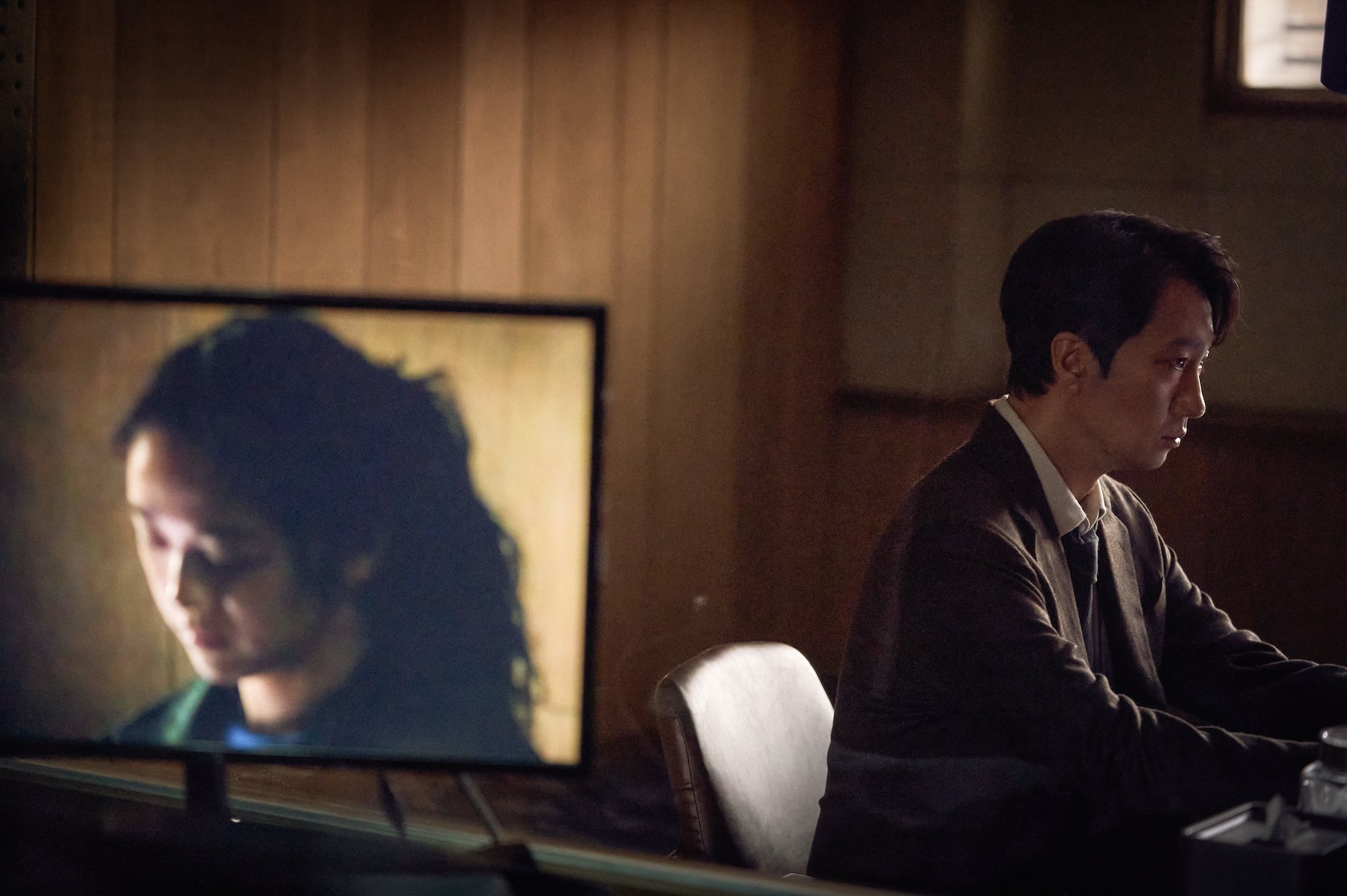
An early interrogation scene embodies all that’s right and wrong with Decision to Leave. When Hae-Joon questions Seo-rae about her husband, Park, self-conscious that we’ve been watching variations of this sequence all our lives, devotes himself to every element that doesn’t immediately matter to his story. Most obviously, Park finds dozens of dazzling new ways to avoid a typical two-shot of the principal characters, utilizing glass panes, computer screens, and phones to forge prismatic images, which affirm the film’s governing notion of modern devices as fostering worlds within worlds that muddy basic communication.

There’s also a reference in this scene to spousal abuse, which matters most for a shot of an X-ray of an arm that’s rhymed with a close-up of Hae-Joon’s arm in bed later on, as he rhapsodizes over Seo-rae. Viewers will recall this image later in Decision to Leave, when it’s reprised again to symbolize the hallucinatory death of a pivotal character. The interrogation scene is loaded with formalist bravado and thematic resonance, yet it’s so busy that it doesn’t work up even rudimentary curiosity about Seo-rae’s role in the crime at hand. Forget Vertigo, because at a certain point one may long for a simple pleasure like Paul Verhoeven’s Basic Instinct, a formally astonishing rendition of a trashy script that has enough momentum for 10 thrillers, even if its mystery makes no more sense than the one offered here.
Take Ki Do-soo’s alleged abuse of his wife. It’s referenced quickly, to set up the film’s extraordinary climactic image, and forgotten. This bit of information, or suggestion, suits the film’s overall design but may leave you wondering what the hell happened, and not in a pleasurable way. Throughout, Park confuses ambiguity with bafflement. And he continues to throw information at us, explaining away things that don’t seem to be worth the effort. Park, for one, is clearly fighting the movie and TV cliché of the cop who only seems to work one case at a time, and so we see Hae-Joon investing himself in other mysteries that are quickly dispatched. But by the time you realize that these crimes have nothing to do with the already convoluted murder of the mountain climber, they’ve been discarded for the sake of more exposition. In The Handmaiden, the twists and sleights of hand intensified our complicity with the characters, while Decision to Leave closes the door on us, drowning us in paperwork.
Just as one is primed for Decision to Leave to take off, plunging us into Hae-Joon’s romantic obsession with Seo-rae, it resolves its central mystery and starts all over again, springing a second, more cluttered, and less compelling murder for Hae-Joon to solve. Via convolutions that are ridiculous even for the crime genre, Seo-rae figures in both cases, as an intangible romantic daydream in the tradition of the mystery woman of Vertigo. But here’s the thing about Vertigo, Roman Polanski’s Chinatown, Fincher’s Zodiac, as well as South Korean landmarks such as Boon Jong-ho’s Memories of Murder: While their plots are thorny, their emotional through lines are primordial. Those films are eaten up with the human need to explain and right what can’t be explained and righted, and with the longing such desires foster. Those films have heroes whose need for absolution becomes our own, in the process mythologizing our everyday regrets. By contrast, Decision to Leave intellectualizes longing.
Park keeps throwing stuff at us—comically symbolic sushi takeout, endless amounts of phone recordings, an evolving history of a woman’s background in elder care, three strained marriages, a largely unplumbed rumination on the differences between South Korea and China, and so on—while letting the story of Hae-Joon and Seo-rae twist in the wind. The plot is so pointlessly complicated that one can rarely savor the characters or luxuriate in the atmosphere, as Park supersizes all of the most interminable qualities of a typical procedural.
Decision to Leave stokes admiration for the inventiveness of a cross-fade, yet fosters our profound apathy toward basics like the identity of a murderer or the stirrings of the forbidden lovers. Throughout, one often feels the plot working against Park’s poetry, though in a few cases poetry wins out, especially during a beachside disappearance that, rife with gurgling waves and inchoate agony, suggests the climax of Robert Altman’s The Long Goodbye. Here, a close-up of a hand closing, sealing its fate, is heartbreakingly beautiful. It’s a pity that we barely know why the owner of this hand is compelled to die to begin with.
Since 2001, we've brought you uncompromising, candid takes on the world of film, music, television, video games, theater, and more. Independently owned and operated publications like Slant have been hit hard in recent years, but we’re committed to keeping our content free and accessible—meaning no paywalls or fees.
If you like what we do, please consider subscribing to our Patreon or making a donation.




I agree with your take. Saw the film this afternoon. Am a huge fan of Chan-wook’s films, but got a sinking feeling half-way through, that we were in a cluttered, inchoate territory, and the experience was becoming increasingly, somewhat bafflingly, less-than-satisfying. Not in the same league as The Handmaiden or Oldboy, IMHO.
I agree that the plot was over complicated, but this review reads at times like you just expected a faster paced movie and never adjusted. And “The interrogation scene is loaded with formalist bravado and thematic resonance, yet it’s so busy that it doesn’t work up even rudimentary curiosity about Seo-rae’s role in the crime at hand.” The domestic abuse stuff was actually pretty clear by the time that half of the movie ended and the interrogation scene both built up curiousity about the case and kicked off the romance. This movie is not perfect but you also missed some stuff that was pretty obvious; the side cases both clearly serve several purposes that I’m not going to get into because this is the Slant comment section so who cares.