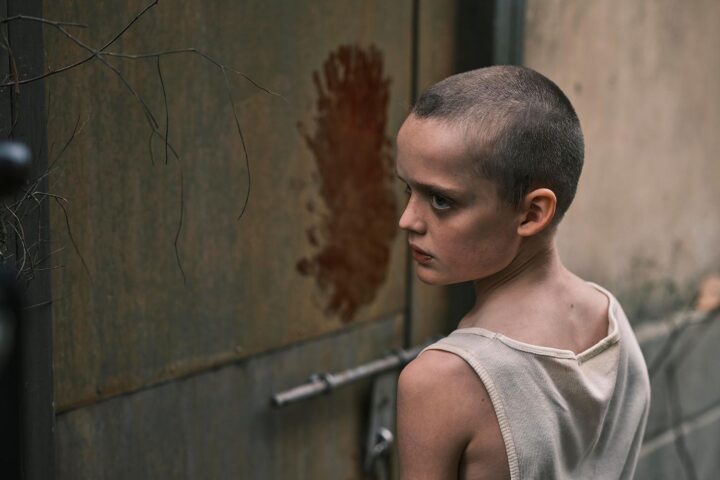
On the press tour for Talk to Me, Danny Philippou’s car accident as a teenager has risen to a level so apocryphal that he assumes I’m already aware of the incident. At 16, he suffered an episode of irrepressible shakiness while hospitalized for his injuries, and it took the touch of his sister’s hand to bring him out of shock and back to reality.
That experience is just one of many that feed directly into Talk to Me, the film he directed with his twin brother, Michael. Like many a great directorial debut, the work feels like a release of everything the 30-year-old filmmakers have been waiting to share with the world. In their freshman feature, suburban Australian teenagers in search of freedom and fun turn to the new frontier spiritual possession through a ritual involving an embalmed hand.
The connection to Danny’s incident comes through in the journey of 17-year-old Mia (Sophie Wilde), who’s still reeling from the death by suicide of her mother two years prior. But the parallels also extend to form in Talk to Me. The Philippous, who established their international profile on YouTube through their RackaRacka channel, are masters of commanding attention through spectacle and sensation, and their contribution to the possession subgenre of horror feels both in line with its classic entries and a leap forward into the future.
My conversation with the brothers covered their online origins, how they leveled up into feature filmmaking, and why they’re keen to engage with interpretations of Talk to Me.
As YouTube creators, you had such a direct feedback loop with an audience. Was having that read on viewership something you think informs the way you made Talk to Me and gearing the film toward what makes them tick?
Danny Philippou: For the set pieces, we’re always keeping that audience in mind. A set piece should work as a clip on YouTube, like its own thing. But we erased some of the YouTube lessons for the more character-driven stuff. I would never upload a conversation between two people on my YouTube channel, really. I’d be scared of that. We’ve probably done it once or twice, but usually it’s super-elevated and screaming for attention. So it was sort of unlearning that a little bit for the character-driven stuff. Sometimes you work through YouTube with really talented performers that have really good improv, and you record these scenes that go on for ages. We love them, but it feels like we’re trying to do a different thing with the film. We were terrified of boring an audience, and we cut out 20 minutes of the drama from Talk to Me.
Michael Philippou: Yeah, it’s like a full-length version of a YouTube video because we decided to keep it moving as quickly as possible. We didn’t ever want to bore anyone or keep anyone there for longer than they needed to be.
Did knowing that audience’s sensibility inform the tonal blending of humor and horror in the film? You cite South Korean cinema as inspiring a lot of that, but Talk to Me also feels born from spawned from something internet-based too.
DP: Yeah, I think that we’re tapping into that. I think that’s just been our language for so long, so obviously some of that’s going to translate into what we’re doing. We did want the film to exist outside of the YouTube channel, but I guess we couldn’t help ourselves.
MP: I think it was refreshing for me to watch Korean cinema, especially Bong Joon-ho’s Memories of Murder, my favorite movie. How can something be so tense, and the characters be so funny, and then it has that switch? I really felt the switch when it turned darker, I really felt I was on board with the characters. Even though the characters are bad people in some scenes, l still really empathize with them because they were funny.
DP: How funny was it when they just drop-kick each other?
MP: Oh, it’s so good. And then when they’re trying to contain the evidence, but everyone’s walking over it. It’s such a perfect film. Watching it, I was like, “I want to do stuff like that.”

You’ve expressed that you found YouTube as limiting for personal expression because you felt like you had to create for that algorithm and audience. Did the platform’s constraints help inspire the freedom of this feature?
DP: There’s such a hunger to express. When you do something for so long in group A, of course, you’re always thinking of group B. Eventually when you go over, things just flow out. I’ve never expressed myself in this way, so the first draft of Talk to Me just really flew out of me. That whole process of really sitting down with my co-writer, Bill Hinzman, and bouncing the script back and forth, we’d never done anything like that on YouTube. It’s rewarding in another way.
MP: I never thought of this, but we kind of needed permission to write. We were writing this thing called Concrete Kings, and we had so many different writers. They all fell through for various reasons. Then because Danny was really specific about some scenes, one of them gave notes on the scenes but basically wrote it. She said, “You should be the one writing this. I could do this and take the paycheck, but you have to write this film like that. That’s the most natural.” That unlocked a thing in us like, “Oh, we could be writers if we wanted to.” We were kind of giving into the stigma of YouTube a little. “Oh, we’re just YouTubers, so we can’t write!”
DP: Having this writer that I really looked up to say that to me did unlock confidence a little bit, so we were able to express ourselves in that way.
It was in the second draft of Talk to Me whenever you unlocked the hand as the central haunted object. What spoke to you about that?
DP: Did you read about my story about my car accident? That whole experience always stuck with me, the power of human touch and connection. It was so evident throughout the first draft of the film. All those scenes and moments are about human touch and connections. Hands were such a recurring motif all the way through it. It was there the entire time. That being the object of our horror, this thematic thing that we’ve been talking about the whole movie, just felt right. It literally it fits so well. It couldn’t have been anything else.
How do you find the balance with using the motif? For example, I loved the cutaway of Mia jealously seeing two hands touch right before she decides to get possessed for the first time.
MP: Oooh! [points finger, laughing]
The moment is subtle. It’s not bludgeoning you with the parallel.
MP: It’s about knowing that you don’t have to bludgeon people over their heads. Just the tiniest thing about a glance, or something tiny in the frame, it can mean so much.
DP: I did an interview today with someone from Sweden that pretty much decoded an entire possession and what it meant subtextually. I was like, “Oh, shit.” He was like, “I think it means this. And this means that.” I was like, “Oh my god, whoa, what the fuck?!” So that was sick. I love hearing people’s interpretations. We learned this with the edit as well. We had full conversations written out, and we learned that we can convey all of that with just a look.
MP: There’s one scene in a car, where it’s raining, there was a whole conversation that was great. But it’s stronger telling the same thing just through emotion, looks, and characters interacting without talking. With the script, you sometimes have to write that stuff. But when you have really talented performers that can convey things with just their faces, it elevates the material. You don’t need that extra stuff. You don’t need to spell it out to people.
There’s a trend right now in the genre of “metaphorror” where it feels like half of the genre movies boil down to “and the monster was trauma.” How did you handle how much to literalize Mia’s connection to the hand and spirit world without making such a direct connection to her grief?
DP: It was all in that mythology bible where we broke down every single spirit that’s connecting, why they’re acting a certain way, what emotions they’re connecting to, and how that spirit died. We tell you a little bit about how the spirits died even with the sound design and all that sort of stuff. Part of me really wants to publish and say, “Look! Look at all this work we did for the thing!” But the other part of me is excited about planting the seeds and having people find [out]. There are scenes I know that people rewatching it will be able to figure out. I’m so excited because I read reviews and Letterboxd things. It’s always interesting when I also read reviews that don’t get it. Like, “Oh, this isn’t really hitting this stuff.” That wasn’t the point of the movie! [laughs] It’s so interesting, I’ve never had this much feedback or analysis on something. It’s really fun to be here. Even having you notice that small hand moment as well is awesome.
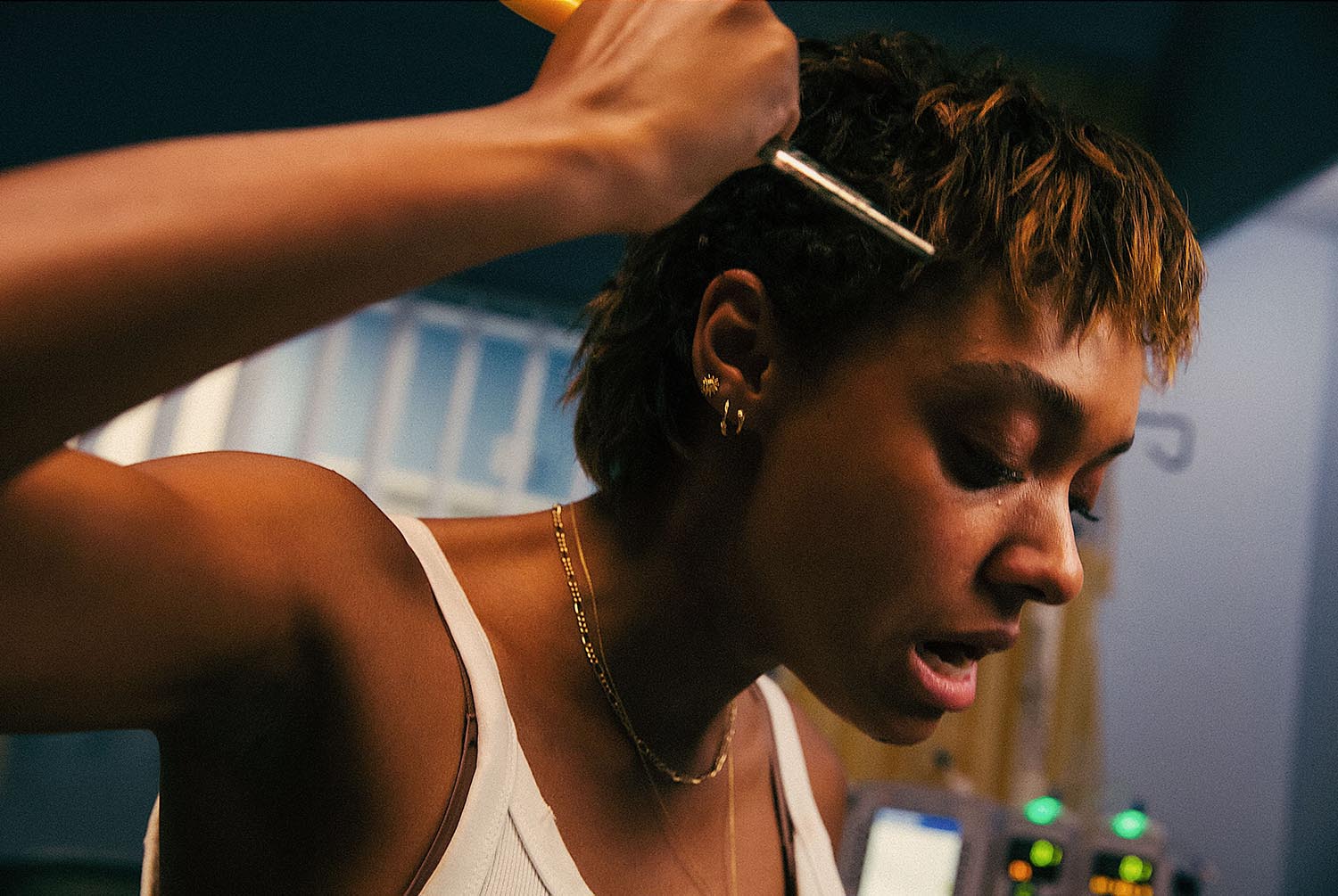
The film has two big extended tracking shots, one at the opening and one near the end. I think you mentioned that the opening one was a bit more practical, as you wanted to make sure that you didn’t lose attention…
DP: Another big thing for that as well was that I really wanted to show the parties dwindle in size. Each party in the film is progressively getting smaller and sadder, to the point where it’s just Mia and her vice. That was another big element. Also, subtextually, even Duckett [Sunny Johnson] being behind the closed door and Mia being behind the closed doors…
MP: You’re literally spelling everything out!
MP: I’m just saying that it wasn’t just for attention. We’re also pulling audiences into the world!
Technology plays a big role in the movie. There’s a conversation about deepfaking a Snapchat. Are these single-take shots that maintain some sense of reality through continuity meant to contrast the cellphone videos? They seem to jolt the characters out of the “haters gonna say it’s fake” mentality around possession.
MP: We wanted to make a film that was current and modern. It’s set in today’s world, so all of that is naturally going to be there anyway. It’s a world that we’re in, and we understand it. If you’re gonna do a movie about teenagers today, social media dominates the world. But then you realize that you’re saying things even without knowing [that you are].
DP: Even when you make something and put it out there, you’re still able to step back and be like, “I didn’t realize I was expressing that.” When you look back, you’re finding the connections in your own work, which is really exciting. Today, things are faked so easily that even if someone shot a UFO landing in the desert, came out, spoke to the camera, and it was real, everyone would say it’s fake. Because it can be faked. It’s so crazy how easy it is to fake things.
But the phones aren’t just set dressing. They’re also thematic devices in showing the ways that teens need a barrier to experience grief or other emotions they don’t want to face. How do you handle bringing that element in?
DP: Mia’s using that when she’s feeling really down, getting lost in social media and looking back at these memories—not learning to move forward yet, reveling in the past and in an idea of who you were, or who you could have been. There are positives and negatives to social media, and there’s a disconnect that happens when people put up their phone. Then again, there are positives to social media as well. I don’t want to sound like we’re anti-social!
MP: We’re used to watching terrible things go wrong on our phone. You’re safe [from them] on your phone, like watching a movie. It’s so common in reality to disconnect through your phone. Your phone is your shield, in a way. That stuff is all in there, and it’s interesting to [read and hear] interpretations [of what we’re doing]. I remember getting told that when the smartphone came out, so many scriptwriters said it was the death of storytelling in a way because it has the answers to everything. Everyone’s got maps and can translate languages or get answers. I wanted to find a way to incorporate the negative sides [of that into the film].
Since 2001, we've brought you uncompromising, candid takes on the world of film, music, television, video games, theater, and more. Independently owned and operated publications like Slant have been hit hard in recent years, but we’re committed to keeping our content free and accessible—meaning no paywalls or fees.
If you like what we do, please consider subscribing to our Patreon or making a donation.