It seems unlikely that any film this year will deliver a stronger opening than the one which sends Stephen Williams’s Chevalier whirling into life. We begin in 18th-century Paris, where a sold-out crowd has turned up in their finest pale makeup and powdered wigs to watch an arrogant virtuoso named Wolfgang Amadeus Mozart (Joseph Prowen) prance impishly across the stage and dazzle them with his musical skills. After finishing off one technically immaculate number, he offers his audience a chance to request their favorite song, leading to a bevy of excited demands for bangers like “Serenade No. 13” and “Clarinet Concerto.”
Much like the pink-haired version of him from Milos Forman’s Amadeus, this is Mozart as rockstar. But that’s just where the fun begins. Suddenly, a man in the back of the hall announces that he wishes to play alongside Mozart. Like a WWE superstar arriving unexpectedly to call out the champ and demand a title shot, Joseph Bologne (Kelvin Harrison Jr.) strides confidently between the aisles and hops up on to the stage as the audience buzzes with anticipation.
Bologne was a French Creole virtuoso violinist and composer whose talents allowed him to climb to the top of an artistic world that resented his existence, even earning the noble title of Chevalier de Saint Georges. At the elite boarding school where Bologne was installed, Chevalier allows us to glimpse how he weathered the abuse of his classmates and rose above them all, using his skill with a blade to fend off those who would not be silenced by his skill with a bow.
Whichever instrument he’s wielding, Harrison Jr. imbues Bologne with an almost feline grace, his back held defiantly straight and a sardonic smirk never far from his lips. As he strolls on stage to join the most celebrated musician in the world, he banters with the easy confidence of a man who won’t be cowed by anyone, not even Wolfgang Amadeus Mozart.
Having chosen their song, Mozart and Bologne begin a violin duet that quickly becomes a duel. For every elegant flurry of notes Mozart sends in Bologne’s direction, Bologne returns an equally accomplished combo. To Mozart’s furious disbelief, they match each other blow for blow, the pace and complexity of their performance increasing with each round, and the two come to suggest boxers furiously trying to find an opening in their opponent’s defenses.
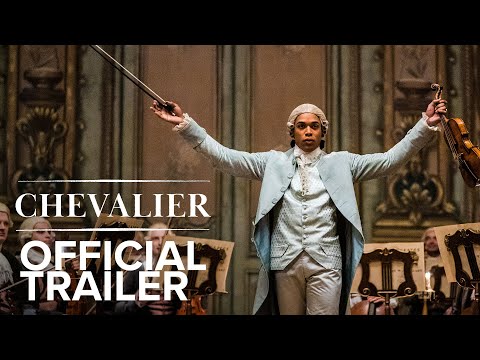
Throughout, the camera swoops around the two men as the battle rages on, framing it like a title bout. When they’re shot from behind, the viewer distinguishes them by the distinctive colors of their clothes: Mozart in deep burgundy and Bologne in the eye-catching powder-blue that will become his signature. It’s like an Old West showdown or a kung-fu epic, black hat versus white hat, boldly drawn figures expressing themselves through their style of combat.
When Mozart and Bologne’s contest finally reaches its explosive climax, and to the audience’s rapturous applause, an exasperated Mozart is left demanding to know who this incredible stranger is. And, after such an exhilarating introduction, we’re every bit as eager to find out. It’s a bombastic, wildly entertaining beginning that Chevalier then struggles to live up to.
From here on, we’re given a fairly conventional rise-and-fall tale about Bologne’s ascension to the top of the music world and the bigoted forces which then contrived to bring him down. He engages in a steamy love affair with Marie-Josephine de Montalembert—played by a devilishly deadpan Samara Weaving—and begins his affiliation with the radical groups that would one day see him leading Europe’s first all-Black regiment in the French Revolution.
Bologne’s own life story was every bit as melodramatic as the operas that he composed, filled with life-risking romances and shocking twists of fate. And that’s why, after an opening that crackles with an electric, modern energy, it’s disappointing to see Chevalier fade back into a largely conventional costume drama. Some of the verve goes out of its visual language, with large parts of the film shot in a stiff, stately fashion. Once we leave the dusky candlelight of the opening scene’s theater, much of Bologne’s story is filmed in the sort of neutral, mood-less light that can give it the appearance of a mid-budget streaming series.
Chevalier also makes the decision to have its largely French cast of characters speak in upper-class English accents, and while that’s certainly preferable than having them speak like Pepé Le Pew, it sometimes presents an issue for the leading man. The physicality of his performance is captivating and, as an accomplished musician himself, Harrison Jr. never looks out of place when Bologne is on stage, but the accent gives way here and there, sometimes leaving his lines sounding too stilted for the silver-tongued lothario that he’s portraying.
It’s a shame that, with Chevalier, Williams hasn’t made a film that matches the revolutionary spirit of Joseph Bologne’s life, but there’s still a lot of enjoyment to be taken from seeing a towering figure, long forgotten by history, returned to his rightful place at center stage. And, at least, Chevalier manages to find its fast ball again in time for the finale: an explosive set piece that sends the film, and an imperious Harrison Jr., off with a bang.
Since 2001, we've brought you uncompromising, candid takes on the world of film, music, television, video games, theater, and more. Independently owned and operated publications like Slant have been hit hard in recent years, but we’re committed to keeping our content free and accessible—meaning no paywalls or fees.
If you like what we do, please consider subscribing to our Patreon or making a donation.