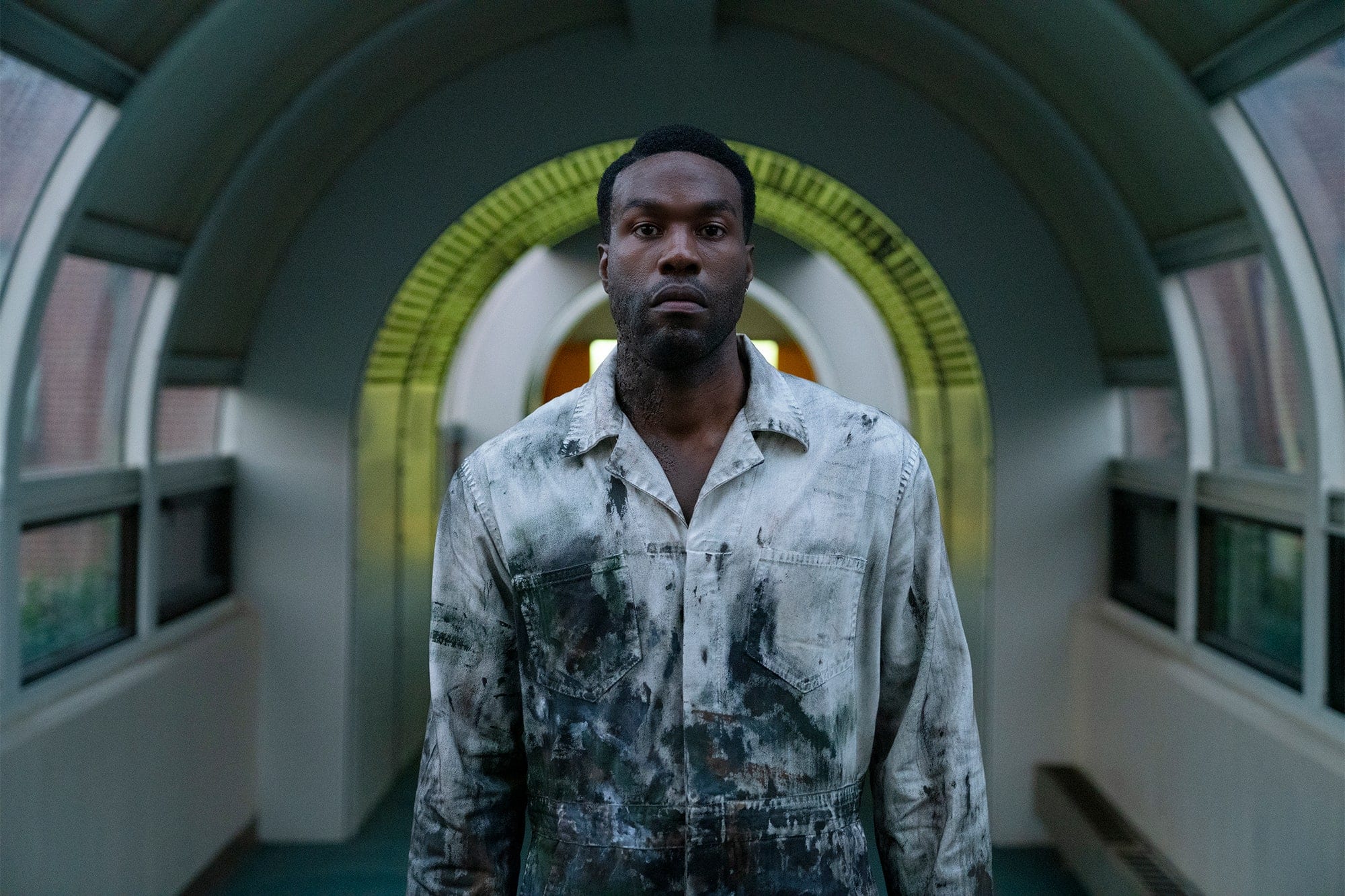
Nia DaCosta’s Candyman rests on a daring wager that unifies the spooky mythos established in Bernard Rose’s original film and the Clive Barker story on which it’s based with the contemporary realities of police violence and resistance. Candyman (Tony Todd), as every schoolchild knows, is a vengeful killer with a hook for a hand, who’s summoned by staring at one’s own reflection in the mirror and repeating his name five times. And DaCosta’s film draws a parallel between that incantation and the practice popularized by the Black Lives Matter movement, of repeatedly saying the names of victims of police brutality in order to memorialize them and with the hope of holding the justice system accountable.
Candyman doesn’t merely note the connection between these two rituals—one of fear the other of remembrance—as it also interrogates it from every possible angle, ultimately incorporating this observation into the very DNA of its mythical eponymous monster. As written by DaCosta, Win Rosenfeld, and Jordan Peele, the new Candyman isn’t just the vengeful spirit of a single person, but rather a compilation—or “hive”—of black men who’ve been unjustly slaughtered by racists and cops throughout the centuries. If this concept sounds a little didactic and unsubtle on paper, it plays on screen as a blistering tragedy that, in its most effective moments, evokes the searing rage of Richard Wright’s Native Son.
On the surface, this film’s protagonist, Tony McCoy (Yahya Abdul-Mateen II), doesn’t recall the conspicuously anguished Bigger Thomas, who’s driven to a crime by the society that denies him the promise of “life, liberty, and the pursuit of happiness.” After all, he’s a mild-mannered visual artist dating an upwardly mobile gallery owner, Brianna Cartwright (Teyonah Parris), with whom he lives in a chic condo built upon the ashes of Cabrini-Green. But as James Baldwin famously acknowledged in 1955 collection Notes of a Native Son, “No American Negro exists who does not have his private Bigger Thomas living in his skull.”
Suffering from a bad case of artist’s block, Tony becomes obsessed with the Candyman story, incorporating the urban legend into his work, much to the bemusement of a white critic, Finley Stephens (Rebecca Spence), who attends his gallery show. Tony’s piece, entitled “Say My Name,” offers a microcosmic auto-critique of DaCosta’s haunting allegory for black trauma and resilience. A mock bathroom mirror that opens to reveal a hellish interior, the work cleverly alludes to Rose’s original film while reconstituting its elements through the eyes of a black artist who sees in the Candyman story a reflection of his own submerged pain.
Tony’s piece becomes the means through which Candyman is first summoned in the film, leading to a double murder that ironically draws instant hype. Finley even summons him to her apartment to announce that what she had earlier dismissed as a bunch of “knee-jerk clichés” now has the aura of the “eternal.” One of the few mainstream American films to depict the contemporary art world with even a modicum of authenticity, Candyman recognizes the way in which proximity to real-world violence can suddenly translate into monetary value. The viewer may even detect a note of self-questioning on the part of the filmmakers in such moments: Are we exploiting black tragedy for financial gain?
While that uncomfortable question lingers over the film, the answer is provided by the seriousness of DaCosta’s vision and her defiant unwillingness to give us the cathartic brutality that we crave. While there are several kills in the film, its violence is evocative rather than gory, shot sometimes at a great distance—including one stabbing that we witness far outside the window of a high-rise—and other times with only synecdochal snippets of carnage, such as a waterfall of blood that we glimpse beneath the door of a bathroom stall.
As in her debut feature, Little Woods, DaCosta has a keen eye for quietly discomforting compositions, and here she ups the ante considerably, building a mood of creeping unease more with canted angles and vertigo-inducing shots of the Chicago skyline than with slasher-like sadism. Rather than employing traditional flashbacks to fill in the complex historical context of the various stories that make up the “hive,” DaCosta uses scenes of gothic shadow-puppetry that recall the work of artist Kara Walker, whose silhouette installations evoke the pain and humor of African-American history with a similarly stripped-down potency.
The film stumbles a bit in its final passages, for attempting to pack too much arbitrary plot incident into its rather slim runtime, such as one scene in which a local Candyman expert (Colman Domingo), essentially playing the part of Dr. Frankenstein, saws off Tony’s arm and affixes a hook to it. A chase through the pitch-black corridors of an abandoned building lit only by cellphone flashlights at first promises to be a show-stopping horror set piece before its abrupt anti-climax. DaCosta’s emphasis on mood and allegory come at the expense of tension and fully rounded characters, but the confidence with which the film synthesizes an adherence to franchise continuity with striking contemporary relevance is hard not to admire.
By film’s end, Candyman is no longer a monster but a kind of savior, an avatar of the deepest, darkest impulses lurking beneath the façade of careerist upper-class complacency. As Tony and Brianna are reminded many times over, in ways both small and large, their membership in the white-credentialed establishment is provisional and can be revoked at any time. To be removed from the relative comfort of their gentrified block and at least nominally inclusive art community is to be thrust full-force back into the long, dark, and still-ongoing history of black subjugation. Resistance is possible, Candyman suggests, but it isn’t always pretty.
Since 2001, we've brought you uncompromising, candid takes on the world of film, music, television, video games, theater, and more. Independently owned and operated publications like Slant have been hit hard in recent years, but we’re committed to keeping our content free and accessible—meaning no paywalls or fees.
If you like what we do, please consider subscribing to our Patreon or making a donation.