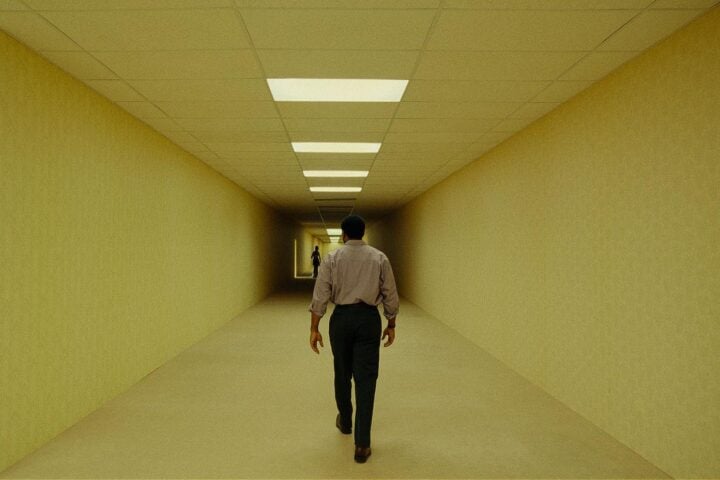
Mel Eslyn’s Biosphere uses its clever sci-fi conceit to examine perceptions of masculinity and the dynamics of a straight male friendship. The film is like a scientific experiment: a buddy comedy that places two men inside a hermetically sealed environment, adds an unexpected variable, then sits back to observe their behavior. And the results of this Black Mirror meets Humpday concoction, though spotty, are both funny and insightful.
Billy (Mark Duplass) and Ray (Sterling K. Brown) appear to be the last humans alive following an unspecified planetary catastrophe. They now live within the titular structure, enjoying a simple domestic routine of reading, running, and holding long, involved conversations about which of the Mario brothers is more vital. After surviving for a substantial period of time this way, they fear that their luck may finally have run out when the last remaining female fish in the fishpond that supplies them with essential protein is found floating on the surface.
There’s also the matter of the bright green light in the inky black sky above that’s slowly making its way toward the biodome. All hope seems lost, but then Billy and Ray are shocked to discover that the biological drive to procreate has led one of the remaining male fish in their fishpond to change its sex. Upon looking down at his own nether regions, Billy is even more shocked to discover that the fish isn’t the only one adapting to the environment.
Even a few years ago, it’s easy to imagine that a premise like this would have been used as a launching pad for lazy gender jokes and gross-out comedy, but the film, which was written by Eslyn and Duplass, does something altogether smarter and more compassionate. What follows is a warmly funny account of two guys trying to renegotiate their relationship to each other and to their identities as men as one of their bodies undergoes a radical transformation. And that process only becomes more fraught when they realize that they’ve essentially been presented with an opportunity to keep the human race going—that is, if they’re willing to sleep together.

Since the entirety of the film is confined to the biodome, it helps that the two leads are so charismatic. Brown ably conveys the formidable intelligence and sense of authority of a man who worked as a scientific advisor for the White House. Billy, then, is the ideal counterweight to such an imposing figure, with Duplass lending an everyman’s perspective to the characters’ bizarre circumstance. Both actors bring an intimacy and tenderness to their roles that ensure that the story always feels emotionally grounded, even at its most absurd.
We also learn that, before the world ended, Billy was the president of the United States, and in a film about an apocalyptic catastrophe and sequential hermaphroditism, this might be the most unlikely of details. That is, Duplass simply feels too much like a someone who you’d actually want to have a beer with. Ray’s characterization is generally more coherent, though his obsession with magic and miracles, which, while clearly intended to feed into the theme about the power of hope, never quite gels with his rigorously science-minded persona.
The world that supposedly existed before and beyond the sphere never entirely comes into focus, and the film largely ducks the question of what kind of future any child of Billy and Ray’s would inherit given that they’re likely the last humans alive. Any time it directs our attention to the did (and does) exist beyond the confines of the biodome, Biosphere begins to flounder a little. But so long as it stays tucked safely inside, it makes for a thoughtful drama about life, gender, and male friendship. And in Billy and Ray’s bro-ish celebrations after the former gets his first period, we even get one of the most oddly heartwarming scenes of the year.
Since 2001, we've brought you uncompromising, candid takes on the world of film, music, television, video games, theater, and more. Independently owned and operated publications like Slant have been hit hard in recent years, but we’re committed to keeping our content free and accessible—meaning no paywalls or fees.
If you like what we do, please consider subscribing to our Patreon or making a donation.