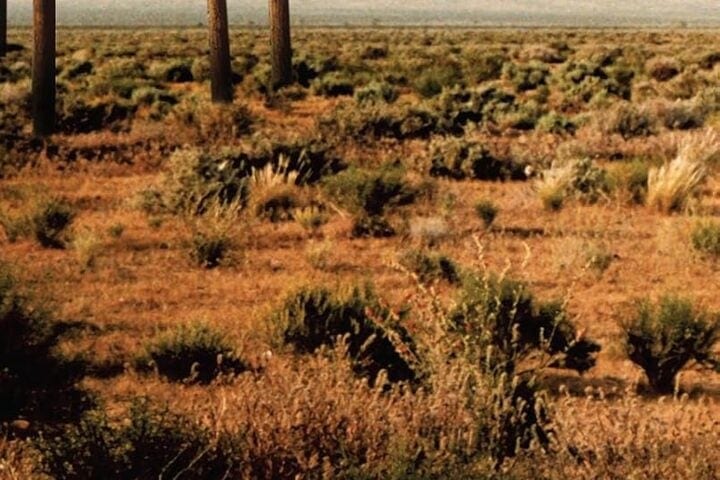
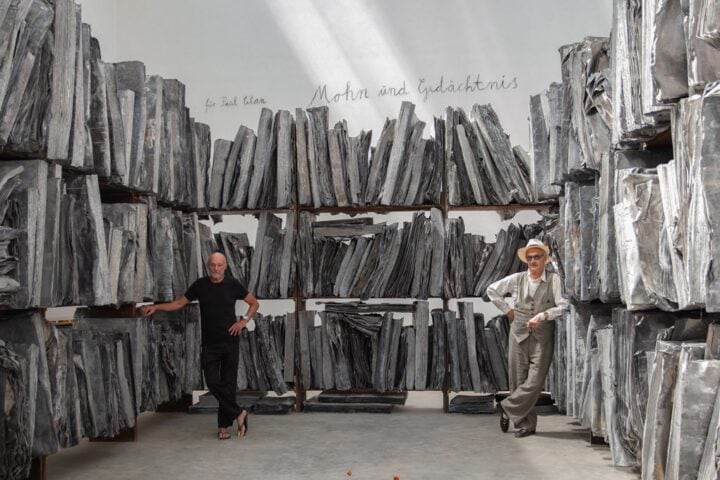
The first sculpture seen in Wim Wenders’s documentary Anselm is a wedding dress, its long train strewn over a massive bed of fallen leaves, perched in a lush forest on a cliff’s edge. All the while, the film cuts between intimate close-ups and long shots that take in the totality of the piece. More sculptures emerge across an expansive outdoor atelier in Croissy, on the outskirts of Paris, each subsequent wedding dress overflowing with harsh textures due to the various hard materials used within them. As if mimicking the experience of an in-person encounter with Anselm Kiefer’s confrontational work, the 3D camera glides past them all.
First glimpsed in the film cycling in his vast warehouse in Barjac, France, the seventysomething Kiefer appears as if he’s sprung from one of his enormous paintings. As Wenders’s mesmerizing portrait of the Austrian-German multimedia artist progresses, the experience of multi-dimensionality sweeps us into a tactile perception of the man’s work. In terms both immediate and implied, Wenders plunges us into Kiefer’s exploration of the “open wound,” as a BBC radio announcer calls it in the documentary, of Germany’s political and social history.
In some of Anselm’s scenes, peering into that open wound is something that manifests quite literally, as in a breathtaking sequence where the film, in the midst of zooming swiftly through a maquette of Kiefer’s recreation of cities in post-war ruin, seamlessly transitions to archival footage of a child walking through the streets of a destroyed neighborhood. From there, we’re plummeted into a little boy’s bedroom, where a young version of Kiefer (played by Anton Wenders, the director’s great-nephew) daydreams on his bed in an airy loft.
Kiefer’s artistic mission is a moral reckoning with his native country’s messy political entanglements and their fallout. Expressly interested in what he’s diagnosed as something of a collective amnesia over Nazi rule, Kiefer exposes by way of recreation. From his large-scale, mixed-media paintings, with their use of petrified wood and ash, to his provocative black-and-white self-portrait photography of him giving a “Sieg Heil” at sites most people have forgotten were tied to Nazi atrocities, Kiefer’s work is nothing if not purposefully incendiary.

To make that thumbprint indelible, Wenders mirrors Kiefer’s process by similarly indulging in recreation and restaging throughout the documentary. In meditative scenes of elegiac beauty that dissolve the border between documentary and fiction, a thirtysomething Kiefer (played by Daniel Kiefer, the artist’s son) strolls the blanketed snow of a countryside taking photographs that later become the inspiration for some of his more iconic work.
Wenders also traces how Kiefer went from an apprenticeship with sculptor and performance artist Joseph Beuys at the Kunstakademie Düsseldorf to striking out on his own, and the way his interests in poet Paul Celan and philosopher Martin Heidegger intertwine into a body of work that’s spellbindingly metaphysical and unique. Wenders doles out information about Kiefer’s life through the occasional archival material but largely leans into first-hand accounts of the artist’s life. In the process, he asks us to consider the effect of the work in both their immediate effects and in their long-term consequences. In one scene, Kiefer is seen walking through his warehouse, where a gargantuan projection of the author Ingeborg Bachmann overtakes an entire wall, and in 3D, the effect is overwhelming and sometimes suffocating.
As in 2011’s Pina, Wenders’s singular 3D portrait of dancer and choreographer Pina Bausch, Wenders aims for immersion. But perhaps the film that Anselm more closely resembles is Laura Poitras’s All the Beauty and the Bloodshed, which, by way of its similar savoring of the innate properties of several different art forms, blends into a unified portrait of both subject and filmmaker. Both Kiefer and Nan Goldin are artists whose work has blown up the doors of taboo in political defiance, and in Anselm, Wenders inevitably says much about himself.
The documentary’s final shot, of an imposing winged sculpture on the same grassy plain where Kiefer’s work is first glimpsed, recalls Wenders’s own Wings of Desire. As the ghosts, angels, and spirits of our collective yesteryear swirl about, Wenders and Kiefer ask us not to forget the context of the world’s greatest tragedies. Anselm, then, is ultimately an extension of Kiefer’s “protest against forgetting,” as it reminds us that art is an act of remembrance.
Since 2001, we've brought you uncompromising, candid takes on the world of film, music, television, video games, theater, and more. Independently owned and operated publications like Slant have been hit hard in recent years, but we’re committed to keeping our content free and accessible—meaning no paywalls or fees.
If you like what we do, please consider subscribing to our Patreon or making a donation.