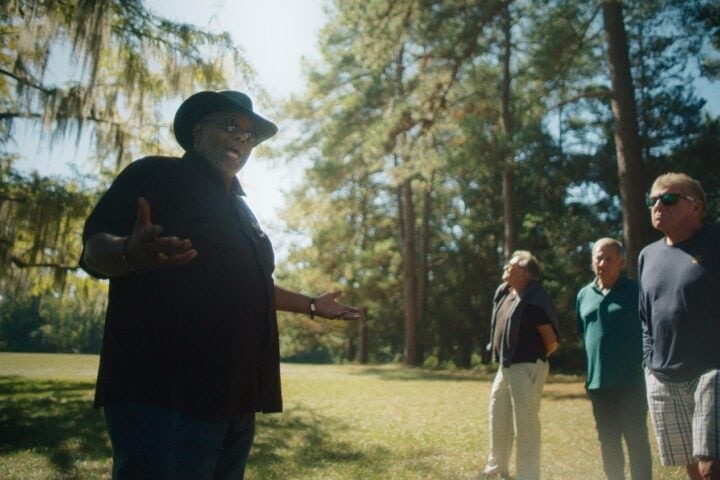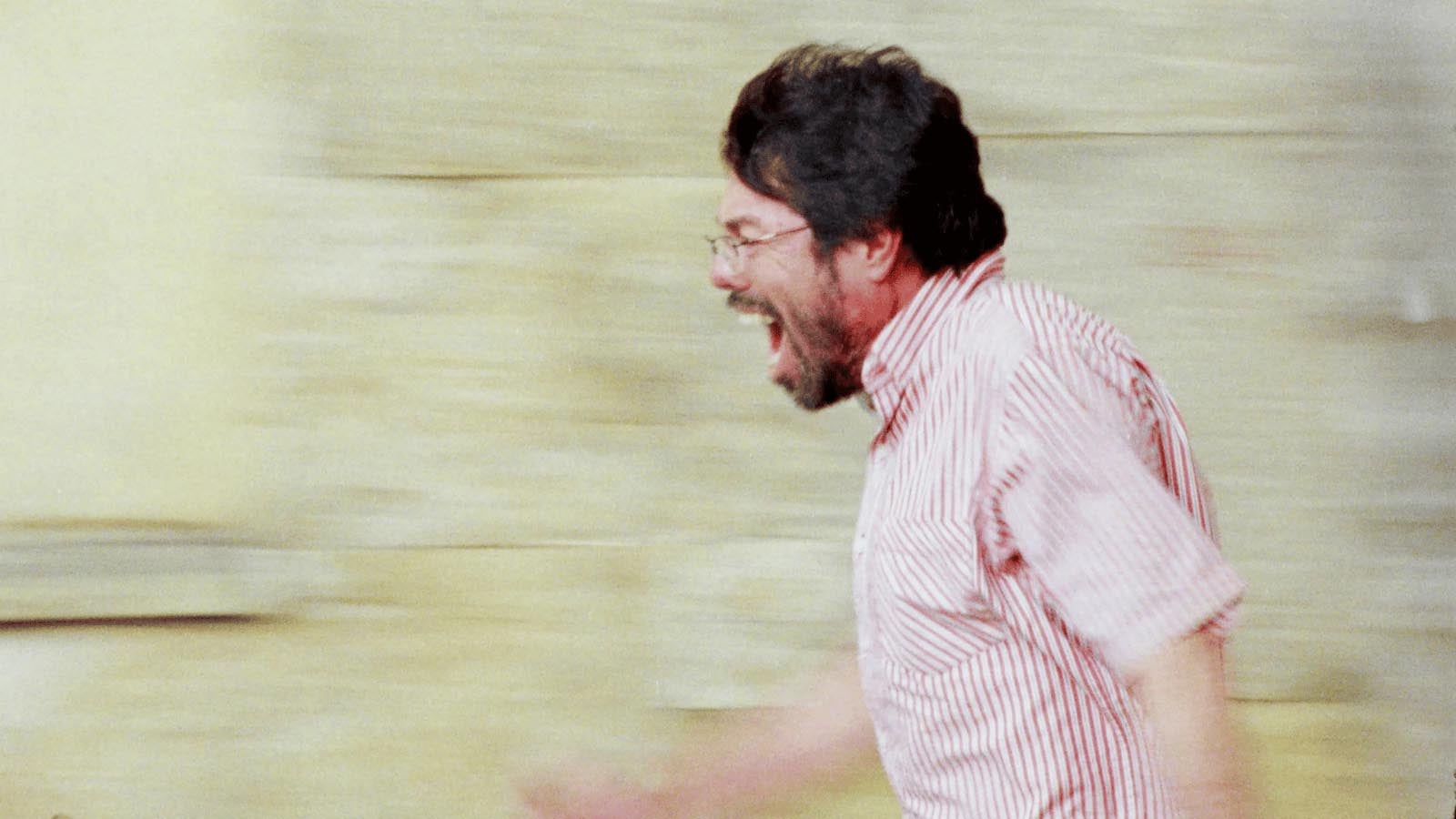
Writer-director Simón Mesa Soto’s A Poet is a paean to failure. The titular poet, Oscár Restrepo (Ubeimar Rios), a winner of national awards in his youth, has lapsed into self-pitying obscurity and alcoholism. Divorced and living with his mother (Margarita Soto), he refuses on principle to stoop to usefulness of any kind. Until, that is, he gets it into his head to pay for his estranged daughter Daniela’s (Alisson Correa) university education, and takes a job teaching poetry to teenagers. Oscár’s almost Sisyphean commitment to failure allows A Poet to move past being another needless allegory for making art. This finely shaded character study of a recalcitrant social pariah feels more than anything else like an existential parable.
Oscár’s redemption is pinned to Yurlady (Rebeca Andrade), one of his students. He recognizes her talent and attempts to nourish it, becoming a proxy father in the process, by introducing her to Poetry Viva, a press and workshop for promising young writers. The institution is run by Efrain (Guillermo Cardona), celebrated for his socially committed novels. An embodiment of all the hypocrisy, pettiness, and cynicism of the literary world, Efrain plays up his status as an established writer by belittling Oscár’s poetry every chance he gets.
Only when Yurlady’s talent promises to boost Poetry Viva’s prestige does Efrain change his tune, somewhat. “You’re a poem,” he tells Oscár, so as not to praise the poetry itself. “A pretty sad one.” Likewise, he frames Oscár’s mentorship as poetry by other means. Yurlady will be Oscár’s “magnum opus,” not anything he actually writes. But failure is never far behind, and after Oscár brings Yurlady home from a poetry festival blackout drunk, her family accuses him of rape.
Set to Los Zafiros’s doowop-influenced bolero “La Luna en Tu Mirada,” title cards announce the film’s several chapters. Each time this occurs, the song’s wistful harmonies get jarringly interrupted by the opening shot of the subsequent scene. Many of the scenes also end abruptly just before what would be their decisive moment. Rios so radically embodies Oscár’s essence as a “walking problem,” as Efrain puts it, that we can intuit how this type of scene would end if it weren’t cut off: yet another debacle for Oscár, and confirmation of his self-image as a failure.
But there’s more than economical filmmaking at play in this clipped structure. After meeting Yurlady, Oscár begins living up to what society expects of mentors and fathers, though, given the truncated conclusions of these scenes, we may not realize that until one or two scenes later. This shift upends expectations even as it lays the groundwork for a reversion to failure.
In contrast to Oscár’s mostly underwhelming verses, Mesa Soto confirms Yurlady’s talent through a moving sequence that recalls Ron Padgett’s poems for Jim Jarmusch’s Paterson. In voiceover, she reads a poem about the dreams trapped inside her room, while the camera travels from her sleeping form toward an open window, its flowerprint curtain fluttering in the breeze.
In an early scene, Oscár harangues a crowd gathered for a poetry reading about his idol, José Asunción Silva, a Colombian poet who cemented his fame by committing suicide. Oscár drunkenly proclaims Asunción Silva’s superiority to Gabriel García Márquez, who penned an undisputed masterpiece, One Hundred Years of Solitude, before schematizing magical realism to appeal to the international literary market. That he sold out is, for Oscár, evidenced by his portrait on the Colombian 50,000 peso note. Efrain comes to represent this same compromise, pressuring Yurlady to write a poem for the festival that caters to his Dutch funder’s idea of Latin American poetry as an outcry against socioeconomic inequality, and nothing more.
In the absence of recognition (from Daniela, Yurlady, or the literary set) or real talent, Oscár’s temptation to suicide deepens the film’s existentialism. Committing suicide would be, for him, another way of chasing validation. But besides selling out and giving up, there’s a third way. In A Poet, the only authentic triumph comes with the futile struggle in obscurity in the service of some ideal, which here happens to be poetry—not as a vehicle for making money, making friends, or even as a marker of identity, but as a ritual for making meaning.
It’s a sign of Mesa Soto’s mastery of storytelling that Oscár, despite disappointing everyone around him, ends up inviting the viewer’s admiration. In this sense, he’s both quintessential loser and existential hero, not in spite but because of his failure.
Since 2001, we've brought you uncompromising, candid takes on the world of film, music, television, video games, theater, and more. Independently owned and operated publications like Slant have been hit hard in recent years, but we’re committed to keeping our content free and accessible—meaning no paywalls or fees.
If you like what we do, please consider subscribing to our Patreon or making a donation.