Richard Linklater’s decade-spanning masterwork Boyhood introduced the world to the concept of a Beatles “Black Album.” In that 2014 film, Ethan Hawke’s Mason Evans Sr. presents a personally curated album of the rock band’s solo tracks to his son on the child’s 15th birthday. Mason Sr. explains the impossibility of picking a favorite Beatle because the beauty of their artistry lies in their balance. The curatorial act of synergizing the sensational, the spiritual, the sensual, and the sentimental elevates them all.
The same logic that applies to the Fab Four also works as a description for Linklater himself. The Austin-based filmmaker remains one of American cinema’s most versatile artisans, as comfortable helming a mass-market studio comedy as he is a talky indie drama. No matter the form his output takes, it bears his trademark stamp of wisdom and wonder that’s been evident since his 1991 breakout Slacker when he ventured in front of the camera to postulate, “Every thought you have creates its own reality,” to an unsuspecting taxi driver.
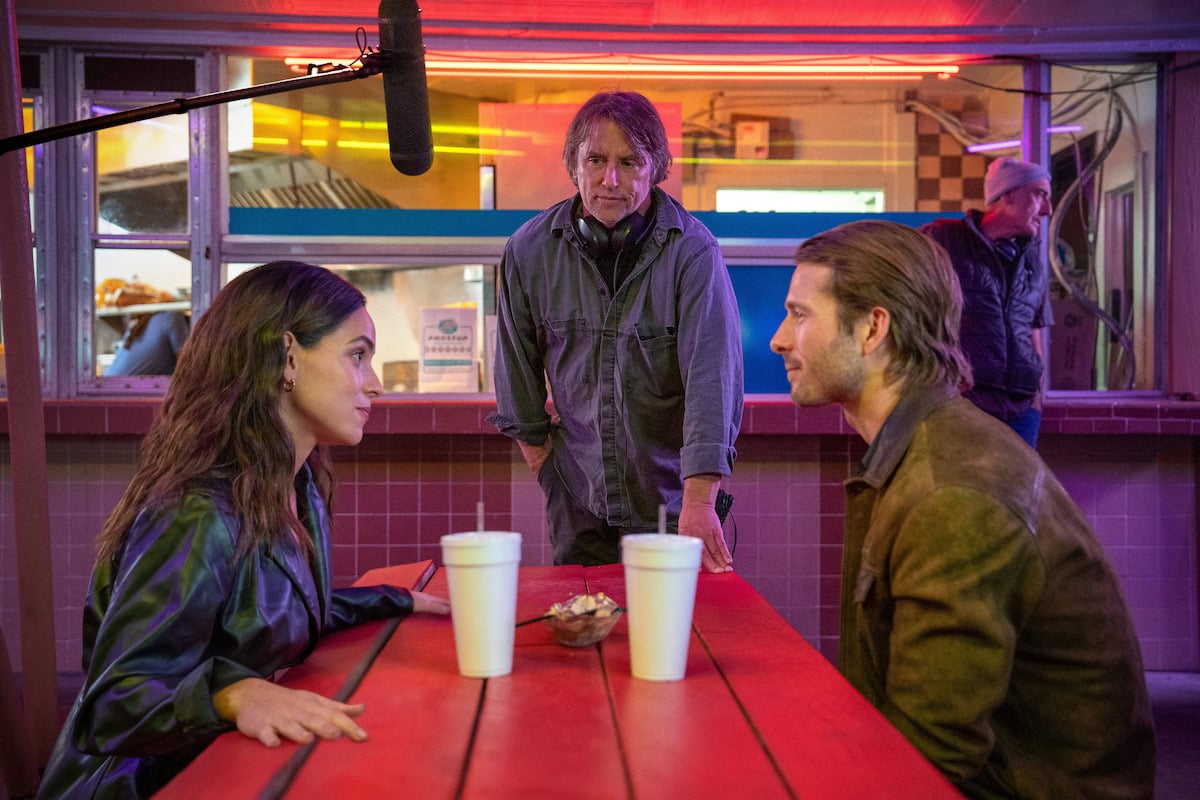
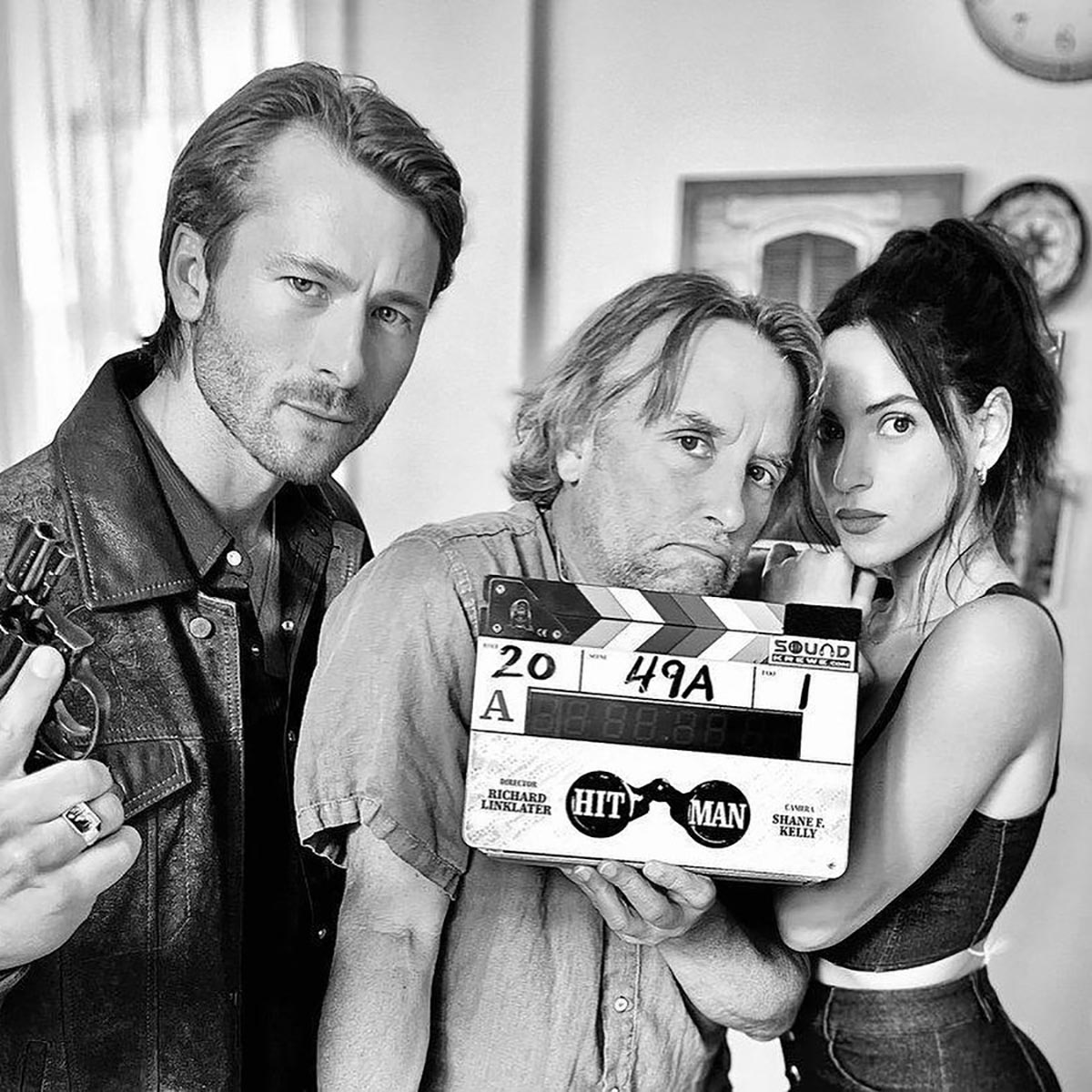
Glen Powell’s Gary Johnson, the protagonist of Linklater’s Hit Man, makes good on the promise of what was just an errant thought for the aforementioned backseat philosopher. As a part-time undercover operative for the New Orleans Police Department, Gary finds reinvigorated purpose by concocting elaborate scenarios and disguise through which he can entrap would-be contractors of a hit man’s services. While taking inspiration from a real-life story documented in a Texas Monthly article by Skip Hollingsworth, Linklater and Powell (also credited as a co-writer and producer) imagine a reality beyond the story’s end where Gary’s alter ego Ron proves so alluring to Adria Arjona’s Maddy that she re-engages him to satisfy a different primal urge.
Hit Man feels equally confident in the register of a screwball rom-com as it does in that of a noir-like thriller. All the while, Gary’s day job as a philosophy professor gives the character ample time to openly discuss how his newfound love of role-playing complicates fixed notions of identity. And, naturally, the film remains an excellent time to kick back and hang out.
I spoke with Linklater prior to Hit Man’s release on Netflix. Our conversation covered his collaborative process, where the film overlaps with his previous projects, and whether people’s identities can change with enough will power. But given that much of his and my formative cinematic education took place a generation apart at the same arthouse theater in Houston, Texas, I couldn’t help but start by asking about our shared heritage.
As someone from Houston, where this story occurred, I have to ask why it was shot in New Orleans. I assume it was primarily for tax reasons?
That’s a big part of it. The film industry, especially at the indie low-budget level, you really have to go where they want you. Unfortunately, we caught a window where Texas didn’t really want our film even though it was written for Houston. But it was an easy lateral move to go to New Orleans. It’s equally a town where this could have taken place. Even more so, maybe.
Do you still feel like there are some elements of our good old Carcinogenic Coast [a term used to describe Houston in Linklater’s 2012 film Bernie] in there?
Oh yeah, certainly. [laughs] The characters, there’s a bleed over between crazy Louisiana people. They move back and forth. Permeating the membrane between the states is pretty easily done.
With this film, Glen Powell joins the rank of heavy hitters like Ethan Hawke and Matthew McConaughey with whom you’ve collaborated several times. Is there a thread uniting these actors that you’d bring them into the fold in such a way?
The most rewarding thing about doing this long term over decades is probably those relationships you form from working together. You make true friendships, and it’s always great to work with people you’re familiar with. You know their rhythms. It’s like being in a band that breaks up, but in working with people, the band gets back together and makes a movie. So I really do treasure that, and there are a number of actors I’ve worked with multiple times. And that’s not uncommon for directors. Why wouldn’t you? And crew, too, [I use] a lot of the same department heads. You’re gonna go with what you know will produce the results you need, so that’s just natural. But sometimes, you bond. I remember first meeting Matthew, and the fact that he was from Texas—Uvalde at first and then Longview—I was like, “Oh, yeah, I’m an East Texas boy too!” You just feel some kindred [spirit]. Glen, too, he’s born and raised in Austin.
Does the same go for the extras and character actors in your films? I love watching people from Bernie show up in Boyhood and Everybody Wants Some!!
Yeah! I remember, it was so funny, I had a guy in Dazed and Confused who was old then. He was the guy who pulls Pink aside and says, “Oh, we’re looking forward to next year!” He’s just an old guy in town, and then five or six years later I’m doing The Newton Boys and [learned] “Oh, Zeke’s still alive?! Well, let’s get him in here!” [laughs] There are all these wonderful people that you’ve met, a kind of character actor [where it’s] like, “Do we have a part for them?” I tell young actors you want to be the guy that they’re going, “Oh, do we have a part for blank in here?” You want to be on that list, not like, “Oh, God, not that person.”
The nature of what Gary does in his role as a hit man is definitely acting. In some ways, is it directing? I’m thinking especially about the cellphone scene.
Oh, absolutely, yeah.
Was that connection the character has to your artistry one of the initial hooks for you and Glen writing the screenplay, or did that emerge along the way?
A little of both. The themes kind of emerged. Skip’s article ends around the time he lets her go. She’s soliciting the murder of her husband, and he lets her off. And we imagined, “What if she got back in touch with him? What if she thanked him? What is that relation?” Then he’s stuck as the hit man, Ron, but that’s good because it becomes a story of identity and self. We see that theme, and there’s a lot of role-playing, deceit, and artifice, I would say. We see her 100% from Gary’s point of view, and he’s in that position a lot of directing her. And then she’s playing into it too. She’s like, “Well, I’m in love with this hit man. What would he like? Maybe I’ll have a gun, and he’ll relate to that.” There’s a lot of role-play in that scene where he really is directing her.
The cellphone scene when they’re under surveillance and being recorded is so overwhelming. They’re acting on three levels. It’s kind of a makeup scene; they’ve broken up earlier. There’s so much going on there. But she’s got her eyes on him, and they’re communicating on multiple levels. That thing is highly choreographed. It’s fun to see Glen as Gary and Ron having to lead that, but Glen takes it on so well. He’s a natural, and I think even in his position in this film as my creative partner, co-writer, and one of our producers, he was empowered to take that role. He really ran with it. All the hit man characters and personas, Glen really went off the deep end with that. He had a lot of fun there with the accents, the makeup, and the wigs.
I saw correlations between this character and Finn, Glen’s character from Everybody Wants Some!!, because of their comfort playing with different identities. The thread uniting them to me is at least having some tie to being in a collegiate setting where you’re encouraged to think about who you are. Do you think there’s something special about college or education in general that’s conducive to identity play?
You know, my mom was a college teacher, and I just loved academia, even though I only did two years of college. I wasn’t an academic, but I loved it as an atmosphere. It seems so optimistic, a world of ideas and young people. I just always carry that with me. I’ve done it in other movies and set things in around college or academia. But it was fun to have a guy who’s lecturing, actually! It’s a good forum and a shorthand too. You can come out and talk about some of the themes of the movie. Gary was this Jungian scholar and psychology teacher; he did think deeply about all this stuff. He was such a fascinating guy, so it’s fun to have him lecturing and transforming slowly into this other character at the same time. It’s a fun atmosphere to be in. Everybody Wants Some!! is the college environment, not really the classroom so much, but I see how it all fits together.
In short succession last fall, I saw Hit Man, a marathon of your Before trilogy, and the Broadway production Merrily We Roll Along, which you’re currently making into a film over 20 years. I couldn’t help but connect all these works as having characters in their early 30s who face a big turning point of making choices that lock you into who you are. Maybe that’s just my lens because I’m that age, but what is it about this time period in life that seems to lend itself to such an identity crisis?
Yeah, what is that stage of life? I think in your late 20s, you start to lock in on who you are. But, then again, so much of our personality is really set before 25. If you meet anyone you knew at 25, they’re kind of the same person. Career and other professional trajectories are pretty set by your late 20s or early 30s. Those are two, and I don’t think those are contradictory.
But I’m always fascinated with this evolution of self—who are we, why we do what we do. Pretty fundamental questions, always! But in this movie, I take it to, “Well, can you change?” It’s more of an active thought of how much can we change. This movie is very much about transformation. For both the lead characters! She changes a lot. When we first meet her, she’s in this oppressive atmosphere and relationship, and she transforms. Off screen, largely. And then we see his transformation. The Gary at the end of the movie is a Gary at the beginning he couldn’t have imagined. He even comes out and says it: “I couldn’t get worked up enough to kill or die for anything, but I admire these people.” And then, by the end, look who he is. Well, I guess you can! He proves the thesis of the movie. You can change.
From the perspective of this film, is the answer to keep mixing and matching with our identity? Or do we need to choose at some point?
Wow! I think just being open to that transformation, as he says in his final lecture to his class, be open for that and choose who you want. I think we can choose! I think if you put enough of your brain power into it and are methodical enough, you can create the world you want to live in. I feel like I did throughout my twenties; I’m currently living in the world largely as I imagined it. But you have to work pretty hard. James Baldwin said, “Talent is insignificant. I know a lot of talented ruins. Beyond talent lie all the usual words: discipline, love, luck, but, most of all, endurance.” He put talent not at the top of the list. Interesting.
Thinking about how Hit Man is in conversation with your other works, Gary says to seize the identity you want for yourself, while the final line of Boyhood is that the moment seizes us. Are these variations on a similar theme? Are they meant to synergize? Or is this an updated point of view?
I think they can’t help but reflect each other. I feel like the movies, strung together, are some kind of conversation, if you want to think of it that way. I think Hit Man is a little bit of an update. Because I’m reading all the time, I was interested in this notion of change. We see it in his scene with his ex-wife. She’s a psychologist who has clients and is talking about change, the “as if” principle, and what makes up a personality. To me, that’s very crucial to the movie, and I’ve been thinking a lot about that lately. So I was like, “Oh, let’s really take on the notion of willful change. It sounds interesting.” As you get older, you tend to get more set in your ways just out of laziness, routine, or just a default method. I think it’s a challenge to not be that and to still be curious and pushing yourself in some way. Not in some hokey, self-help, bucket list way. Everyone’s different, but push yourself in things that you feel really matter to your soul.
Since 2001, we've brought you uncompromising, candid takes on the world of film, music, television, video games, theater, and more. Independently owned and operated publications like Slant have been hit hard in recent years, but we’re committed to keeping our content free and accessible—meaning no paywalls or fees.
If you like what we do, please consider subscribing to our Patreon or making a donation.