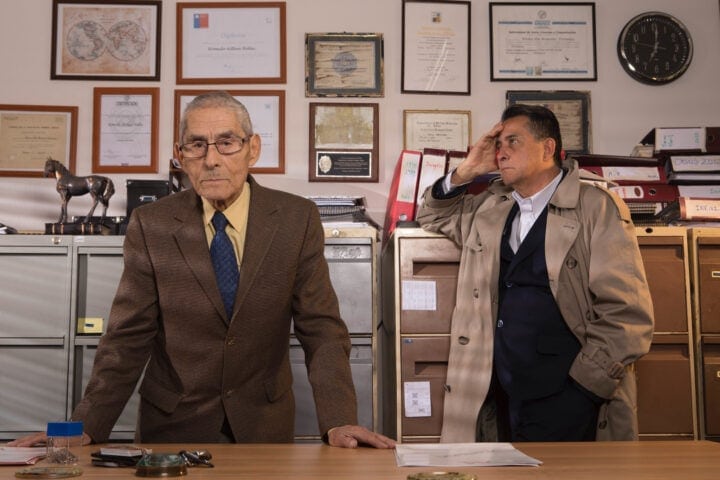
“It’s very important for us to reconstruct memory,” Chilean journalist Augusto Góngora observed in 1990, “not to be anchored in the past, because we think reconstructing memory is always an act that has a sense of future.” He was addressing a crowd about his book The Forbidden Memory, a history of his countrymen during the first decade of Augusto Pinochett’s regime. Yet he also seemed to be anticipating the events of his own life as captured by Maite Alberdi in her documentary The Eternal Memory.
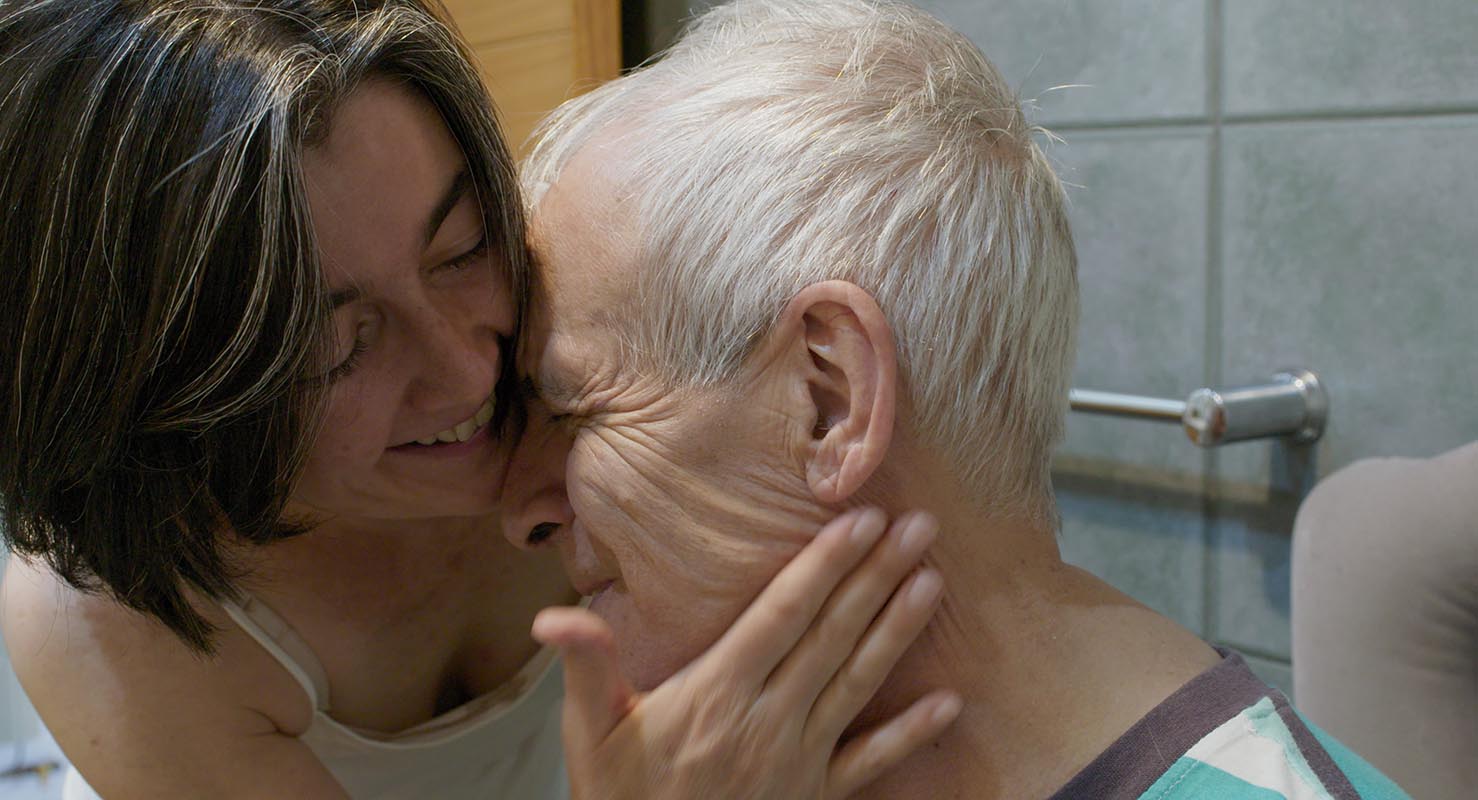
When Alberdi catches up with Augusto’s story, he’s starting to experience the effects of Alzheimer’s more acutely. But her film quickly moves beyond the surface-level tragic irony of a man devoted to preserving a national memory having to endure losing his personal memory. The Eternal Memory blossoms into a tender-hearted love story as its patient observations reveal the durability of the affection between Augusto and his wife, Paulina Urrutia, that no disease can take away. Alberdi gently presents their passage between fear and joy as a synecdoche for a nation trying to forge ahead into the future without losing a grip on the past.
I spoke with Alberdi shortly before her film’s theatrical opening. Our conversation covered the contemporary resonance of Augusto’s work during and after the Pinochet regime, the beauty and struggle of having to hand over her camera to Paulina during the pandemic, as well as how she came to construct the narrative arc of their journey through his illness.
Your film is The Eternal Memory, and Augusto’s book is The Forbidden Memory. Are these two types of memories related or opposed?
I feel they’re completely related. It’s related not through the title of the book but more through the content of the book. It’s an exercise that Augusto and his friends made to preserve historical memory. In the film, it’s to preserve and to tell what was happening to not forget. The name of the film is The Eternal Memory because I feel that there are so many things that Augusto never forgets—some historical events that he never forgets, his love that they never forget, some pains that he never forgets. So, in a way, both the book and film are infinite, eternal memories.
As Augusto’s life attests, the body never forgets. But is the film a warning that the body politic, a people at large, can forget?
Yeah, the film is a warning. It’s a proposal of how to maintain historical memory from the feelings, not from the events. He clearly said in his speech at the opening of the book in the ’80s that we have to make our mourning and construct the story emotionally, not with dates and events. As you can see in the film, Augusto never remembers dates and numbers. Like, “How much time have we been together?” He doesn’t remember. But he remembers “our house.” He remembers that she didn’t want to have kids. He remembers the name of his friend that passed away during the dictatorship. He remembers feelings, not numbers. It’s a way to understand historical memory from the pain, not from a version of the history.
Around the time you met Paulina and Augusto, Chile was tentatively moving toward democratic advances with an amended constitution that ultimately wasn’t ratified. We don’t see that political backdrop, but how was it affecting how The Eternal Memory developed and what it meant?
Augusto was one of the main voices on the public [television] channel during the return to democracy [in 1990]. It was a period of hope in Chile. When I was making the film with all the social protests and the writing of the new constitution, it was also a painful period. But there was also hope that we really were going to have a new country again. I think it was the same kind of hope. [But that was lost] when we lost the election for the new constitution. We are trying to construct that hope again. But it was the same feeling that you’re living through important, necessary change. I didn’t realize that, thank you for telling me! [laughs]
After making The Mole Agent, you reflected that it taught you that there is no one way to age. How did this film enhance your understanding of that idea?
In The Eternal Memory, you see a couple that has desire and love in the middle of memory loss, illness, and a process where the body isn’t completely accompanying your mind. But they’re being such a lovely couple that, as a person, I really wanted to be with them all the time. That only demonstrates that there’s not only one way [to love and] to tell stories.
You’ve made a number of documentaries now with characters who have known each other for many decades. Would it be more accurate to say that the passage of time and memory is your subject than age itself?
Completely. It’s the passage of time and the possibility of making documentaries over many years and without a deadline. Transformations in reality only take place when you dedicate time. To feel love with people only happens when you spend a lot of time with them because you’re constructing relationships. That’s my proposal.
The Eternal Memory has a complex tapestry of past and present tense as you intersperse archival video of Augusto and Paulina through the footage shot for the film. How did you determine the structure?
The structure was written in the editing room. I think that this was a very intuitive film because we were trying to register what was happening to Paulina. In the editing room, we decided on a structure that wasn’t chronological, because we were trying to reconstruct memories. We were trying to reconstruct the feeling of a relationship, more than an order to explain things. Which scene from the past makes you understand that moment of the present better? How can we build that kind of association? That non-traditional structure was written in the edit.

Between Paulina reading to Augusto on their walks and his active interest in her theatrical plays, narratives feel like such a crucial element of the film. What did you make of seeing how important storytelling, and sometimes fiction, was to them as a couple to construct a shared experience of reality?
I don’t know about fiction, but the way that he understood reality with Paulina was a bridge with a storytelling that she’s constantly constructing for him. It’s useful for him and for the audience because she made the exercise to explicitly explain. If you see the first scene of the film, he was completely lost in the middle of the night and didn’t remember anything. And she didn’t go crazy about that. She’s there like, “Okay, I’m Paulina. I’m an actress. You’re Augusto. You’re a journalist. We have been together 20 years.” [Augusto says] “Really, I’m married?” in such a calm, funny way. They put you in a mode that makes you understand a situation that can be tragic [in a different way]. She’s constructed for him a constant story, but not a fiction, of their life that she can repeat all day if necessary. That way of telling him doesn’t make him feel that he’s forgetting because he always has someone that helps him to remember.
How did the film change once Covid hit and Paulina had to take over the camerawork? Did she become as much author as subject?
The lockdown in Chile was very long. It was two years of strict lockdown. At the beginning, for me, it was like, “I’m going to send you the camera so I can have research material to know what’s happening until I go back.” But it took two years [before I could go back]. So, at the end, that was the material. It was great because it wasn’t material that was like, “Please shoot this scene!” It was like a daily diary that she sent me to show me what they were living. It was completely improvised. I tried to teach her how to use the camera, and she never understood!
I was curious if you gave her direction.
Yeah, all the time! Like, “Paulina, please, the focus is off!” She never got it. The material was so bad that I never thought I was going to use it! That gave us a light way to approach the situation. Then, after a lot of time, I realized I could use it. It was solid, and she got scenes that I wouldn’t have with all the access in the world. I would never have been there at two in the morning [to capture] situations that only happen when you’re in a couple. It was an unexpected gift.
Speaking of gifts, Paulina has said that she now sees the film as a gift since Augusto’s passing. How has the film changed for you?
I’m happy to have it. It’s related to what you asked about hope. The film [coincides with] the 50-year anniversary commemorating the [start of the] military dictatorship. [It allows us to] remember Augusto as a voice that always promoted democracy in a journalistic, ethical way. He approached people in a way that was tender in a way you don’t usually see. For me, it’s a side of Chile that you don’t see anymore in media. It’s an ethical approach that we need to remember.
At one point, you wanted to follow the story until Augusto died. When and why did you make the decision to stop the story on a moment of their love?
I finished there because there was one day when they were giving thanks to each other and he said, “I’m not myself anymore.” And she said to him, “You are.” He was saying, “I don’t feel like the guy I used to be one month ago.” For me, him saying that he was feeling uncomfortable with himself was the limit. I also felt uncomfortable shooting someone who’s feeling uncomfortable for the first time in the five years that I’m there. So that was our final scene. Everybody tells you that Alzheimer’s is a slow death, but Paulina told me all the time that she missed the guy from one year ago. She’s not missing the guy from 20 years ago. She also missed being there with him even one year ago. It’s amazing how they constructed identity until the end.
Since 2001, we've brought you uncompromising, candid takes on the world of film, music, television, video games, theater, and more. Independently owned and operated publications like Slant have been hit hard in recent years, but we’re committed to keeping our content free and accessible—meaning no paywalls or fees.
If you like what we do, please consider subscribing to our Patreon or making a donation.