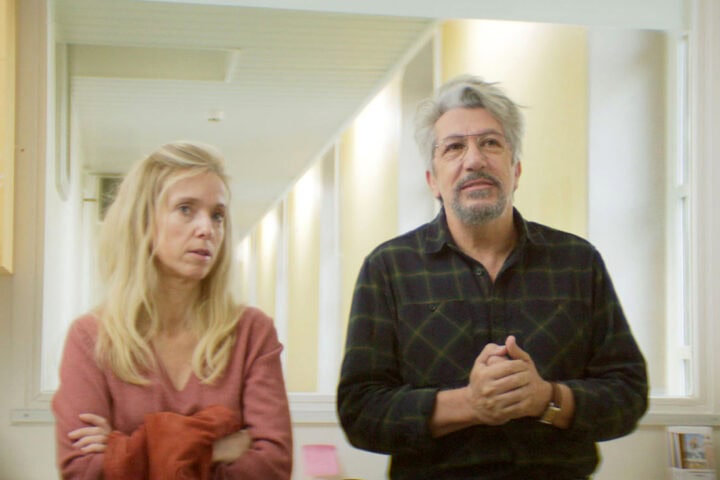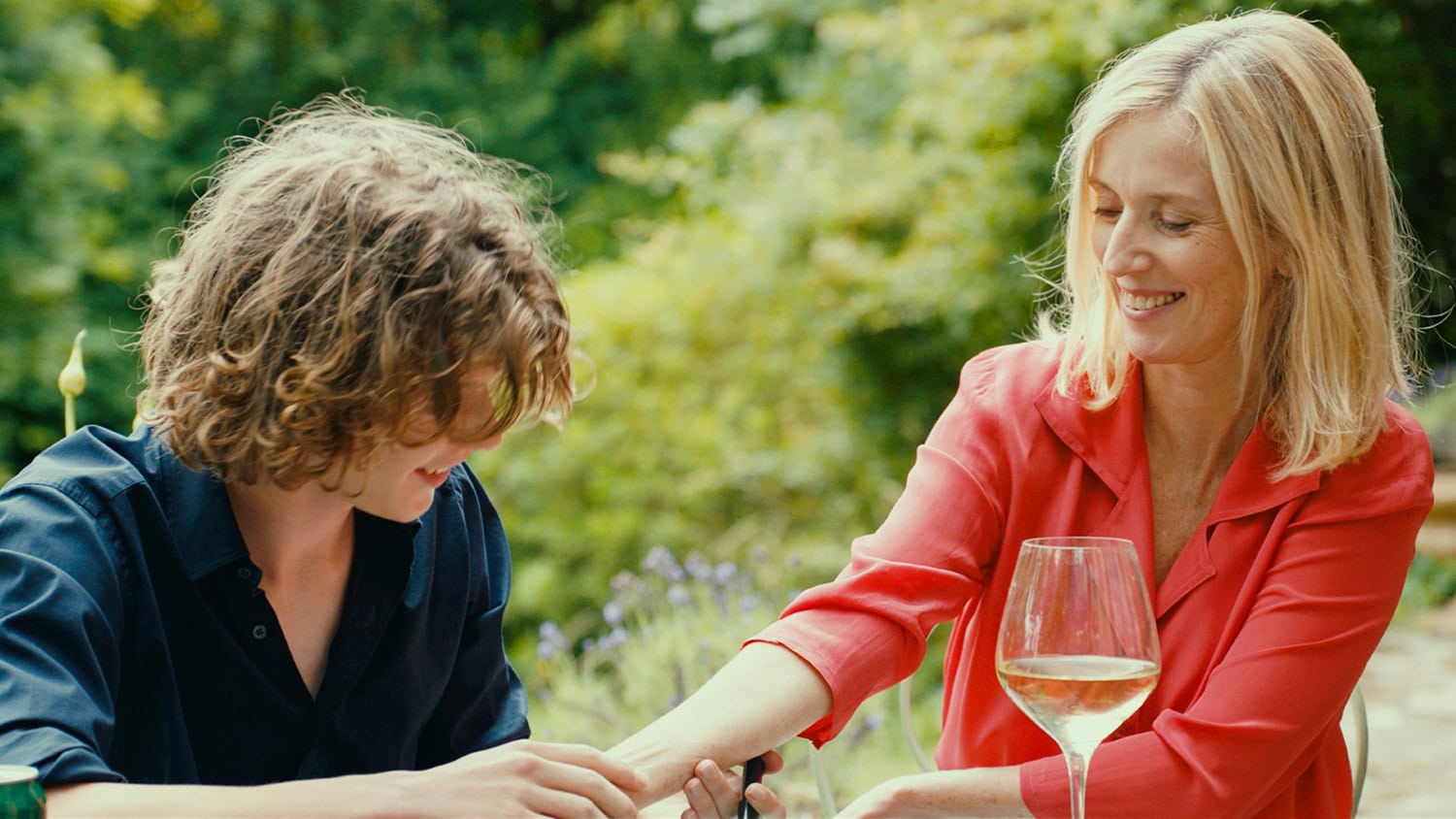
Cinema is replete with depictions of mothers good and bad, though few are depicted with such radical ambiguity as Léa Drucker’s Anne in Last Summer. This comes with the territory for the film’s legendary director Catherine Breillat, who’s broken ground for decades with her fearless explorations of female sexuality. Yet even knowing the French filmmaker’s background, it still feels radical to watch the story of a mother involved in an affair with her teenage stepson, Théo (Samuel Kircher), presented so freely of judgment.
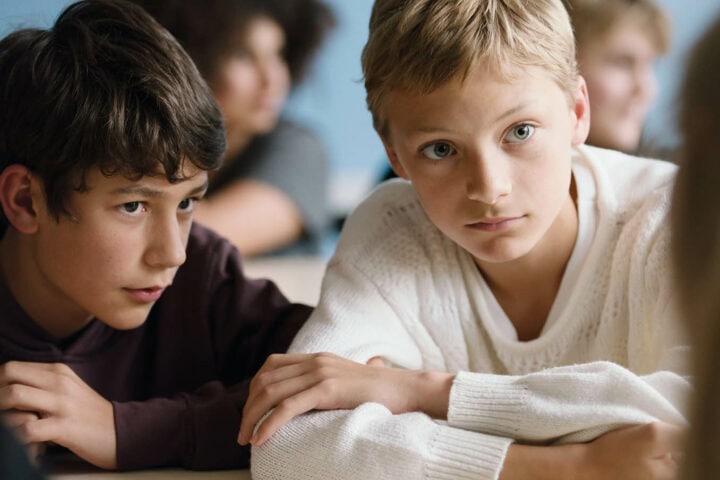
Breillat bakes in much of that perspective at the script level as she adapts the 2019 Danish film Queen of Hearts with a less moralistic bent. But to realize Anne in a way that goes beyond mere intellectualization requires a partnership with a brilliant actress like Drucker, who has recently come to prominence outside her native France in films such as Xavier Legrand’s Custody and Lukas Dhont’s Oscar-nominated Close. She makes herself a willing tool to Breillat’s exacting technique but also comes to the project with ideas on how to explain, if not excuse, how a woman comes to engage in such a taboo desire. In Drucker’s capable hands, Anne is neither a monster nor a martyr. She’s just human in all its simplicity and complexity.
I spoke with Drucker last fall when she came to present Last Summer at the New York Film Festival. Our conversation covered how she handled Breillat’s precise and often “tyrannical” directing style, why she thinks Anne acts out in the way she does, and what surprised her about the film’s construction while in production and after it was edited.
They are very different films, obviously, but I have to say I saw some similarities between Last Summer and your role in Close—an unconventional relationship between a woman and a much younger person who’s not her biological child. Was there anything you were able to pull forward from that film?
I’m sure. I asked questions that appeared to me after reading the script of Last Summer. Clearly, it’s not the same kind of link to children between Close and Last Summer, but it’s a very close relationship as an actress to work with a young actor. In Close, it was a very protective mother, and in Last Summer, I don’t think I can call this protective. It’s a story about how to rebuild yourself. This woman in Last Summer must have had a very traumatic experience when she was very, very young. She talks about it to him. And I think that’s what I felt as we were doing the movie. She was trying to repair herself from something but also creating chaos.
Catherine’s approach to understanding a character is not sociological. Did you feel you had to explain how she came to be, the past tense of Anne, or was it purely in the present tense of how she reacted in a moment?
Yeah, the script allowed me to have a lot of space, even though the direction is very precise and sometimes rigid. Catherine actually asked the actors to be in a frame like in a painting, sometimes. But in these restrictions, there’s a lot of freedom. And she’s really open to what we will improvise emotionally. She’s going to be very surprised herself by things. I think she was surprised at how I would get into this illusion of being very young, like suddenly this woman becomes a 15- or 16-year-old girl talking to Théo. She was open to those things. This story is so particular, so I could understand some things as I was doing the movie. But I liked the fact that I didn’t understand everything as I was doing something like that. Because this is a Catherine Breillat film, there’s a lot of mystery in it. I like the fact that we can always have a space to fantasize about something as actors but also as the audience.
In a film about deception, do you have to know the truth for Anne?
Yes, I have to know. I have to understand why she’s doing what she’s doing. For example, what’s the strong motivation for lying like that? I had to be very connected to that because when you read the script the first time, you can be very judgmental about the character yet interested in the project. But when you engage yourself with the character, then you have to start to find the key to open it and understand her. I had to be absolutely non-judgmental about her, and I had to understand why she was doing what she was doing. Specifically, the lie, the denial part. My strong motivation was the family. That’s what I had to build up for me, that she would protect her family no matter what. That was my key to the role.
Was there a process of removing judgment? I’ve seen the original Danish film, and I know it presents your character as a little bit more of a predator.
Catherine didn’t want her to be a predator because she wanted to explore something about the complexity. Really, I think she likes to explore the dark side of our humanity, especially in the feminine way. She has always explored this transgressive desire of women in her movies. If my character was immediately a predator, you cannot have this journey. There would be less disturbance, probably, if you knew right away she’s a predator and he’s a victim. If that’s it for the movie, we know how it’s going to evolve. I think the audience can say, yes, she’s a predator even in Catherine’s movie. But Catherine doesn’t insist on that. Someone can also say, well, it’s a complex story. And even though this relationship can be very dramatic and tragic, especially for this very young boy, they might also have feelings [for each other]. And this is quite disturbing. This is what she wants to explore. The audience can have their own judgment. The movie is not saying: “This is how you must feel, this is how you must think.” I think it’s open.
The scenes of seduction and sexuality early on play largely off Théo. Did it feel different to watch the finished film and see the events from his side?
I was very, very surprised when I saw the movie. I had an idea, but they made some choices in editing all those scenes. We did the other shots, and she decided with the editor to focus on what Théo is feeling about Anne and that only. That, I think, is a very strong editing choice, and it surprised me when I saw it. And I thought it was great. I loved it. It’s fun because everything was surprising with Catherine. The preparation was surprising. The shooting was surprising. It took me to some places I’ve never been, and I explored things I didn’t know yet in my work. And then I saw the movie. Like many directors, of course, she’s really so obsessed with creating her cinema in her way. It doesn’t look like anything else. She would direct me with paintings and very surprising indications. That’s how she works and builds up her movies in every single way. And editing must have been something very, very important. And also, she’s talking during the shoot. In the rushes, they could hear her talking. So they had to do strong work cutting out everything Catherine was saying as we were performing. It’s a whole experience.
Were there any specific moments or scenes where you had to trust that you would find something on set?
It was really a collaboration. On this movie, we instinctively had to trust each other. I really trust Catherine, even though sometimes she can be a little bit rough on the set. She’d say that herself, so I’m not betraying her! She can be tyrannical because she has very strong visions, and she wants everybody to succeed in [helping her to realize] them.
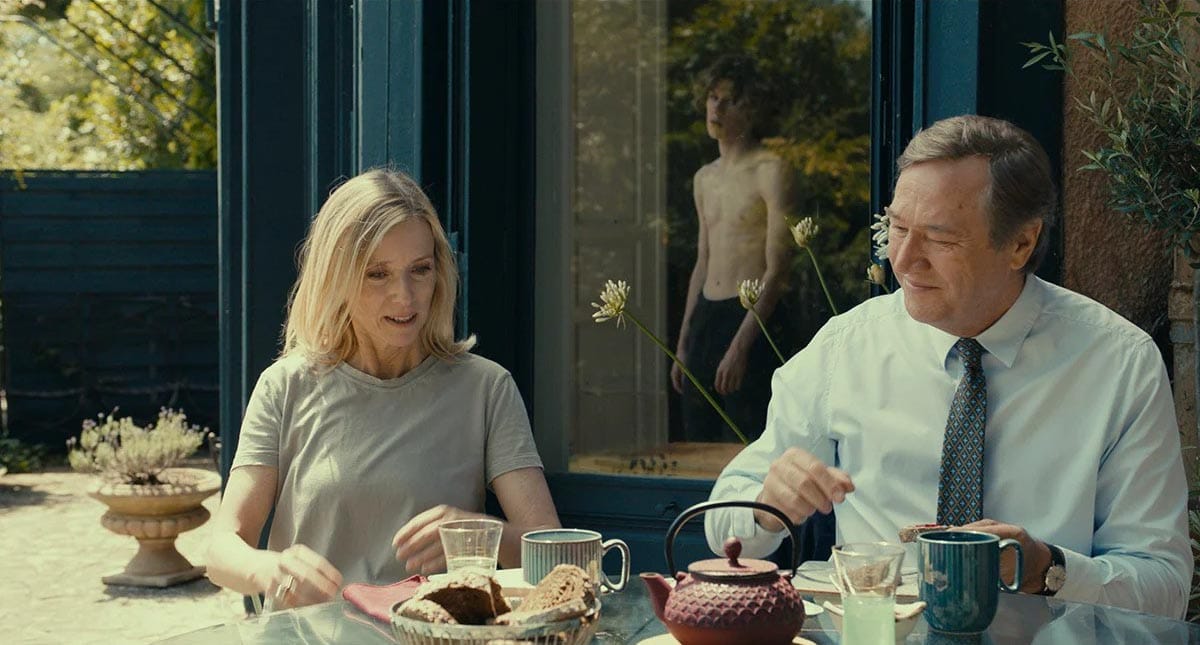
The intimate scenes were a little scary for me, Samuel, and also for Olivier [Rabourdin, who plays Anne’s husband Pierre]. As we were going there, it was like a stunt. It was very prepared. We had rehearsed, and we knew exactly where the frame was. There was no surprise about that. But in the scene, as we were thinking, “Okay, it’s done, and I think we were good,” she would say, “Go further!” It was very difficult to understand clearly what she wanted, and then she came with an ecstatic painting of Caravaggio and said, “This is what I want.” She would take us to this weird place that’s not very realistic. If you don’t trust the director as she’s asking something like that, then you cannot go there. And, of course, it’s a collective process. It’s the acting, but it’s also the camera, the sound engineer, and we were all together trying to get into this.
Are Catherine’s references to Caravaggio about more than just the framing? Is it also about capturing the spirit of those paintings?
Well, there’s something a little mystical in her direction. Catherine has explored the desire at the limit of a transgressive thing. But she wants it, I think, to be unrealistic and mystical sometime. That’s my interpretation. She helps herself [direct] with 17th-century paintings that she’s very passionate and obsessed about. It’s also something about sex and death. And also about love, even though it’s disturbing. Her movies have explored a sort of freedom that was difficult to get as a woman directing those movies. Last Summer [exists] maybe a little bit out of time. She also interrupts and says things like, “You should act this scene like Eric Rohmer! It’s Pauline at the Beach!” She gives a movie reference, and you try to go somewhere.
Catherine said she asked you and Samuel to act as if you were 15. What were the biggest challenges of tapping back into adolescence?
It’s easier for Samuel! It’s fun for me because acting, sometimes, it’s a kind of playground. Even though you’re an adult, there’s something about authorizing yourself to be someone you would never authorize [yourself] to be in real life. It’s weird, but this is what I like the most about this work. On the set, I didn’t try to compose a young person, but there were some elements that put me into [the mindset]. I was trying to connect with Samuel a lot on the set and respond to what he would send me emotionally. And he was a very strong and brave actor. I felt a lot of responsibility, and when she said he would go very high and dive into the situation. I had no choice because some things were asking us a lot. So I had to dive, and not try to perform a woman acting like a 15-year-old but just try and respond more emotionally to things. Who you were at 15 is never totally lost. It’s always there, you just have to authorize yourself to let it be.
Did you feel the generational difference with Théo that Anne speaks about?
Well, that’s totally true, but also went Anne talks with Théo about this, they’re connected and having a strong conversation. She’s probably saying things she’s never said to anyone. She’s talking about her mother. They’re at the same level. It’s not a question of age, they’re just connecting somewhere. I also think they’re both prisoners of something. He’s a prisoner of his relationship with his father that’s not very nice. He’s a prisoner of something wild in him that he needs to explore somewhere. She’s a prisoner of something that she’s responsible [for]. She has built up something with her career, with her family life, with her sort of bourgeoisie [life]. But you can feel this woman is a little trapped, and she’s not coming from there. There’s something inside herself that’s never been expressed, and she can express it with this very young man. But, as I said at the beginning, she tries to repair something while also she’s creating something disruptive. She’s taking that risk.
Do you feel that the character is putting aside some of her maternal instincts in those moments? Or is she trying to figure out a way to be both a mother to the children and a child herself?
Inside, there’s something very destroyed in her. All the things that she’s built—family, career—are probably also some sort of mask. And inside, there’s something very tormented. I think she’s putting aside her motherhood as she’s going into this relationship with him. But she fights back when it comes to [asking], “What have I done? I’m going to lose everything!” And it’s terrible what she does because she wants to save her family. Suddenly, she becomes a mother [again], and she will be in total denial. For her, it’s the truth. It’s what she has to do.
The shot in the film that really sticks with me is the long shot on just your face when Pierre confronts her about the lie. How did you and Catherine find the right length for how long to hold there before she talks?
It’s coming a lot from Catherine, honestly. As I was preparing for the scene, I had a lot of ideas. I came on the set very prepared, and I was thinking, “Okay, that’s the scene. It’s so important. It’s the twist.” At the beginning, I thought I had to express a lot of things emotionally and be very rough. Catherine surprised me totally and said, “No, no, don’t move your face. Everything is inside, but you don’t move. Just through the eyes.” It was weird for me, but I respected that direction and said, “Okay, let’s go for it. It’s interesting.” It was not the first idea I would have [had]. If I was with the director who would wouldn’t have directed me, maybe I would have moved more. But I thought I should try what she was saying and go totally into it.
When I saw the movie, I was very happy with the scene. It’s interesting how some directors like her are so radical in their direction that they can take you further than what you imagined would have been more realistic. What I was doing, for me, was realistic. But who cares? Because when I saw the movie, I thought it totally worked. She had this reference as we were shooting the scene. She would yell at me, “It’s Hitchcock! It’s Kim Novak! Kim Novak!” So I say, “I’m Kim Novak. Let’s believe this.” Of course, I’m also obsessed with cinema, so I have all these visions. Hitchcock, Kim Novak, it took me somewhere.
It’s so unsettling because you keep wanting her to show some emotion, and the fact that she’s so just blank becomes almost unbearable.
It is! But it’s also part of the mystery of the movie, and it permits the audience to react in many ways. Catherine is very strong with the fantasy and unconscious. She knows how to film that.
Since 2001, we've brought you uncompromising, candid takes on the world of film, music, television, video games, theater, and more. Independently owned and operated publications like Slant have been hit hard in recent years, but we’re committed to keeping our content free and accessible—meaning no paywalls or fees.
If you like what we do, please consider subscribing to our Patreon or making a donation.