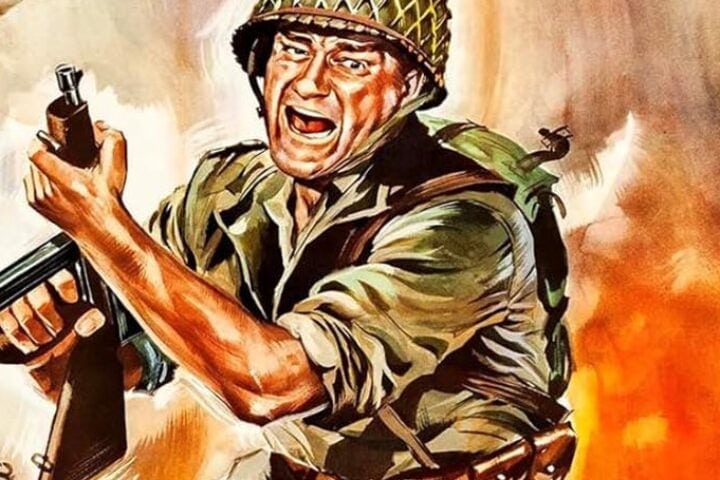
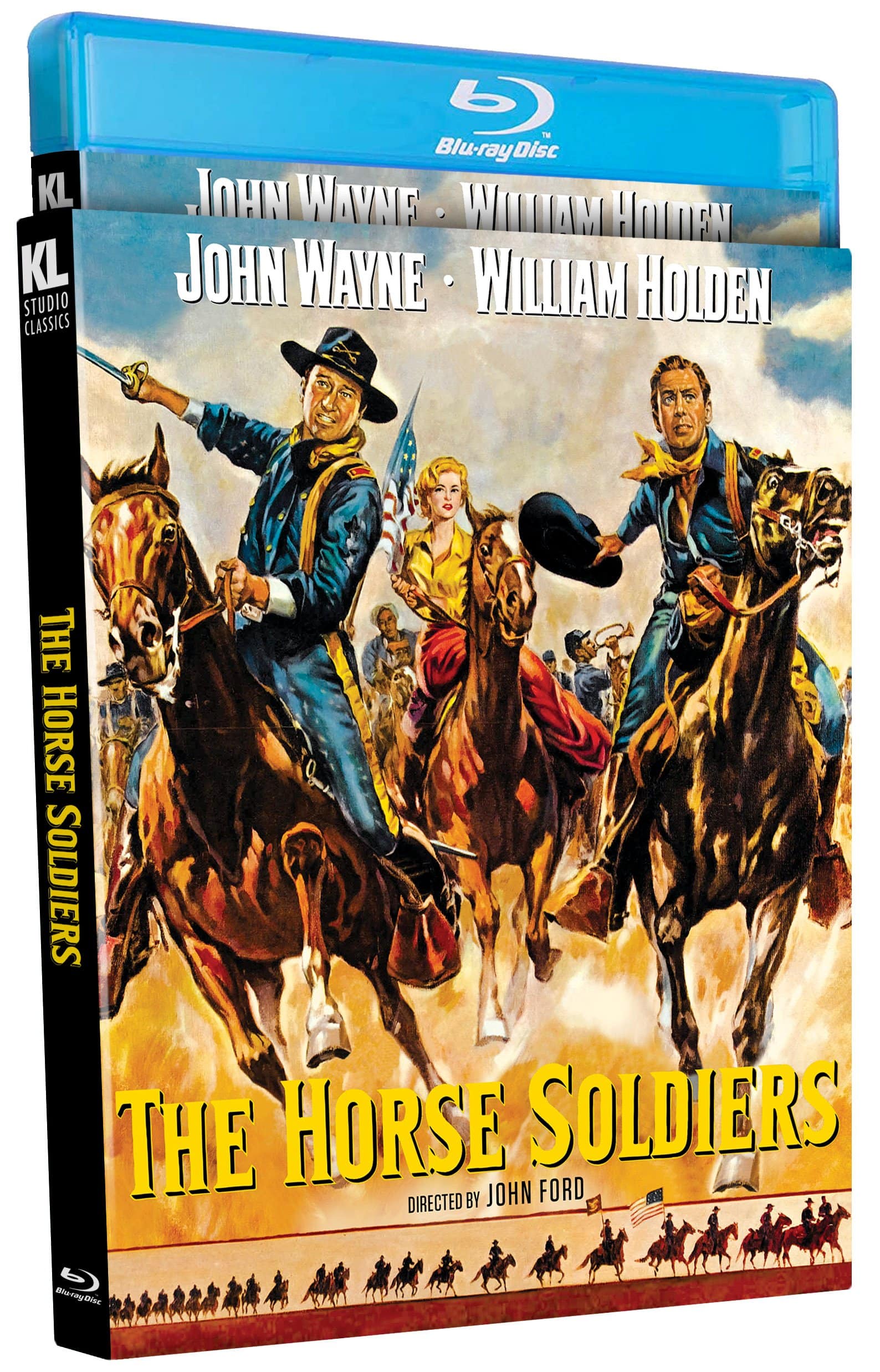
 Grierson’s Raid, a Union cavalry raid during the Vicksburg Campaign of the Civil War, is the historical foundation for John Ford’s The Horse Soldiers. The 1959 western follows grizzled, cynical John Marlowe (John Wayne), a cavalry colonel, as he leads a diversionary, guerilla-like strike on Confederate supply lines in Mississippi to aid Ulysses S. Grant’s campaign.
By the time we meet Marlowe, the carnage of the war has already hardened him, and Wayne pours all his acidic laconicism into the terse manner in which the soldier accepts his mission. Marlowe’s resentfulness is only compounded when an encounter at a captured plantation forces him to travel with the plantation’s mistress, Hannah Turner (Constance Towers), and her slave, Lukey (Althea Gibson), to prevent them from giving away their battle strategy to the enemy.
This results in dubious comedy as Marlowe wrestles with Turner throughout, even as he inevitably shows enough chivalry to win her over. But the most meaningful impact of Turner’s presence is that it adds another layer of horror to the fighting that soon erupts across Mississippi as Marlowe’s small Union force overwhelms the surprised Confederates.
The Vicksburg campaign was the most significant military operation of the Civil War, placing the Mississippi River under Union control and making the South’s defeat inevitable. As The Horse Soldiers shows, though, the writing was already on the wall. Many plantations that the cavalry unit encounter in the spring of 1863, two full years before the surrender at Appomattox, are already bereft of white men who have gone off to fight, leaving only women and slaves behind, the latter of whom immediately beseech the soldiers for freedom. In one queasily farcical scene, the cavalry arrives at one battle to see that their foes are children who were impressed into service. When one of Marlowe’s men captures a scrawny drummer boy as a “prisoner” and asks what to do with him, the colonel only growls, “Spank him!”
Even revisionist westerns of an ostensibly left-leaning persuasion have a tendency to buy into Confederate romanticism as a symbol of rebellion, which makes The Horse Soldiers’s thoroughly unsentimental view of the South as a doomed state throwing hundreds of thousands of corpses onto a pile in the name of defending an immoral, bestial institution all the more remarkable. Nonetheless, Ford’s film is also guided by empathy, most evidently when Lukey is caught in the crossfire during the Battle of Newton’s Station and her mistress falls apart in grief as Marlowe looks on sick with guilt at putting the slave woman in harm’s way. Ford shows sensitivity to Hannah’s agony over Lukey’s death even as he leaves hanging over the scene the awareness that the woman’s “friend” was also her indentured property.
Ultimately, the mostly forgotten The Horse Soldiers has the rotten luck of being merely a very good film released in the midst of a career twilight that produced some of the most radical achievements of the late studio system era. Like some of the later projects of his greatest devotee, Kurosawa Akira, Ford stages colossal battle sequences but cuts them down to only a few seconds of screentime, conveying the brutality of war while refusing to wallow in it. And at its heart, the film perpetuates a theme that stretches all the way back to Ford’s first sound feature: that of a military man’s disgust with the notions of blind honor and duty that lead only to slaughter even as they continue to obey such codes out of ingrained behavior.
Image/Sound
Previously issued on a MGM Blu-ray, The Horse Soldiers gets a significant upgrade via a 4K master that, among other things, presents the film in its correct 1.85:1 aspect ratio. Colors are deeper and textures are sharper throughout, though some interior shots show a softness in darker corners that can likely only be addressed by a restoration. The mono audio track lacks any tinny quality or hiss, but for a war film, The Horse Soldiers does tend toward the quiet side, with the music cues often louder than the sounds of battle.
Extras
Film historian and John Ford expert Joseph McBride contributes a new commentary for the film, and he brings his usual mix of deep research and engaging formal analysis to the enterprise. McBride particularly calls out how Ford’s lifelong interest in and extensive study of the Civil War contributed to this film’s blunt honesty about the conflict.
Overall
John Ford’s bitter Civil War action western The Horse Soldiers gets an improved home-video presentation and an excellent new commentary track from Kino Lorber.
Since 2001, we've brought you uncompromising, candid takes on the world of film, music, television, video games, theater, and more. Independently owned and operated publications like Slant have been hit hard in recent years, but we’re committed to keeping our content free and accessible—meaning no paywalls or fees.
If you like what we do, please consider subscribing to our Patreon or making a donation.