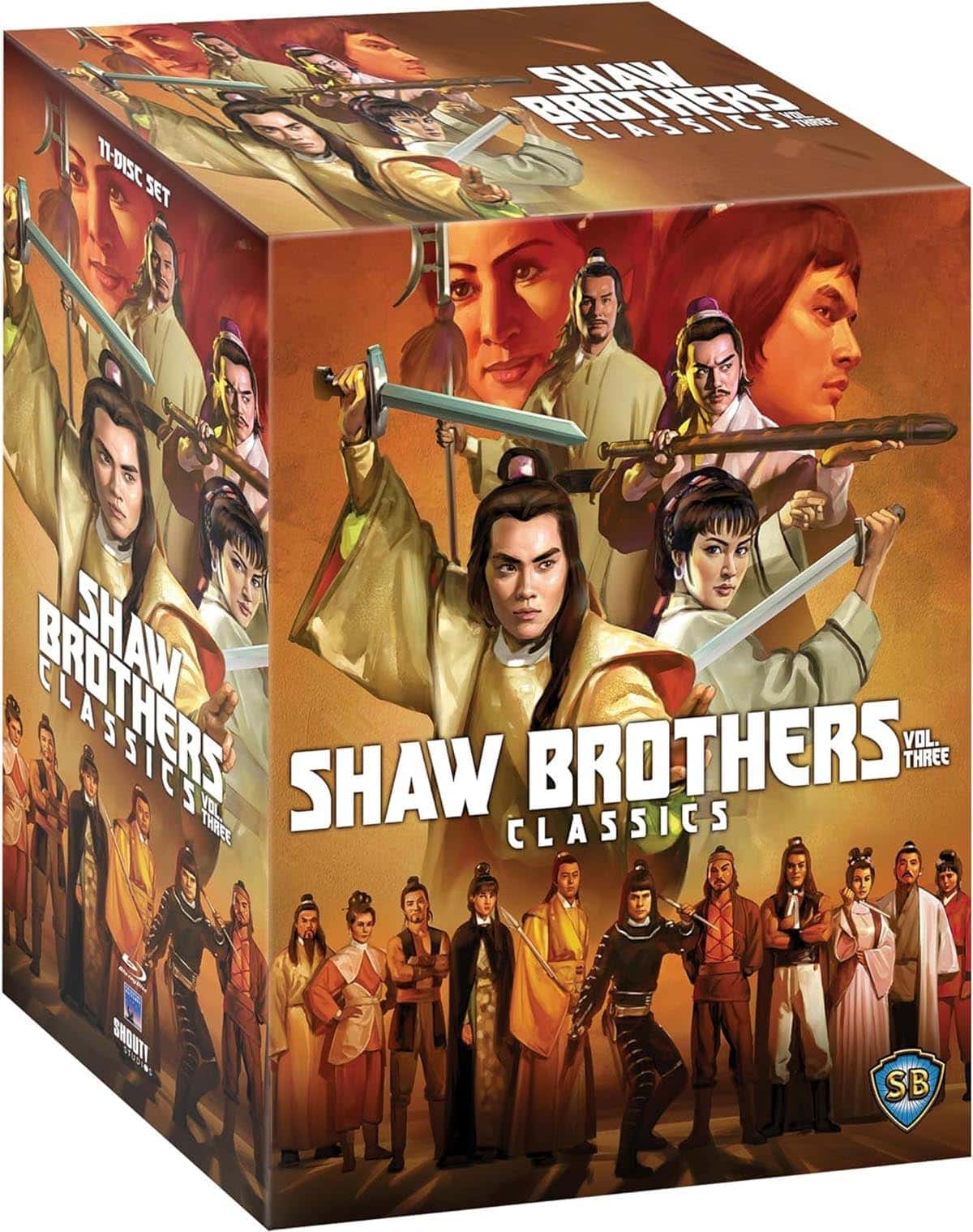
 Shout! Factory’s Shaw Brothers Classics: Volume 3, covering the years 1976 to 1980, coincides with Shaw Brothers Studio’s creative zenith, when a decade’s worth of honed techniques and emergent competition at the Hong Kong box office propelled the studio to new artistic heights. That, though, means that this is the period that’s been most thoroughly mined by specialty home video labels looking to preserve the legacy of the studio’s work and Hong Kong genre movies in general. Most of the classics of these years, such as Lau Kar-leung’s The 36th Chamber of Shaolin and Chang Cheh’s Shaolin Temple, have already been released on home video. Notably, Cheh’s work, the usual highlight of these Shout! collections, is somewhat underrepresented here due to a smaller selection pool of titles.
This collection, though, still represents a stellar opportunity to discover some of the less-heralded gems of the Shaw Brothers Studio’s golden era, many of which take advantage of the studio’s desire to stand out in a saturated market by experimenting with in-house styles and story structures. Take the three Chang films on offer. Life Gamble, from 1978, and Shaolin Rescuers, from 1979, are showcases for the increasingly ambitious choreography of his Venom Mob stunt team, each film showing off elaborate and varying forms of weapons combat. But Chang’s most interesting work contained in this set may be the least successful.
The Shaolin Avengers, from 1976, structures its narrative as one giant fight broken up by flashbacks explaining how the hero played by Alexander Fu Sheng wound up in his current melee. This works better in theory than in practice due to constant momentum shifts, but the frequent hazy transitions in and out of the past give the film an oddly dreamlike quality, and a phenomenal closing stretch features nonstop and imaginatively staged action.
If Chang’s films find him flexing already mastered skills, the two Ho Meng-hua entries demonstrate how one of the studio’s heretofore pedestrian workmen had grown as a filmmaker through consistent work. The Vengeful Beauty, from 1978, acts as an unofficial continuation of Ho’s Flying Guillotine, lacking that film’s sheer brio but making up for it with sheer over-the-top escalation, epitomized by a scene where an actress engages in a sword duel topless.
Shaolin Abbot, from 1979, is a narratively unremarkable riff on the Shaolin Temple mythos that nonetheless displays a keen eye for maximizing the dimensions of the film’s vertiginous mountainside sets and using hard, jolting edits to emphasize the honed skills of its hero, a monk named Chi San (David Chiang). There’s also a healthy amount of comedy in the action, from a goon’s face being shoved into a butchered pig’s head to one poor soul being dispatched by fingers being shoved so deep into his ears that they puncture his brain.

Elsewhere, Hua Shan’s Soul of the Sword, from 1978, and Sun Ching’s The Deadly Breaking Sword, from 1979, chiefly demonstrate the ballistic energy and grasp of form that used to only be on display in the studio’s canonical work. The former especially is a perfect example of a B movie, as there isn’t an ounce of fat on this 85-minute star vehicle for Ti Lung, one of Shaw’s most charismatic stars, with the sword duels practically drenching the camera in prop blood.
One of actor Lo Lieh’s rare turns behind the camera, 1980’s Clan of the White Lotus boasts choreography by Lau Kar-leung and a magnetic lead performance by Gordon Liu that makes up for Lo’s pedestrian direction. Delightfully, the film flips the chauvinism that marked the studio’s late-’70s efforts on its head by having Liu learn to overcome his foe by adopting a more “womanly” fighting style that stresses fluidity over brute strength.
The most consistently rewarding films in this box belong to Chor Yuen, a prolific director, screenwriter, and frequent actor (Westerners will likely know him best as the sneering villain from Jackie Chan’s Police Story). Yuen’s three films here show significant stylistic variation but are linked by a keen eye for composition and an unerring ability to capture fluid action. His opulent, Godfather-esque wuxia Killer Clans, from 1976, immediately shows off just how elaborately staged and arty Shaw Brothers could afford to be by 1976. Boasting a large cast of characters and a thorny plot full of double- and triple-crosses, Killer Clans also looks spellbinding with expressionistic colors and precisely ordered production design.
Compare this to 1976’s gnarly rape-revenge tale The Web of Death, which not only takes a more gruesome and intimate perspective to its material but adopts a grindhouse aesthetic to match with leaner and meaner action. Even the scattershot Death Duel, from 1977, is a highlight thanks to its florid splashes of red and its atmosphere of disgust at its own unstoppable violence, the latter hinting at the tone of Hong Kong classics to come in the next decade.
Image/Sound
As ever, Shout! Factory’s transfers will come as a relief to anyone previously forced to find these movies on bootleg-quality, standard-def discs. Colors are consistently stable and textures are clear in each film, and there are no instances of blocky pixelation. Only in some darker shots can one spot minor issues of crushing, but overall the films look by far the best they ever have on any legitimate or illegitimate video release. The soundtracks are uniformly spotless, with clean separation of the post-synch Mandarin dialogue and various musical cues and sound effects.
Extras
Shout! offers the usual bevy of extras to fill out their latest box set, including commentary tracks for each of the 11 included films by various film critics and experts. Interviews with some of the filmmakers and actors, from films like Killer Clans and Death Duel, provide insight into the rigorous working conditions of the Shaw Brothers Studio during this prolific period, while video essays by critics and historians unpack the studio’s experiments with genre and aesthetic influences like American grindhouse and Italian spaghetti westerns.
Overall
Shout! Factory’s ongoing Shaw Brothers Studio release project casts a spotlight on hidden gems from the Hong Kong studio’s greatest era.
Since 2001, we've brought you uncompromising, candid takes on the world of film, music, television, video games, theater, and more. Independently owned and operated publications like Slant have been hit hard in recent years, but we’re committed to keeping our content free and accessible—meaning no paywalls or fees.
If you like what we do, please consider subscribing to our Patreon or making a donation.