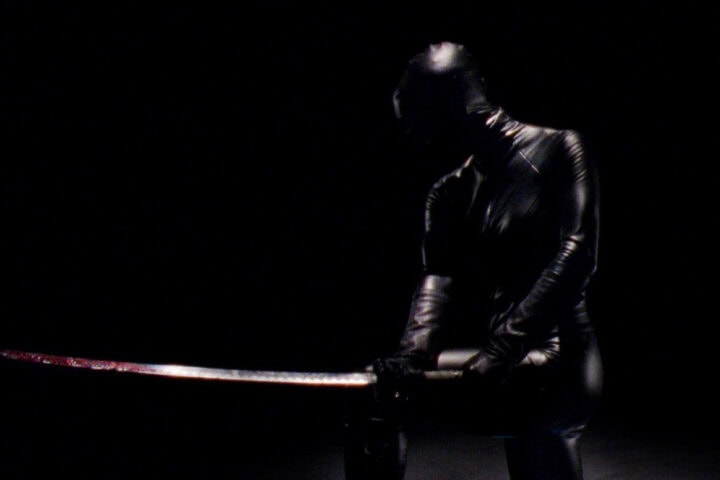
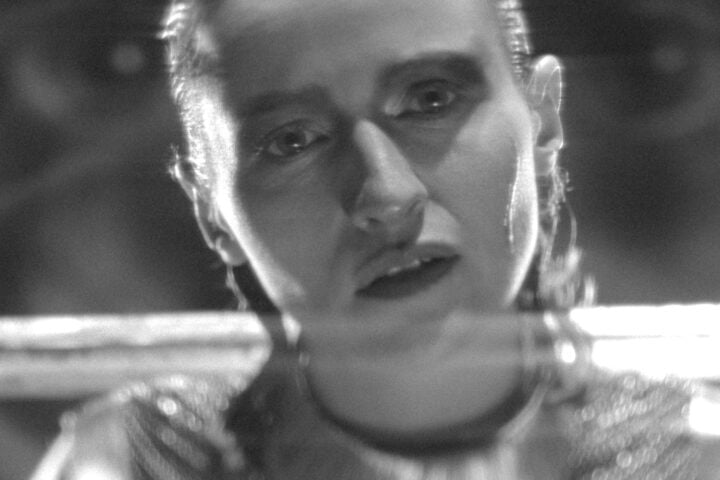
Hélène Cattet and Bruno Forzani’s Let the Corpses Tan might rekindle a familiar debate regarding style and substance in art and whether the distinction matters in discussions of aesthetics. Riffing on 1970s-era Italian crime films, Cattet and Bruno Forzani get so lost in their catalogue of fetishes that they lose grasp of the snap and tension that drive even a mediocre heist narrative. That’s partially the intention here, as the married Franco-Belgian filmmakers are aiming for a wandering bloodbath that stews in their characters’ obsessions, which presumably parallel their own, but those obsessions often feel trivial, distracting from the abstract plot.
In Let the Corpses Tan, Cattet and Forzani announce their self-consciously derivative intentions with explosions of paint that suggest blood as well as the act of ejaculation. This link—between art, sex, and violence—is the thread purportedly uniting the film’s various shoot-outs, sexually and religiously inflected fantasy sequences, and odd camera angles, lurid color stocks, and splintered editing. Luce (Elina Löwensohn) is a painter living out among the jagged and sunbaked cliffs presumably somewhere along the Mediterranean, where she drinks, works, sunbathes, fucks, and keeps the company of a traditionally motley collection of misfits. Some of these misfits have just robbed a truck carrying hundreds of kilos of gold, brutally killing several guards and police officers in the process. These acts are played nearly for comedy, with explosions of blood that echo Luce’s splattering of paint against canvases. And the crimes bring the police upon Luce’s desert idyll, triggering a shoot-out that spans the majority of the film’s running time.
The film’s desert setting is memorably beautiful and punishing, and Cattet and Forzani milk it for quite a bit of its erotic potential, gazing at Luce’s often nude body as she sweats in the sun while the coterie of grizzled thugs ogle her. Pleasurable for their own sake, such scenes also affirm the notion of the gold heist as a re-channeling of unfulfilled sex. A little of this symbolism goes a long way, and amusingly so, though Cattet and Forzani keep indulging jokey metaphors, from a lamb roasting sensually on a spit to a martyr fantasy in which Luce is tied nude to a stake, her breasts lactating champagne.
The latter sequence offers a juxtaposition of cruelty and sadomasochistic sex that might’ve been startling in a film less grab-bag in nature—if, say, the scene had been allowed to serve as a narrative culmination, suggesting that the heist and hostage situation inspires in Luce a reckoning with forbidden desires. In this context, however, it feels as if Cattet and Forzani are merely adding another whimsy to their woodpile in order to certify their bona fides as cult rebels. There’s another violent and sexual fantasy sequence later in the film, which seems present just to give the audience a nude shot of another actress, and the images are festooned with leather, guns, insects, skulls, and seemingly endless close-ups of the bad-ass bank robbers’ faces.
Let the Corpses Tan is diverting when watched for 10 minutes—and which 10 minutes you choose doesn’t really matter, as the film runs in circles, re-digesting its conceits as characters stalk and kill each other. In the end, Cattet and Forzani’s pastiche is less reminiscent of Italian crime films than of Quentin Tarantino’s own brand of orgiastic cinephilia, and this contrast elucidates why Let the Corpses Tan feels so hollow. Though Tarantino is also a trickster enthralled with formalist gimmicks, his best films have emotional texture, expressing the longing that drove him to movies to begin with. Cattet and Forzani are too cool for such vulnerability.
Image/Sound
On the whole, Kino Lorber’s transfer leans a bit on the dark side, leading to more muted reds, greens, and golds, especially throughout the film’s daytime sequences. Still, the graininess of Manuel Decosse’s 16mm cinematography is ably preserved; the acute textural details found in the film’s endless array of close-ups of sweaty, expressive faces and objects in motion are beautifully rendered. The nighttime sequences, often shot with a blue filter, still offer ample contrast between the deep black shadows and carefully lit bodies that move gracefully in and out of them. The 5.1 surround and stereo sound tracks are particularly impressive, offering an evocatively layered and full-bodied mix that highlights the film’s intricate sound design. The crackle of fire, creaking of leather, and bursts of gunfire sit forward in the mix, replicating the sensorial overload of the theatrical experience.
Extras
Film critic Alexandra Heller-Nicholas and Queensland Film Festival Director John Edmond, who have known each other for years, evince an amiable rapport on their engaging audio commentary, and while this frequently leads them into light-hearted digressions, they do manage to cover a large amount of ground regarding the cinematic influences that inform Hélène Cattet and Bruno Forzani’s aesthetics. Their discussions of ’70s Italian crime films, gialli, and spaghetti westerns are informative if a tad predictable. More fruitful and compelling are the stretches where their talk veers into the unexpected, such as the influence of Satoshi Kon on the filmmakers’ sense of narrative structure and the film’s playful warping of time through rapid-fire editing. Perhaps most enlightening is when Heller-Nicholas and Edmond link Let the Corpses Tan, for its plethora of associative metaphors and reliance on sexual and religious iconography, to George Bataille’s Story of the Eye and the work of Kenneth Anger. The only other extra included is a theatrical trailer.
Overall
Kino Lorber’s edition of Let the Corpses Tan is fairly slim on extras, but the solid audiovisual transfer will allow home viewers to fully experience Hélène Cattet and Bruno Forzani’s unrelenting, expressionistic assault on the senses.
Since 2001, we've brought you uncompromising, candid takes on the world of film, music, television, video games, theater, and more. Independently owned and operated publications like Slant have been hit hard in recent years, but we’re committed to keeping our content free and accessible—meaning no paywalls or fees.
If you like what we do, please consider subscribing to our Patreon or making a donation.